
Translated material
At the siege
About why citizens flee from banks, Russian clients find themselves under special supervision, and the companies do not know what to do: either withdraw everything, or to pick up everything
The thin world is better than a good quarrel. Business can adapt to everything when at least somehow it is possible to predict what will happen next. But now in Russia, uncertainty has reached peak values. Is it possible to conduct business with foreign companies in Russia? Or tomorrow their assets will be nationalized in response to sanctions against Russia that will undertake the United States and Europe? Is it possible to keep money in Russian banks? Or will international calculations be covered tomorrow and you will not be able to use this money abroad? Is it possible to trade with Europe or now only with China? Thousands of economics are now asking such questions now.
The business of definition is related to risk, but this is an economic risk. But political risks and uncertainty associated with state regulation are what markets do not like the most. After all, this uncertainty cannot be controlled. The only cure for her is to "go to the cache." But, firstly, in this form, money does not bring income. Secondly, when your funds are invested in an enterprise working with an asset, you cannot “fall out” the next day. Or only by selling a business at a very low price.
The experience of the crisis
A couple of years ago, Scott Baker, Nick Bloom (University of Stanford) and Stephen Davis (University of Chicago) created an indefinite economic policy index taking into account three components: how often the leading media are written about uncertainty, whether tax changes will have to and how great the disagreement between macroeconomic forecasters. Further studies in different countries of the world have shown that uncertainty extremely negatively affects GDP, investment and consumption. It was the factor of uncertainty that was responsible for the outflow of 70% of American investments during the 2008 crisis. A similar pattern - and for developing countries.
The mechanism in all cases is one. Uncertainty makes investors demand more compensation for the risk they take. This is not a whim: risks are really growing. But this requirement makes the investment unprofitable, and the economy stops or falls.
Banks are dangerous
 |
 |
Economic statistics are delayed by definition. The uncertainty reached the maximum in early April, and the published statistics still reflect a more calm state of February and the first data for March. But something is visible now. Citizens are afraid for the safety of funds in banks. And the banks themselves are afraid for the safety of funds invested in the economy, and prefer to keep funds in the “cube” - on accounts in the Central Bank.
According to the fresh statistics of the Central Bank, for March, that is, during the operation of the accession of Crimea, the funds of commercial banks placed in the Central Bank increased by 37.2%. This is extraordinary growth. At the same time, the amount of funds provided to non-resident banks was reduced by 20.5%. But in general, the amount of funds placed by banks in the interbank lending market decreased by 13.1%. For the first quarter of this year, the outflow of capital from Russia, according to the Central Bank, amounted to $ 50.6 billion. This is almost equivalent to the amounts that left in 2012-2013 for the whole year ($ 54-60 billion).
The caution of banks is easy to understand: more recently, a temporary administration was introduced in the Moskomprivatbank, the “daughter” of the Ukrainian Privatbank. At the same time, the bank is solvent, funds from it were not withdrawn, the deposit insurance agency did not have to take the bank’s obligations to depositors. The Ukrainian shareholder of the bank was removed from management three days after Igor Kolomoisky, the owner of Privata and recently, the governor of the Dnipropetrovsk region, called Vladimir Putin the “completely inadequate” opponent, and the Russian president answered the Kolomoisky epithet “Crumber”.
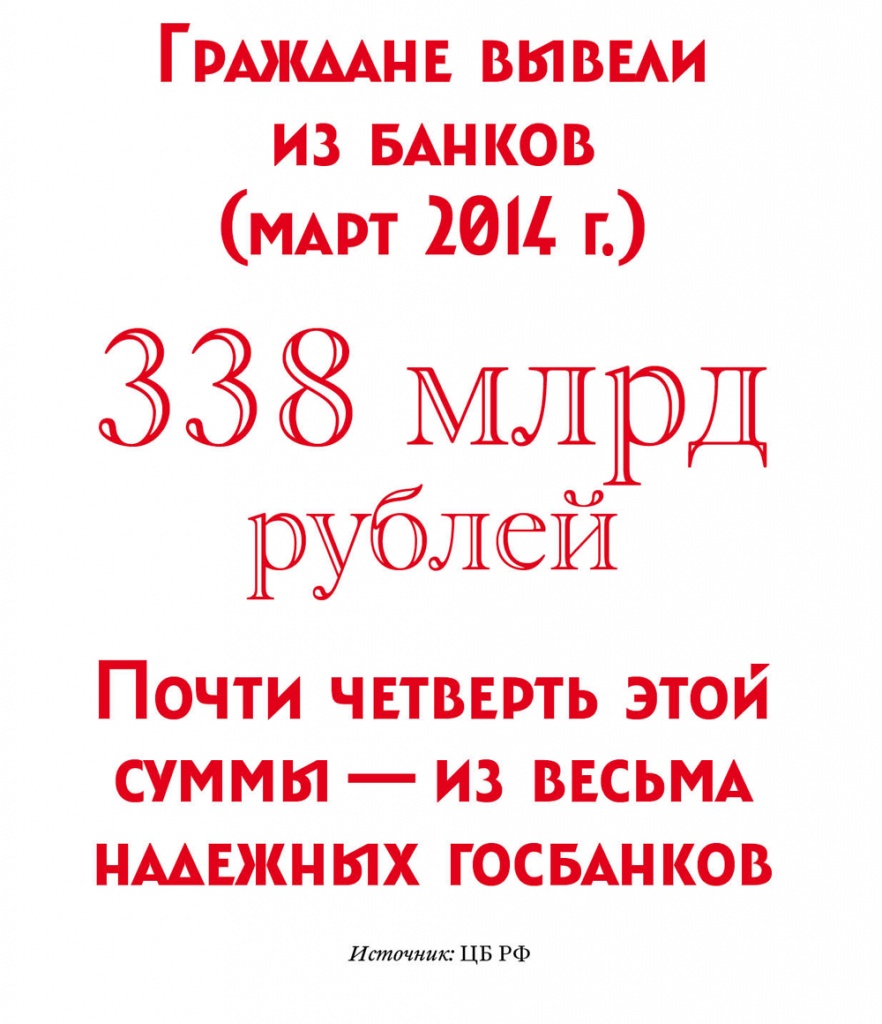
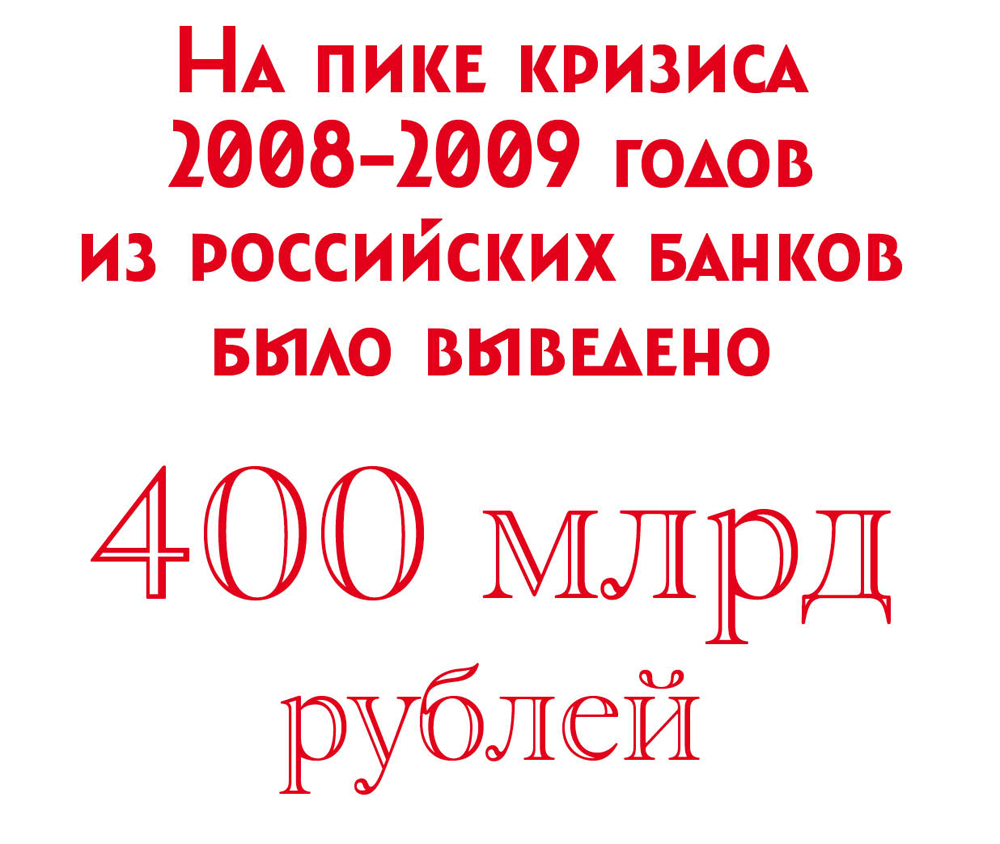
The depositors, of course, are scared. The funds of citizens in the banking system, according to the Central Bank, were reduced by March by 2%. Citizens withdrew 338 billion rubles from banks. Almost a quarter of this amount - from very reliable state banks: Sberbank (67.8 billion rubles - 0.9%) and VTB (13 billion rubles - 1%). Half of the outflow has, apparently, a “paper” character: the currency funds placed in banks were “dried up” as a result of the devaluation of the ruble. Note: at the peak of the crisis of 2008-2009, 400 billion rubles were withdrawn from Russian banks, in other words, we came close to the worst values over the past 15 years.
Where is the money going? Bankers say that fellow citizens choose banking cells, and if funds allow, they purchase real estate. Therefore, since the beginning of the year, the demand for mortgage loans has increased: in January-February, banks issued 200 billion rubles of mortgage loans, half more than a year earlier. Almost three quarters of this amount was on the same Sberbank and VTB.
Russian banks begin to become dangerous for enterprises and citizens. And the point is not even the stability of any particular bank. Just a few months of such an outflow will make the strongest bank insolvent.
Russians under supervision
For foreign banks, any client from Russia became dangerous. There is not a single bank that would like to become the subject of the investigation due to a too loyal attitude towards Russian depositors. Therefore, according to Bloomberg, in the largest foreign banks, transactions with Russian companies after the introduction of sanctions became an object of special control. After all, everyone remembers what Bank of America was worth participating in the withdrawal of Russian capital abroad in 1997-1998. Now in Citigroup, Bank of America, Jpmorgan and Deutsche Bank have introduced a special procedure for transactions with Russian clients. They must make sure that the sanctions imposed by the United States and Europe do not violate. The risk of any transactions with Russia for foreign counterparties has grown incredibly.
"
"Companies that want to maintain good relations with the government, it is better to close the ADR/GDR programs and delusting"
"
Running home!
Last week, the First Deputy Prime Minister Igor Shuvalov recommended to Russian companies whose shares are located on international exchanges to switch to MMEVB to avoid possible new economic sanctions. “This is a matter of economic security,” said Shuvalov to shareholders of leading companies in Russia, whose shares are mainly quoted on the London and New York exchanges.
If the owners of Russian companies listen to this warning, the discharge of shares may become landless, says Alexey Golubovich, managing director of Arbat Capital. At the same time, for businessmen, Shuvalov’s words were not sounded as a warning about a possible threat, but as a threat itself, Golubovich believes: “It is better to keep good relations with the government to save good relations with the government and conduct divisting.” That is, close the trade in foreign receipts on stocks issued in Russia and leave the exchange. But without these actions, the market this year can fall by 15–25%.
Shuvalov does not joke. The Russian government would want the largest Russian industrial assets to be free from the risks of the Western judicial system. Obviously, the action on the accession of Crimea will not be the last action of Russia, grossly violating all the principles of international law. In this situation, Russia will face claims of several types. Ukraine will require multi -billion dollar compensations, the USA and Europe will impose new sanctions. In response to this, Russia can nationalize the assets of foreign companies in the country, and the USA and Europe - as security for claims - to arrest the foreign property of Russian legal entities.
So Shuvalov is absolutely serious. When in 2008 there was a risk of transition to foreign shareholders of the shares of the largest Russian companies that could not pay off their debts on their own, the government did everything so that the companies pay off the creditors, and the property remained in Russia. Now similar risks arise not only due to high corporate debt, but also because of the crazy actions of the Russian authorities. You can protect yourself from them by withdrawing stocks from exchanges in New York and London. Undoubtedly, in the near future, companies will begin to implement the recommendation of Shuvalov - if only Russian foreign policy suddenly does not turn 180 degrees.
Russia closes. Uncertainty is growing. In such a situation, for some, the exit will be the transfer of assets abroad, and for others, on the contrary, the abandonment of foreign assets. We switch to a siege.