
Translated material
Coming will show
In the course of Ukrainian events, the Soviet Union was again on the surface of the world political ocean
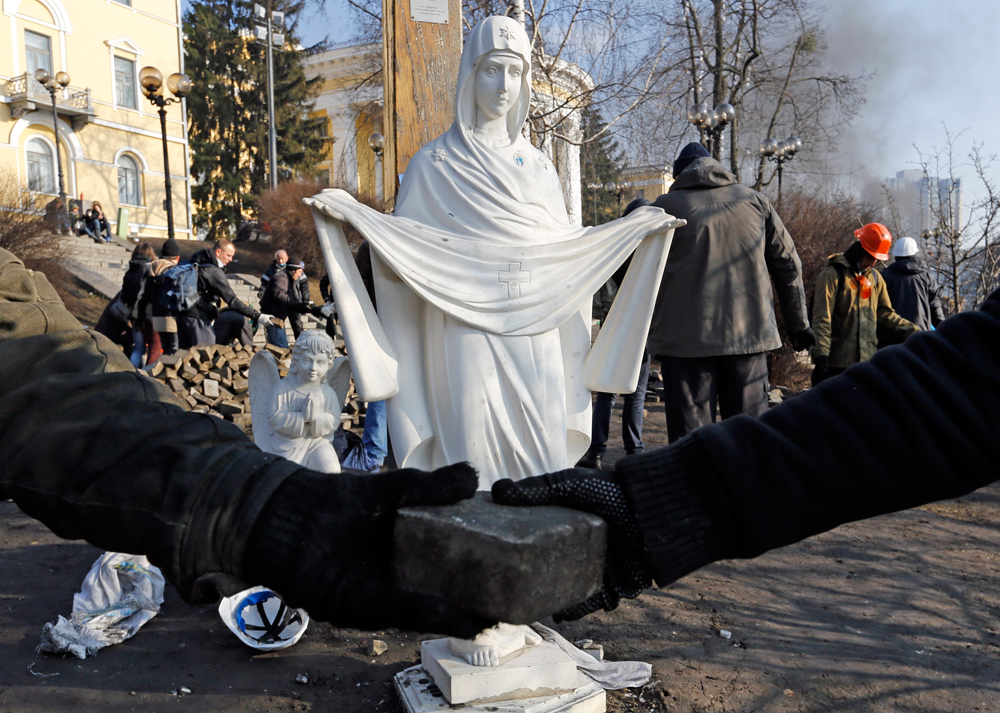
On the Kiev Maidan. The picture was taken in February 2014 /Photo: Yannis Behrakis /Reuters
My friend, economist, translator and publisher Yuri Kuznetsov the other day recalled the book of Martin Van Creleld, the world -famous theorist of war. He writes that today the power struggle for control over the territory sometimes begins to resemble the Middle Ages. Stones, slings, sticks, helmets become weapons. And small arms are not used.
Moreover, Crelegal draws attention to a curious fact: when the intifada just began, the Palestinians used Molotov cocktails, but soon abandoned them. Why? Because the rebels primarily fight for sympathy, for their bright image in the world media. The Palestinian leadership then demanded to use only stones during the intifada - a television team with a burning Israeli soldier immediately destroys the “criminal - victim” scheme.
You can fight for the territory with well -armed police and army forces exclusively stones. And win. The ability to use force against the rebels is now limited. But the rebels in their actions strive to use "symbolic violence."
Modernized societies-not only in the West, but also in Southeast Asia-continue to remember the era of mass wars with large victims. And for 50 years they have been striving to resolve conflicts with the help of point actions and symbolic threats. The era of nuclear deterrence did its job.
Events in Ukraine are an important confirmation of the postulate of Van Krevlda: the recognizable features of the “military Middle Ages” returned to the world policy. Police forces are more and more like medieval knights in heavy multi -kilogram equipment. The rebels fight with them with the help of slings and stones. For their own protection, they use the elements of combat equipment taken from knights: shields, helmets. The visual climax of the Euromaidan combat equipment was an attempt to build a catapult on the defended territory: literally according to medieval drawings. But the second event of the “War in Ukraine” - the capture of Crimea - also shows the miracles of the modern war: “Green little men” without identification marks, the blocking of military bases with the help of women and children, careful control that firearms do not sound. Bottom line: an bloodless operation to annexation of foreign territory was a success and highly appreciated by military experts.
Without a single shot
The fear of the big war is great. Especially in Europe. The European Union and NATO are amazed to look at the actions of the Kremlin, but the power answer is impossible. The troops turn out to be an illegitimate participant in the conflict. Putin throws the paratroopers to the borders with Ukraine, but at first he refuses to admit this. And then - after his conversation with Merkel - the Russian media suddenly report that Putin had given the command to withdraw troops.
NATO, for his part, does not dare to take a single step. Only statements. If only not to be accused of "escalation of the conflict."
Before our eyes, the 45 millionth state in Eastern Europe is moving towards collapse. At the same time, the troops remain in the barracks and does not sound a single shot. Only the "rebels" and the mercenaries storm state buildings and emit manifestos.
The Ukrainian military in the Crimea found themselves in the position of medieval Landsknecht: some bought out, others let go where they looked. Part of the Ukrainian fleet, captured in the Crimea, is kept on bail for debts of Kyiv. Donetsk separatists call themselves "Russian spring", use tires, parodying the rebels of the Maidan. Strange video frames bypass the world: “defeated enemies” make them crawl out of the city.
The giant military vehicles of world powers stand aside. Everyone carefully ensures that the shutter does not clap somewhere. The whole world bypass the words not of a political figure, but a Russian journalist: "Russia is able to turn the United States into a radioactive ash."
Guilty logic?
Can all this be considered a preamble of the Third World War? Of course, many historians see: the “new Middle Ages” of 2014 is very reminiscent of the previous “New Middle Ages” - in pre -war Europe.
In 1938-1940 The “rebels” played an important role: the progerman - in the territory of Czechoslovakia and Austria, pro -Soviet - in the Baltic states, in Bessarabia, Finland. And, as today, those rebels were partly local, partly imported from the outside, and partly at all “green men” - dressed in civilian and Stalinist military. Therefore, in relation to today's events, the “language of description” arises, in which such words as “Sudeters”, “Anschlus” are symbolically.
But we see another “language of description”-it is quickly formed both in Russia and in some places in the West. This is the "Chamberlain" language of recognition of Russia's rights to restore "after Versailles/1991". We hear the voices, for example, Gerhard Schröder, Helmut Schmidt and the famous American Sovietologist Stephen Cohen - they are ready to recognize that logic, armed with which the Kremlin began his redistribution of the world in 2014. This is the logic of "Western guilt in 1991."
Before us-dejaugu pre-war argumentation of the late 30s of the last century. A striking situation! In the language of Russian propaganda, designed for their own population, all recognizable concepts of pre -war revenge rhetoric arises: the image of the helplessness and demoralization of the enemy is drawn, myths about the “special path of Russia” are strengthened, that Russia has always been in conflict with the West, and the second myth moves from marginal circles to the political center and is made by the “common place”; At the same time, the concept of “Russian land” (even outside the Russian Federation) is constructed.
"
The Soviet Union wants to replay a scenario of its own death. And so far it is unclear that he can prevent him from doing this
"
It is completely impossible to believe in a new big war in Europe. But at the same time, several of its factors are already present in the public field: “counter -revolutionary rebels” in Donetsk, revenge propaganda, the willingness to “move the borders”.
Then questions: what is before us? What are we witnesses? Does 50-year inertia of “nuclear deterrence” still continue to operate? (And then Van Creleld is right: we just have new “military tactics” of the bloodless seizure of territories, that is, further “postmodernization” of power policy.) And are we too frivolous we relate to this inertia of “nuclear deterrence”, considering it eternal?
I do not want to believe that before our eyes the myth of the “almost bloodless end of the USSR” is collapsing, which Yeltsin, Gorbachev, Kol and Reagan were so proud of. And that the Soviet Union before our eyes suddenly pops up to the surface of the world political ocean. To break again. With a roar. With a big war. With big victims.
It seems that the Soviet Union wants to replay a script for its own death. And so far it is unclear that he can prevent him from doing this.