
Translated material
Strasbourg: Excommunication from Europe
Pase punished Russia for Crimea: Details from Strasbourg
The Parliamentary Assembly of the Council of Europe (PACE) deprived Russia of the right to vote and led it out of its governing bodies before the end of the year*. Behind the ups and downs of the scandal followed by The New Times
| *This is the second similar incident in the history of the Russian Federation in PACE. For the first time, Russia was deprived of the right to vote in PACA in 2000 in connection with the counter -terrorist operation in Chechnya. Then the delegation of Russia left the Hall Pase and refused to participate in work until its powers are completely restored. In January 2001, PACE spoke for the return of Russia, and the delegation resumed the work. |
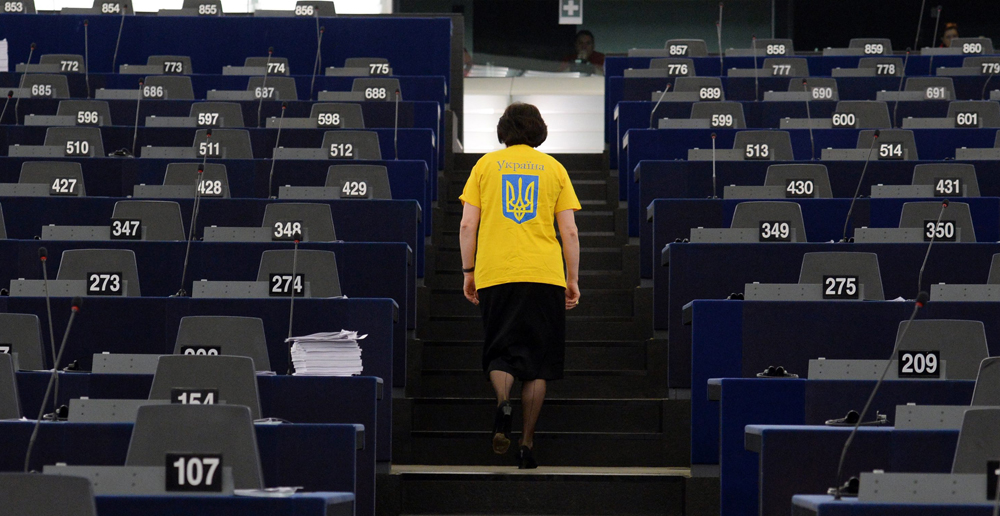
Strasbourg, European Palace, April 9, after a PACE meeting in Ukraine/Photo: Patrick Seeger/EPA/ITAR-TASS
In the middle of last week, on the way to the building of the European Palace in Strasbourg, one could observe a spectacle rare for these places: some clearly unwell people chanted slogans, they had Russian and Ukrainian flags in their hands. Only a closer look, it could be understood that these are actually two different pickets and share them literally a few centimeters.
Ukrainian activists, as usual, sang a national anthem, waving posters with a caricature image of a certain hybrid Putin and Stalin and shouted - Sanctions! Sanctions!, Demanding from delegates to PACE of strict actions in relation to Russia.
Next to them, the crowd shouted a little smaller with Russian tricolors - no fascism!, Unfavorable hinting at the new Ukrainian authorities. He conducted the picketers, climbing on a small stepladder, a former State Duma deputy, and now a member of the Public Chamber Maxim Mishchenko. Thanks to the winning position and Megafon in his hands, he managed to scream louder than anyone.
Fascism - this word on the streets of Strasbourg has not heard for a long time.
British catch
From the very first day of the spring session PACE (it opened on April 7th. - The New Times), members of the Russian delegation - deputies and senators - understood: sanctions cannot be avoided. The only question is what exactly they will be. On the sidelines, our politicians complained to reporters: it is very difficult to work in PACA, all around solid Russophobes. And they clarified, raising his eyebrows in surprise: “They are not just against Putin and the current government, they, imagine, are against Russia.”
State Duma deputy Robert Schlegel worried about the fate of the delegation, it seems, more than other colleagues. According to him, Russian parliamentarians in Strasbourg had to experience unheard of outside pressure. Among the main spitens, he called Russian neighbors from the Baltic countries, Georgia, as well as British conservatives. But if with representatives of the first two groups our political establishment is traditionally bad, then the “catch from the British” was unexpected and unpleasantly surprised the Russian delegation. Robert Walter, a colleague of the head of the Russian delegation Alexei Pushkov (chairman of the State Duma Committee on International Affairs) in the European Democratic Group, and not so long ago, and its leader (and his deputy was the same Pushkov) - on the first day of the Assembly made the most stringent draft resolution in Russia - it provided for the deprivation of our delegation of authority until January 2015. If the parliamentarians supported this document, Russian politicians would have to immediately leave the meeting room, and within 24 hours - the Palace of Europe, where the PACE session was held.
"
“Well, 20 million is not such a lot of money that it is to save ... but the fact that we will stop flying here is yes, it will turn out to be saving”
"
And such a shame, it is worth noting that there was no in PACE. In the early 80s, Turkey wanted to deprive the Turks, but the Turks did not bring the case to the lynching-they left the assembly themselves. A similar story occurred in 1969 with a Greek military junta - there was no one to get out here too, Greece was retreated itself.
The version of the resolution from Walter Pase did not support. Rather, not even because of its excessive stiffness. No matter how paradoxical it sounds, they really do not want to quarrel with Russia in Strasbourg. The Assembly understands: if the Russian delegation is deprived of authority, Russia will be followed by Russia from the Council of Europe (CE). And this is already fraught not only with the final loss of the highest Russian leadership of communication with reality and in the future - the self -isolation of Russia. In this case, Europe itself will lose an important negotiation platform with Moscow.
And then Nadezhda dawn: since they are not deprived of powers, then maybe it would cost to completely. And by the way, at the starting press conference on April 7, PACE Chairman Ann Brasser also gave rise to optimistic gossip. It turns out that initially there were three scenarios against Russia: deprivation of authority, deprivation of the right of voting, as well as the complete absence of any sanctions. In the last option, some German delegates insisted.
| *“Who are you ..., such to teach me,” they say that Sergey Lavrov said this phrase in a telephone conversation with the ex-head of the office of the office David Miliband in 2008, during the Russian-Georgian crisis. |
In the course of the work of the session, the Wind of Sanctions changed direction several times. Alexei Pushkov preferred to contact the deputies of the Assembly in French, it was elegant, in places fiery, but for those sitting in the hall - it seems unconvincing. In principle, the tonality of Pushkov’s performance could be described by one winged phrase (though in English), which is attributed to the head of our Foreign Ministry to Sergey Lavrov*, who are you to fucking lecture me? The argument that appeals to the bombing of Belgrade, to Libya, Afghanistan and Iraq, to fill the indentation of the West of Independence of Kosovo, Europeans, judging by the reaction of the hall, seemed uninteresting.
Stop feeding Elsas!
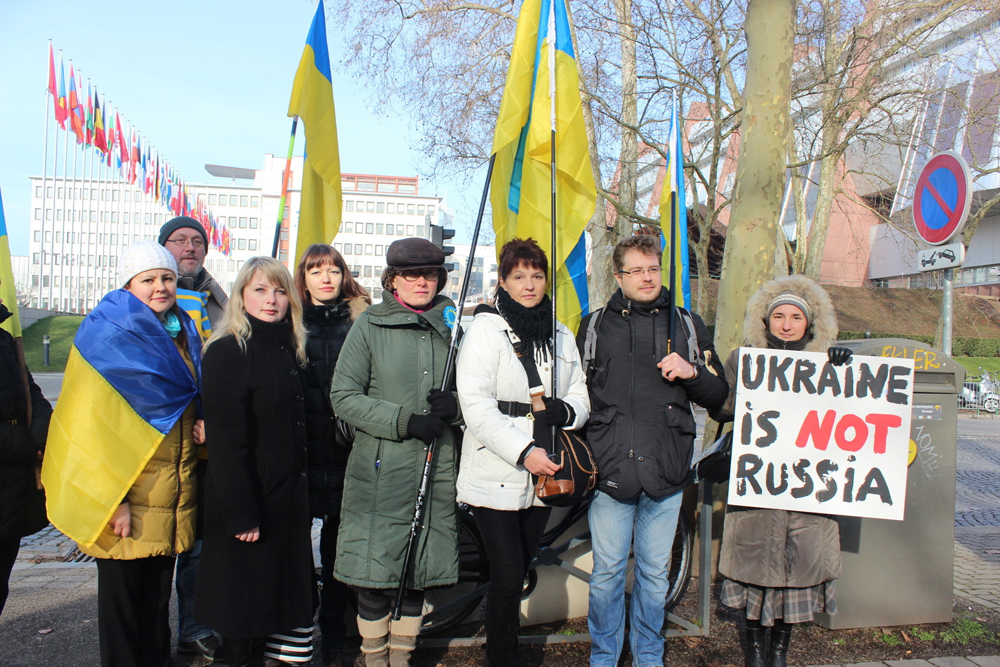 |
| The support group of Ukraine in front of the Council of Europe. Strasbourg, January 30, 2014/Photo: Fatma Esma Arslan/Anadolu Agency/Getty Images/Fotobnak |
If you can’t convince words, the last argument remains - actions. When the prospect of flying out of PACA loomed, Senator Morozov and deputy Schlegel spoke of a “symmetrical” answer. Once we fly out of PACA, and then from the Council of Europe, it is time to think about the return of the death penalty, which a moratorium is imposed on the CE in the Russian Federation in the Russian Federation. In other words: try to drive us out, we will begin to kill. Their own.
A little later, Russian delegates began to actively look for another possible benefit from deprivation of powers. Someone remembered that PACE is worth the money, moreover, no less than € 20 million per year. Stop feeding Elsas! It is better to spend this money on social projects in Russia. True, one of the members of our delegation on this occasion skeptically remarked: “Well, 20 million is not so much money that it is to save.” Then he suddenly added: “But the fact that we will stop flying here is yes, the savings will turn out.”
In the decisive phase, the confrontation of our parliamentarians with European colleagues entered on April 9 - this day in PACA was Ukrainian. And then a lot has already become clear. The Assembly confirmed the legitimacy of the Turchinov government-Yatsenyuk, condemned the separatists in the east and southeast of Ukraine, called not to delay the investigation of the “Sniper case” on the Maidan in February and warned Moscow: “Do not go further.” It became clear: Strasbourg is ready to forgive Russia Crimea, but this is the last line.
The unexpected support of the European left can be considered an outlet for our delegation. Thus, the representative of the Netherlands Tini Cokes sharpened the public attention for the role of oligarchs in Euromaidan. A large business, according to Koks, pulled the threads, and the result was a bloody massacre in Kyiv.
The representative of Hungary Tamash Gaudi-Nad not only supported the Russian side in the Crimean question, but also stated that Transcarpathia should belong to Hungary. On April 10, during the adoption of a resolution in Russia, these theses were already reflected directly on the T -shirt of the Hungarian deputy. By the way, the meeting itself on the issue of powers of the Russian Federation in the PACA Gaudi-Nad called the "Congress of the Bolsheviks"-for unanimity.
The Russian delegation would not be able to give their own assessment of the debate in PACE. None of its members came to the meeting room on the morning of April 11, preferring to spend several warm spring hours on the terrace of one of the cafes of the European Palace. Our threatened demarche in the form of early leaving the session from the very beginning, and journalists were very afraid to miss this moment. Everyone wondered exactly how our deputies will come: either they would leave when they recognize the name of the speaker in Russia, or only in case of voting according to the most stringent resolution ... But they took and did not come at all.
Perhaps in vain. The speaker on the resolution was a deputy from Austria Stefan Shenna, whose many considered a compromise. Russia was not deprived of authority, but limited to vote and imposed a ban on the right to be submitted to the Assembly Bureau and the presidential committee, which, of course, connects the hands of Alexei Pushkov personally as the head of the group of European democrats in PACE.
Go out! Go out!
Immediately after the adoption of strict sanctions PACE, representatives of the Council and State Duma arranged a press conference that turned into a uniform scandal. Western journalists and experts were first dissatisfied with the lack of translation, and then the fact that the press conference, in fact, turned out to be a monologue of Russian politicians who were in no hurry to give the present to ask questions.
Go out! Go out! - Robert Schlegel rushed the Western journalists defiantly leaving the hall.
The first deputy chairman of the Council of International Affairs Vitaly Ignatenko complained to the remaining: "I have not heard a single good word about Russia for the entire time of the session."
And the deputy Leonid Slutsky, who is already an all -in -law in the EU and the USA, said that what was happening in Strasbourg reminds him of the parliamentary assembly not under the Council of Europe, but under NATO.
Talking up in such a spirit, the Russian delegation left the building of the Palace of Europe, without waiting for the end of the working day.