
Translated material
The time is in captivity
Anniversary portrait of the theater, which is no longer
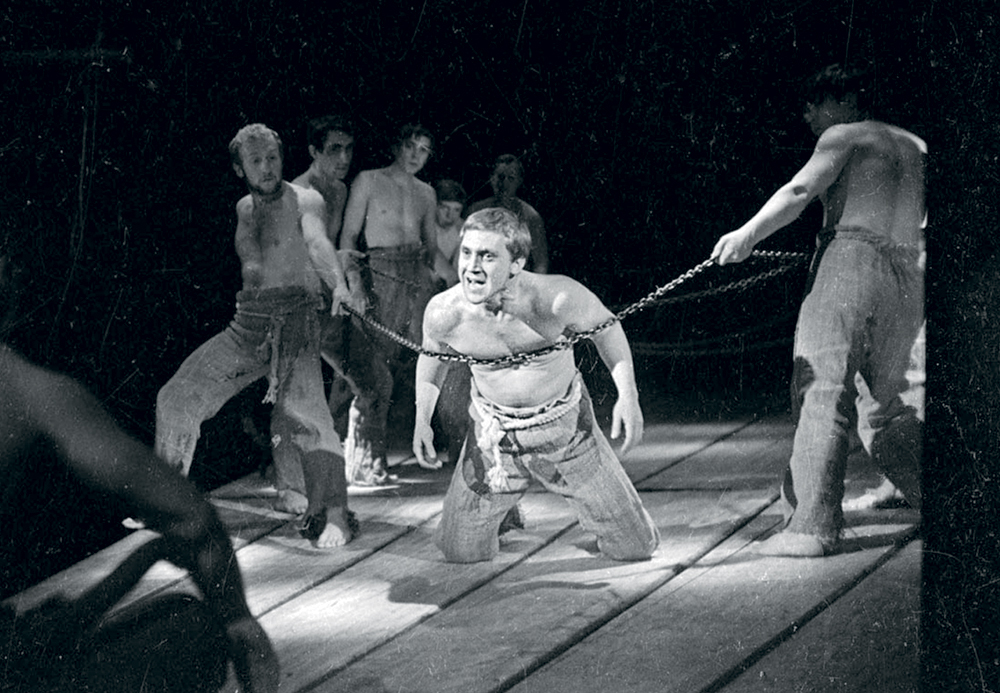
Vysotsky in the role of Chlopushi in the play "Pugachev." To get to this and other performances "Tagani", they stood in the queue at night /Photo: The Archive of the theater on Taganka
"Taganka", 50 years ... A strange anniversary. Strange, because by April 2014 there was practically nothing left of the great theatrical legend except memories: the founder of the theater left his brainchild with curses, the new leadership has nothing to do with the former Taganka - neither in the generation or in the artistic sense. The remnants of the old troupe were mired in endless intrigues, large masters - Taganka stars - are trying to avoid talking on painful topics. It is difficult and scary to admit the obvious: the story of the Taganka is over. And no anniversaries. Let everything start first. Let everything begin as it began once in the 64th: when Lyubimov came to the private, faceless Moscow Drama and comedy theater and turned the theater world turned over.
"Repeat!"
“Taganka” for several Soviet generations was larger than the theater, and more important than the theater. It is still impossible to say with confidence whether the “Taganka” is a cultural phenomenon or its birth and ascent-from the category of socio-political events?
Of course, everything in this story is mixed, tied - both politics and a sight. Although Lyubimov himself, at the mention of the “Political Theater”, falls into a grouchy dissatisfaction: according to his version, the audience and authorities made the Taganka political theater, he never considered himself a clerk director, except as an artist. Try to tell this to those young eyewitnesses that they got into a viewing of the student performance “Good Man from the Sezuan” by Bertolt Brecht in the distant 60s. When, after that, after the “zong about the ranges” sounding from the stage, with the words: “The rams are walking in a row, the drums beat, the rams themselves give the skin”, the excited hall began to stomp with their feet and chant: “Feed! Repeat!" - Was it not about politics? When the rector of the school Boris Zakhava, who turned over with horror, demanded to close the performance as “anti -people, formalistic” - was this not about politics? And all twenty years-from the 64th to the 84th-the “golden” Lyubimov time-isn't this about politics?
"
The work of the Taganka was supervised by the head of the famous 5th department of the KGB Philip Bobkov
"
In the history of the Soviet “Taganka” there is not a single performance without a censorship personal business: each premiere was torn off with meat, with a huge number of alterations, changes, bills. In the "fallen and living" dedicated to the 20th anniversary of the Victory, the censors found too many Jewish poets and the inappropriateness of the eternal fire, which was demanded to abandon. "Try to extinguish!" - The front -line soldier Lyubimov yelled at them. In the poetic oratorio according to Yevtushenko’s poems “under the skin, the statues of freedom” saw the malicious propaganda of the “universal values alien to the Soviet man”. Boris Mozhaev’s “live” village drama was declared “Pasquil on the Soviet way of life”. To the story of Mozhaev, Lyubimov stubbornly returned several times - and each time he received a refusal. “Living” was invented and set in 1968, and played the prime minister only in 1989. The performance was banned for 21 years!
Save and destroy
The famous expanded artistic council, which included representatives of the Soviet elite - writers, poets, scientists, journalists - was invented by Lyubimov as a lightning cord from brutal total censorship: members of the artistic council had the right to attend closed discussions, express their opinion and even argue with representatives of the nomenclature.
The artistic council with the help of high patrons - from Trifonov and Yevtushenko to Kapitsa and Karyakin - could pull the time and “pull the end”, but the performance of censorship scissors was unable to protect. And everything flew under the knife: from replicas and mise -en -scenes to semantic accents and specific performers.
The theater was constantly under the close round-the-clock attention of the KGB, the work of Taganka was personally oversaw the head of the famous 5th ideological management of Philip Bobkov, a veteran of the fight against dissent, now positioning himself as a “overturned theater” with a subtle aesthetic taste, a fan of Vysotsky’s work and generally arguing that there were no persecutions for the theater, but more talks about mythical persecutions.
The Taganka ended then in the 84th. By this time, they forbade the play of Vysotsky and Godunov, forbidden to put the Theater Roman, Lyubimov went on a rage for production in London, gave a desperate interview there, in which he expressed everything that he thinks about the Soviet regime. In response, he was deprived of Soviet citizenship, his name was removed from all posters (the performances became as if anonymous, as if there had never been any director).
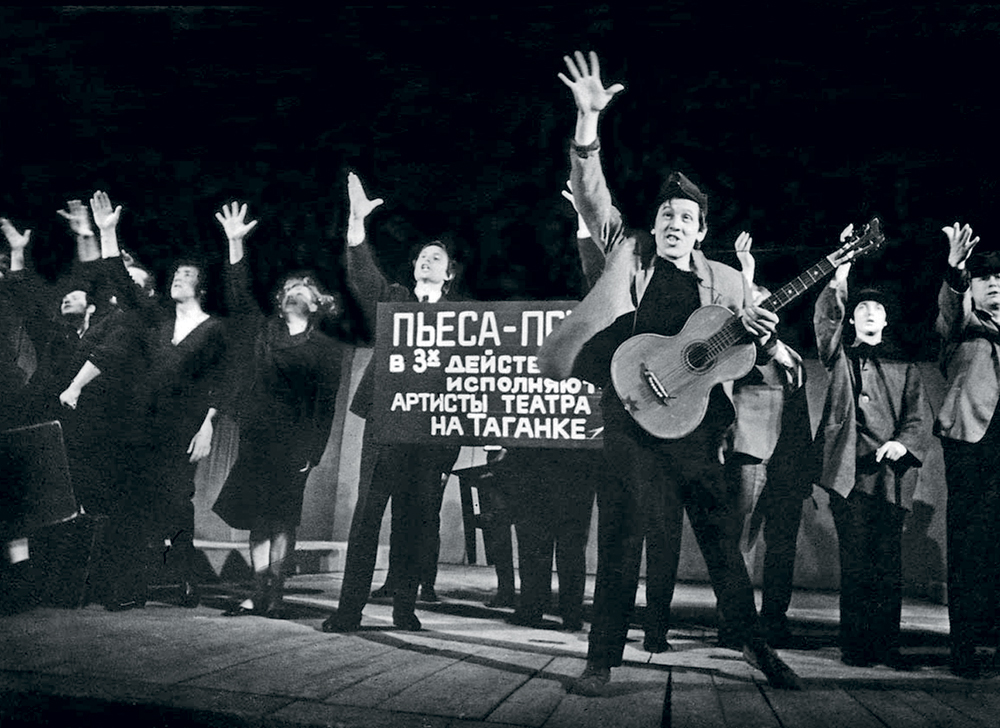
The scene from the play "Good man from the Sezuan." Lyubimovskaya "Taganka" began with him /Photo: The Archive of the theater on Taganka
Bitch children
For a long time, collective convulsions and seizures shared the troupe for a long time - the then atmosphere in the team was very accurately described by one of the leading artists Leonid Filatov in his painting “Sukina Children”. In the film, the Heroic team of the theater defends its disgraced art and declares a real war to the regime.
| *Anatoly Efros (July 3, 1925, Kharkov - January 13, 1987, Moscow) - the famous director and cinema director, headed the Moscow Theater "Lenkom", worked in the theater on Malaya Bronnaya, in 1984, after the departure of Yuri Lyubimov, he was appointed chief director of the Taganka Theater. |
However, in life, everything turned out much more tragic: Anatoly Efros*, who entered the Taganka, was driven into the decapitated theater, like a firefighter in a burning house. Efros “burned out” with the house - not without the help of the part of the troupe, which took his arrival as betrayal. Efros was rude at rehearsals, wrote denunciations and anonymouses on him, cut a crusty sheepskin coat, pierced the tires of his car. Two years later, he died of heart attack.
And two years later, Lyubimov returned. Inspired and spoiled by Western experience, he decided to transfer it to unhealthy Russian soil. Hearing the terrible word “contract”, the soil broke and exploded: the theater turned into one continuous abscess, into a bloody mess of ambitions, disappointments, mutual insults and curses. The most intelligent left, the most passionate - they fought to death, the most mediocre ones - sweding and provoking. Then, in the 92nd, everything collapsed completely, and so far the Taganka has not been able to recover from this monstrous injury, the grinding fate and the life of the once talented fearless community.
Everything that happened to the theater after the fault is all phantom pain when it hurts and rubs what is not.
Therefore, the current anniversary is more reminiscent of awkward fussy funeral. The story of the Taganka is tragic as the story of any theater that has survived its physical death. Happy are those who witnessed the formation and heyday of this unique phenomenon. Those who did not recognize and did not see the shameful ugly finale of this story are happy.
On the site of the former Taganka, sooner or later, someone’s new creative fate will begin the countdown. And let her be happy.