
Translated material
American Gothic Gordon Parksa
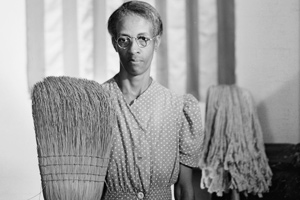
In the New Manege, as part of the photobiennal, the exhibition " American History " is held in one of the classics of American photography of Gordon Parks (1912-2006).
Gordon Parks is an African American photographer, director and writer, whose art was one of the first steps in the struggle for equal rights for different ethnic groups in the United States of America. And he knew how to show in his photographs what others did not see then. His work is a reflection on America of the middle of the twentieth century using Aristotelian poetics, according to which art serves to better understand reality.
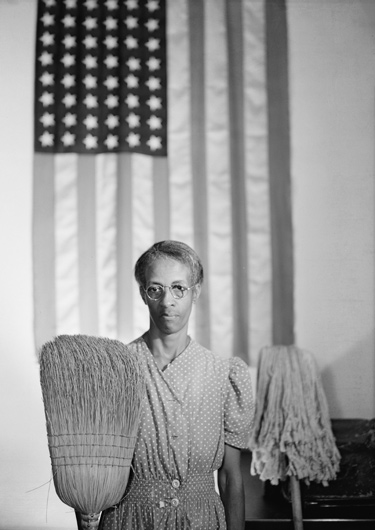 © The Gordon Parks Foundation Gordon Parks, American Gothic, 1942
In the 1940s, working for Roy Straiker , a successful economist and photographer, Parks creates his first masterpiece-“American Gothic”. The photo is a portrait of a dark -skinned woman against the background of the US flag with a broom in one hand and a mop - in the other. Her name was Ella Watson. At that time, she was a cleaner in a government organization, and the photographer captured her at the workplace.
When Gordon Parks raises the problem of racial discrimination, he turns to the picture of Grant Wood “American Gothic” (1930), which has already become an iconical way.
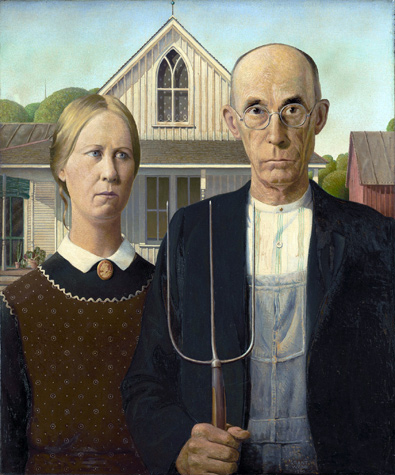 Grant Wood, American Gothic, 1930
Parks leaves vertical lines of composition and replaces the male figure with a mop. Interestingly, the picture itself in its composition is a parody of American photographs of the late 19th century and the satire on rural life of small cities in the Middle West. The scene presented by Wood never happened in reality. The artist wrote his father and daughter separately, and the house was a typical example of Plotnitsky Gothic, rather a generalized image than a particular building. The picture has become one of the most recognizable in the world and confidently occupies a high position among the "most American" works of art.
A photo of the park is a really dual portrait. On the one hand, it expresses real problems of that time - for example, racism or the question of the inequality of men and women in the labor sector and in society as a whole. Before taking a picture, Parks talked with Ella Watson, asked her about life in order to correctly compare the internal and external. He presented a real person in a natural place for him, thereby expressing the reality as it is. Although, on the other hand, the same reality is adjusted by the Parks: it not only cuts out a fragment from space, but also makes you look at it from its own point of view. The author himself is present in this photograph, which expresses his opinion, up to the point that he chooses the pose of his heroine.
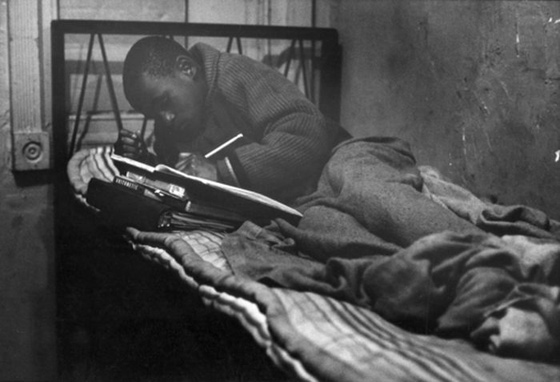 © The Gordon Parks Foundation Gordon Parks, “Kenneth Fontainel does homework, Harlem, New York, 1968
This method of presenting reality puts this photograph in the borderline position between documentation and art. The duality of perception is enhanced by reflections applied to each other: Parks’s photograph is the first parody of Wood, the picture, in turn, is a satire on photography of the end of the previous century and, on the other hand, also a representation of reality made in another way - with the help of fiction. The mirror gallery built by a parks in this picture distinguishes and isolate it from others from the series “American History”.
In the photographs of Gordon Parks, there is no sharp and rough unambigence, which could configure the viewer in advance to a certain impression. He seemed to smoothed the corners, bypassed sharp moments, but did not refuse them completely, modeling them in his own way.
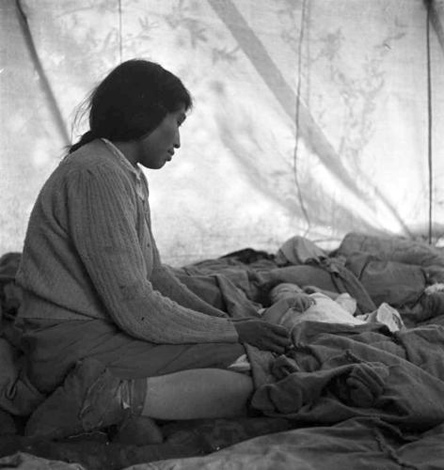 © The Gordon Parks Foundation Gordon Parks, “Mother monitors a sick child, Yellow -Afa, Canada,” 1945
The photographer did not bypass the topic of poverty, which was part of his own biography. It creates reporting portraits, whose simplicity contradicts emotional content. Parks himself appears in them a witness and an eyewitness of reality, shows fragments of everyday life, and the viewer involuntarily speculates the past and future of each of them.
He was not limited to social plots. Famous athletes, Hollywood stars, public figures: Barbara Streisand, Mohammed Ali, Malcolm X and many others fell into his lens. Even working in the fashion industry, Parks retained the individuality in this genre. The photographs are voluminous, inside each there is space, dynamics, naturalness, which was unusual for fashion shooting of that time.
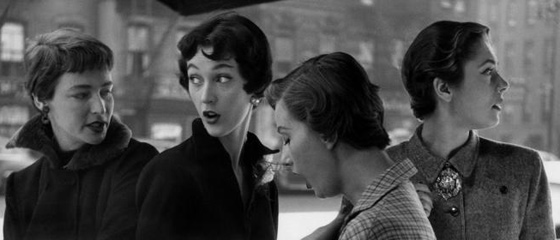 © The Gordon Parks Foundation Gordon Parks, “Models with short haircuts, New York, New York”
The versatile, but the integral figure of Gordon Parks in itself is an angle, the point of viewing of the loud social phenomena of America in the twentieth century. It was an emotionally saturated century, not only in the USA, but also in Europe and Russia, and we can find points of contact between different experiences of historical experience. We still continue to rethink the events of the second half of the twentieth century, especially within the framework of Russian reality, where the same protection of civil rights, if it occurs, concerns most of the majority than minorities, ethnic or any other. We can find a lot of acquaintances in those plots that Parks show us.
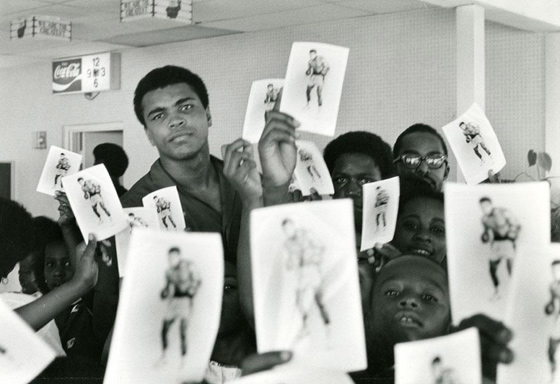 © The Gordon Parks Foundation Gordon Parks, “Mohammed Ali gives autographs to young fans, Miami, Florida, 1970