
Translated material
Is the arrival along the ass?
The regulatory authorities have doubted the ability of the community of co -religions to contain a monument of history and culture of federal significance
The struggle for the former building of the Nikolsky single -faith church continues. The Russian State Museum of the Arctic and Antarctic, having lived in the center of St. Petersburg for 77 years, should now move out of here. So the law adopted by the State Duma in 2010 on the return of the church of property seized in Soviet times
The struggle for the former building of the Nikolsky single -faith church continues. “New” told ( see No. 18, 20, 31 for 2014 ) that the Russian State Museum of the Arctic and Antarctic (RGMAA), having lived in the center of St. Petersburg - on Marata Street, 24 A, now I have to move out of here. So the law adopted by the State Duma in 2010 orders the return of the church of property seized in Soviet times. The Nikolsky single -faith parish, since 1991, trying to “conquer” the indicated areas, took advantage of this right and at the end of 2013 undertook (started) a new trip to the building. However, on April 16, federal officials officially refused clergymen to transfer the museum premises.
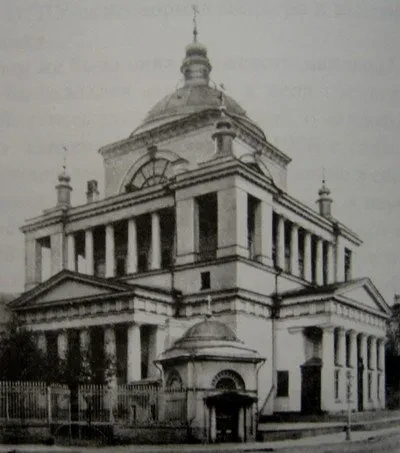
The Federal Property Management Agency refused the Nikolsky unequivocal arrival in the consideration of an application for the building due to the incompleteness of the submitted documents.
“The co-religious community was not presented by the most important of them-the draft security obligation of the Church, agreed on the Ministry of Culture of Russia,” the newspaper explained to the “new” press service. - Since the building, which the clergy claims, is a monument of federal significance and an object of cultural heritage, they need to confirm their ability to maintain and save it. In the meantime, the parish itself exists on donations from parishioners and regularly asks for help.
Nevertheless, the rector of the Nikolsky unequal parish, Petr Chubarov in an interview with the "New" promised:
- We will continue the struggle for the building of the Museum of the Arctic and Antarctic. While we have not yet received the official text of the refusal, but as soon as he comes, we will plan how to happen further. We have already sued about the return of this church building ( we refused all the claims - N.P. ), perhaps again, we will go to court again. But we cannot allow the church building to remain in non -church hands.
Recall that on Marat Street, the Nikolskaya single -faith church lived since 1840. In 1932, after its liquidation, by the decision of the city authorities, the building was overhand under museum expositions ( spent 560 thousand rubles - at that time a lot of money ) and gave the Arctic and Antarctic to the museum created in 1930.
Peter Chubarov has repeatedly turned to Roshydromet ( founder of the RGMAA ), and to the city authorities demanding to return the former temple to parishioners. They are here, however, no more than 50 people. But the law is a law. The museum does not seek to change the place of residence: any relocation inevitably entails loss and destruction of a unique exposition. But he agrees to move if a suitable option is found. The new building should be at least 7 thousand square meters and located in a no less convenient place for citizens and guests of the northern capital ( since more than 60 thousand people visit the RGMAA in the year of the RGMAA, and attendance grows by 4 to 5 thousand people ).
However, instead, the museum tried to push into places, completely unsuitable for him. For example, in the building of the Arctic and Antarctic Research Institute, where RGMAA was allocated less than 4 thousand square meters. The scientific funds of the museum ordered to squeeze into utility rooms and warehouses requiring overhaul. And to arrange the exposition in the conference hall of the Research Institute, where international forums are regularly held.
In March 2014 alone, after the meeting of the director of the RGMAA Viktor Boyarsky and the deputy of the St. Petersburg parliament Boris Vishnevsky with the Governor of the city, George Poltavchenko, adequate proposals began to be discussed. There are several of them. From the point of view of experts, one of the best is the construction of a new building on the Novo-Admiralty Island with the inclusion of the Arctic nuclear icebreaker to the museum. There are other “points”: the industrial buildings of the Obukhov plant (they are ready to transfer them to the city, there is a lot of space, nearby - metro and Neva); The southwestern part of the Vasilievsky Island, next to the Krasin icebreaker, according to which there is a former pier of the Baltic plant and to which the Arctic can also be moored, Kronstadt is also considered as an option.
“The estimated cost of any resettlement is about 2.5 billion rubles,” Viktor Boyarsky concludes. - And if there is no money for this in the budget, it is most correct - to save the museum in the same building on Marat Street, until real financial and technical opportunities for moving.