
Translated material
The roar of the waves
My country! You proved both to me and to everyone that your spirit is alive, when, having sensed the sting in the body, you swept away, groaned, all - frenzy, all - impulse!
Valery Bryusov
The poem of Khodasevich “Monkey” of 1919 is one of the most underestimated in Russian poetry. Few, when reading, a lump will not approach the throat. The author is casting a general plan in a guest gathering, for which a trained animal on the street of the country village near Moscow, as far as Darius and Alexander, and then suddenly approaches so much that all the folds on a monkey found with the human one are distinguishable. This sketch ends with a line, which was carried out separately: "On that day, war was declared." Why so? Maybe this is the opposition of the world, sympathy, which look especially piercing when they, as Heidegger said, "put forward into nothing." The reader does not let go of the feeling that this is not just a sketch, not just the memory that this last line is some important frame, an indefinable border between the present and the past, but it still does not work out to the end of the intelligible picture. Now, when the piercing cordiality of this poem is compatible with the prejudice of the war that covered us all, something may be clearer. But better about everything in order.
* * *
The events taking place in the last weeks in Crimea, losses and acquisitions that they promise direct participants are not comparable with their psychological effect. Ultimately, Crimea is only a piece of earth, turning from one not too caring owner to another. Its inhabitants, and previously not spoiled by the attention of the authorities, will cope with the consequences of what happened. But much more people who have a very mediated attitude around the ill -fated peninsula - all residents of Russia and Ukraine are already experiencing the consequences of the Crimean Crisis of the Information War. And these consequences may turn out to be - and already turn out to be much more serious for them.
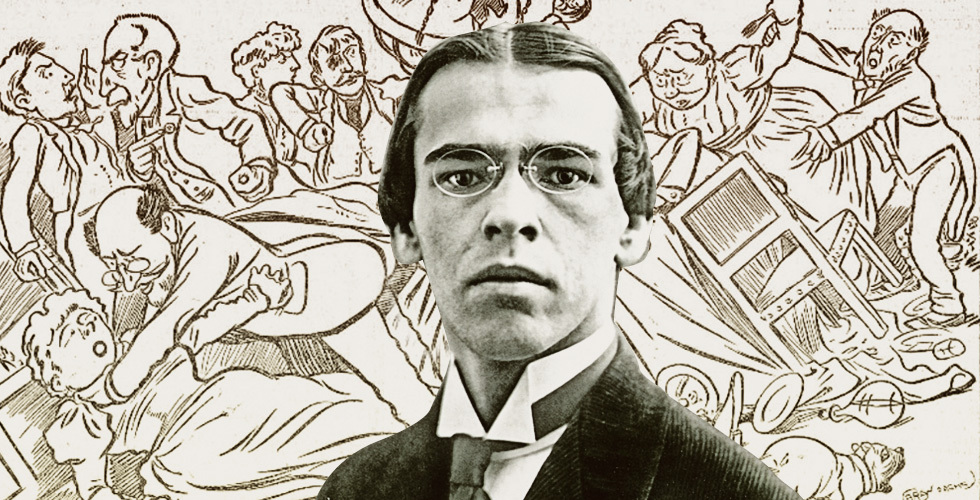
The hysterical state, which has mastered the population of two neighboring states in some weeks, is amazing. To feel this, it is enough to listen to conversations in public transport, in the store, to mention Crimea in a conversation with friends or in a dialogue in social networks. The degree of intolerance is so high that the traditional mechanisms of discussion refuse-controversial statements are completely leading to the outputs, bypassing the discussion, and the Internet science is forced to turn off the comments on their sites. Aggression, hatred, stamps fall on us in the most unexpected situations and from the side of usually completely restrained and not prone to hysteria people. Stories about the "atrocities of the Bandera" penetrate even the most inaccessible layers of society for propaganda; This is no longer propaganda, but the next step is a wave running and picked up by the public. This situation is not unique. It is enough to recall how accurately the famous French caricature reflects what is happening today, telling how a bureal family dinner turns into a battle after mentioning the Dreyfus case.
If you carefully listen to the accusations generously scattered in this discharged atmosphere, you can notice an important thing. It is known that the meaning of words is erased, if you use them for other purposes. The word “fascism” has long been balancing on the verge of loss of meaning, it has now faded completely, it is no longer at all able to adequately describe reality. Moreover. For the first time in many decades, approaching the surge of the present, not for the red word, fascism, we suddenly distinguish that fascism itself - no matter how strange it may sound - not the worst thing. This is particular, one of the possible, albeit to the limit, incarnations rising in society of irrational hatred. It is useless to fight foam on the crest of the wave, it is necessary to be able to distinguish the emergence of the wave when it can still be extinguished. The processes of “disconnecting” ethics, which are implicitly, turning society into a crowd of pogroms, yesterday’s friends into enemies, and quite explained domestic irritation into irrational thirst for blood, much more commonplace and more universal than transcendental villains like mass executions and gas chambers, and at the same time they are these villains a necessary condition. It is impossible to “understand” gas chambers, this, in addition, is a completely meaningless activity. But to try to consider the properties and patterns of the spread of madness, gradually covering society, is quite possible and even necessary. Let's try to designate the most significant features of this process.
Even if you exclude the example of Germany of the 30s that has lost any evidence-based power from frequent irresponsible use, the history of the 20th century gives fairly vivid examples of such a social hysteria. We quote a fragment from the book of the outstanding Russian philosopher Vladimir Bibikhin “The Language of Philosophy”, from the chapter dedicated to the analysis of the Heraclitian image of lightning (Fr. 64 according to Dilsu-Krange).
“The spread of the Russian population in the vast spaces of Eastern Europe and Asia, the immersion of this population into a natural life could seem to be a guarantee of massive slowness, the leading and the rise, and eternal Chinese stillness. This whole mass of the people, attached, seemed, to the enormous volumes of natural matter, quickly and resolutely discarded the skills of reasonable thoroughness, common sense against all expectation. The message, transferred by the early spring of 1917 from the remote capital throughout the country, acted not by its content, convinced not by the promise of the reconstruction of life on a more reasonable basis to replace the old, less rational. The message was accepted by the country as a signal. It drove a person into another, electrical state. Contemporaries noted that the human type in Russia has changed in a few weeks, if not in a few days, hours. Everyone suddenly realized that he “broke through an hour”. The slow-down was perceived by the impulse, which did not take as external-we know how it is actually slowly rebuilding, with which reluctance a person is mobilizing in response to an external impulse-and Petersburg events came here only by an agent of some more secret power. ”
It is impossible to “understand” gas chambers, this, in addition, is a completely meaningless activity. But to try to consider the properties and patterns of the spread of madness, gradually covering society, is quite possible and even necessary.
Further, Bibikhin quotes the memoirs of Werner Heisenberg about enthusiasm that covered the Germans at the beginning of the First World War is one of the examples of “mobilizing the whole people, whose fullness and speed were inversely dependent on reasonable awareness.”
“If you try to describe what was happening, I would say this: everyone felt that the matter suddenly went seriously. We realized that we had until then surrounded by the appearance of excellent well-being, suddenly since the murder of the Austrian heir of the throne, and because of the backstage, a hard core of reality has now moved to the forefront, from which our country and we all could not dodge and at the level of which we had now to be. Everything was determined, albeit in the deepest alarm, but with all my heart <...> in such a universal impulse there is something circling head, something completely terrible and irrational, it is true <...> everywhere the stations were crowded with screaming, crowded, excited people <...> until the last moment, women and children crowded; People cried and sang until the train left the station. It was possible to say with a completely stranger, as if you know him for many years <...> But how is this an incredible, unimaginable day that you will never forget, if you have experienced it, has what is usually called military enthusiasm or even a joyful sense of war? .. Small everyday concerns that previously crowded us disappeared. Personal relations that previously stood in the center of our lives, relations with parents and friends have become small in comparison with the same and the most direct attitude towards all people whom the same fate befell. At home, streets, forests - everything began to look like before <...> even the sky acquired a different shade. "
It is difficult, reading these lines, not to recall Tolstoy’s “smooth life” and the rapture of Pierre Bezukhov, who felt like part of a large folk organism. And recalling Tolstoy with his “kind” liberation from individuality, it is logical to ask a question: are hatred and aggression, on the one hand, and euphoria - on the other, also only by the private manifestations of the elements described by us, the types of the same kind, the only significant characteristic of which is irrationality and extraordinary.
Nietzsche, the main ideologist and apologist for this non -inventing elements, defined it as an uninformed ethics free of it. The Nietzschean cult of the spirit of music, Posocratic Greece is a cult of pre -ethical natural life, destroyed by Socrates, which raised the question of ethics and eccentric ethics in personality. Thus, the wave is free from ethics, which means that it cannot be “kind”. After all, hatred and aggression are a rejection of ethics, while sympathy exists in the space of ethics and reason, implies a conscious and personal effort. The “good” euphoria of the crowd is always superficial, always to the first obstacle, the first disagreement. With amazing ease, it turns into aggression, and those who shouted “Mosenna”, readily shout “cut off”. Both is an irrational and impersonal “aid” emotion that is not involved in reason, and therefore alien to ethics.
The hysteria cancels not only ethics, but also complexity. Any any non-trivial reasoning are unimportant, not unnecessary against the matter, overlords against the backdrop of a universal impulsive simplification. When “and so it is clear” who is the enemy and how to act, any justifications are suitable. "What are they?" - Quite enough motivation. The reasoning that in the case of Crimea, the Russian authorities simultaneously condemn the neglect of international law from the United States and uses it as an excuse for its behavior, refers to a precedent of Kosovo, without recognizing his independence at the same time, is already too difficult.
This cancellation of complexity is not always noticeable, it is crawling and therefore more dangerous and acts on everyone. Those who are weaker than the habit of analyzing what is happening, the wave simply subordinates, forcing them to pour into a general stream. But on those who are prone to analysis, it also acts, and quite sophisticated. The coverage of hysteria is easily distinguishable from the side, it is easy to identify, which means it is easy to expose. But the one who retained the sober mind in the environment of the insanity of many, greatly temptation to switch to the regime of denunciations and superficial analysis, leaving more time -consuming tasks and maintaining the split of society from the inside. The speed of what is happening captivates and does not give time to think - it is enough to see how much the journalism and analytics are two -week ago are already outdated today. And the discussions of the winter of 2012 and even more so look in Hegelian unhurried and thoughtful.
Entering this state is relatively simple, and it is extremely difficult to get out of it. The public hysteria, like a rising wave, cannot stop by itself, but always requires escalation. Once it starts, it grows, simple excitement strives for an angry, restrained emotion - to expression. As a drug addict, this state requires increasingly strong and more powerful doses of emotional nourishment and is eager to resolve in action - a “fair” reprisal, the return of “its”, “sacred” war. You can try to extinguish the wave, more on this below, but if this is not done, the tantrum risks turning to an explosion, often a war. And then, to withdraw from it, a military defeat is necessary.
Irrational collective metaunity reads elementary signals instead of meanings. The words “fascist”, “bander”, “zhidomason”, even “liberal” should not have rational content, are not designed for a critical perception, their task is to be triggers, trigger hooks that launch a certain emotional reaction. (In this sense, the system of memes that is already quite formed in emotional network battles is important and interesting, the fixation of which is devoted, in particular, the Internet encyclopedia “Lurkmore”; it is no coincidence that the term “Bandera” in his “Crimean” understanding is most accepted precisely by the corresponding article on Lurke.) The way the rapid wave washes He uses the most primitive, tearing off the sign from the meaning, it is clearly visible, in particular, on the example of the so -called St. George ribbon. Invented as a symbol of victory and memory of veterans in 2005, the ribbon quickly became simply a sign of “patriotism”, its marker, “Russian”, against “stranger” and at the end of 2013 - early 2014, was raised on a shield as part of a campaign to discredit Euromaidan, already without any substantive connection with the memory of veterans.
The ruler, who managed to introduce his society into a hysterical trance, is the main hostage of the processes unpredictable and fraught with explosion with his country.
This state of affect is generated by the strong and non -exit by the experience, primarily fear as the strongest mass emotion. As an alien rationalization, fear easily turns into aggression, it is worth pointing to him to the alleged source of anxiety. Since fear is alien to rationality, the enemy can easily be elected arbitrarily. Another significant consideration looms here: the irrational element considered by us is not just easily lending in manipulation, but needs a directional, for a certain conscious conductive will. It is no coincidence that the rise of this kind of wave is always sprinkled with a surge in the company of loyal feelings. Examples of the hysterical cult of the leader in the totalitarian states will not surprise anyone, but here is a scene from a completely different context:
“The representatives of the troops, all departments, and the urban population, who were gathered after that, unanimously expressed the ardent desire to plunge the exciting feelings of love, loyal devotion and selfless readiness without sparing life and property to give a worthy rebuff to the enemy. Vladivostok and its population, called by the king, stand in the forefront of Russian power, ready to cheerfully and firmly meet their first military baptism, expect with the indestructible spirit of enemy creeps on Russian land, petitioning to plunge this before his imperial majesty ”(from the telegram of the military governor of Vladivostok, Governor-General of the Amur Region) [1] .
At the same time, the power, which controls the wave, is best understood that it is impossible to control the elements. You can only become like her, pretend that the process that is going under the process is still under control. It is about this and Heraclitian lightning:
“The human being, and perhaps, every general living creature is ready to discard rationality. Here is the secret of power. Its decisions give, as a rule, the effect opposite to the plan, i.e. From the very beginning they act with a provocation. However, they determine the whole life of society, not contrary to their inability to achieve rationally set goals, but due to their incomprehensibility. The impulse of the authorities seeks to act according to the method of lightning, to imitate a thunderous blow ”(“ Language of philosophy ”);
And the "cereal life" of Tolstoy:
“There are two sides of life in every person: personal life, which is all the more free than abstracting its interests, and spontaneous life, a moisture, where a person inevitably fulfills the laws prescribed to him. <...> The higher a person stands on a public ladder, the more he is connected with the larger people, the more power he has on other people, the more obvious the predetermination and inevitability of each of his acts. “The Heart of the Tsarevo in the Hand of God.” The king is a slave of history. History, that is, the unconscious, general, the vulgar life of mankind, every minute of life of kings uses for itself as an instrument for their purposes ”(“ War and Peace ”).
The ruler, who managed to introduce his society into a hysterical trance, is the main hostage of the processes unpredictable and fraught with explosion with his country. Trying to extinguish the wave, the government risks being washed away by it, and therefore it remains only one thing - to lead it further, as a rule, closer to collapse.
It is noteworthy that the systems and ideologies that exist by getting out of balance, destabilization are striving, as if feeling their inner instability, to call themselves an equilibrium, stable name, as a rule, converted into history (this displacement of equilibrium generally loves to leave, leaning against history), the high gate (port), the third empire (Reich), the Russian world.
Ecstatic enthusiasm, which covers many at once, turning off consciousness, mass aggression - all this is in any, most civilized, society. Is there a special place tested by social experience for this element? Eat. То, что мы назвали истерикой, идет обычно по ведомству спортивных зрелищ, массовых увеселений и развлекательных шоу, «канализируется» ими. Переключение этих страстей в соответствующее русло есть прямая задача государства. Переключение же их в политику разрушительно и свидетельствует о склонности государства к суициду. Это понимают со времен Византии, первого продуманно антидемократического государства, где оставшиеся в наследство от вольной античности политические партии были откровенно переключены в спорт, сделавшись партиями ипподрома. Где-то здесь, во всегда неясно обозначенном поле взаимодействия государства и автономных общественных (корпоративных) образований, располагается поле идеологии, «тонкое тело» государства, странная сфера его возможного воздействия на массы. Курируя массовые увеселения, государство может осторожно подталкивать эту стихию в зону этики — показательно наказывая за конфликты на расовой почве, организуя благотворительные акции, уча здоровому отношению к инвалидам и т.д., — а может решать собственные задачи, пользуясь именно непросвещенностью этой стихии, — например, организуя из футбольных болельщиков боевые отряды на случай беспорядков.
* * *
Если наиболее существенные черты болезни определены, имеет смысл искать способы излечения. Как погасить волну и возможно ли это? Объяснения и увещевания тут, по-видимому, не работают; иррациональная стихия не внемлет доводам и только больше разъяряется, встречая энергичное сопротивление. Воззвать к разуму того, кто пребывает в состоянии глубокого аффекта, невозможно, тем более если таких множество. Впавшего в истерику приводят в себя, окатывая холодной водой; тут необходимо резкое переключение, мгновенная смена перспективы. Такой сменой перспективы может служить личностное усилие, человеческий поступок, «включение» этики. Вот несколько примеров того, как личный нравственный поступок если не гасил разгоревшиеся страсти, то, во всяком случае, имел широчайший и мощнейший эффект.
28 марта 1881 года во время своей лекции в Московском университете Владимир Соловьев выступил за помилование народовольцев, виновных в убийстве Александра II:
«Настоящая минута представляет небывалый дотоле случай для государственной власти оправдать на деле свои притязания на верховное водительство народа. Сегодня судятся и, вероятно, будут осуждены убийцы царя на смерть. Царь может простить их, и если он действительно чувствует свою связь с народом, он должен простить. Народ русский не признает двух правд. Если он признает правду Божию за правду, то другой для него нет, а правда Божия говорит: “Не убий”. Если можно допускать смерть как уклонение от недостижимого идеала, убийство для самообороны, для защиты, то убийство холодное над безоружным претит душе народа. Вот великая минута самоосуждения и самооправдания. Пусть царь и самодержец России заявит на деле, что он прежде всего христианин, а как вождь христианского народа, он должен, он обязан быть христианином. Он не может не простить их! Он должен простить их!»
Речь имела невероятный эффект. «Особая напряженная тишина господствовала в зале, — пишет один из свидетелей, — и никому не приходило в голову прерывать ее рукоплесканиями. Никаких возгласов не было; никто не поднимался перед эстрадой с угрожающими словами, никто не кричал: “Тебя первого казнить, изменник! Тебя первого вешать, злодей!” Это было бы совершенно немыслимо при общем тогдашнем настроении». Народовольцев казнили, а Соловьеву было запрещено выступать с публичными лекциями, но его слово прозвучало на всю Россию и оказалось услышано многими.
13 января 1898 г. в газете L'Aurore была опубликована знаменитая статья Эмиля Золя «Я обвиняю», в которой писатель обвинял правительство в антисемитизме и фабрикации дела Дрейфуса. Статья вызвала небывалый ажиотаж, а ее автор стал объектом жестокой травли, был приговорен к штрафу и тюремному заключению, от которого вынужден был скрыться в Англию [2] . В итоге статья Золя пошатнула французское и мировое общественное мнение по поводу этого дела. Через месяц после ее публикации полковник Мари-Жорж Пикар дал показания в пользу Дрейфуса и против его обвинителей. За это и последующие выступления он также стал объектом травли, был уволен из армии, обвинен в разглашении государственной тайны и посажен в тюрьму. Однако спустя годы именно его показания стали основанием для оправдания Дрейфуса и наказания виновных. В 1906 г. Дрейфус и Пикар были восстановлены на службе с повышением в чине, а Пикар даже стал министром обороны Франции.
25 августа 1968 года, через несколько дней после введения советских войск в Чехословакию, семь человек вышли на Красную площадь с плакатом «За вашу и нашу свободу». Акция продлилась всего восемь минут, и большинство ее участников получили серьезные сроки, но она стала свидетельством того, что не все в СССР поддерживают официальный курс, так что пражская пресса назвала семерых ее участников «семью причинами, по которым мы никогда не сможем ненавидеть русских».
В важном и имеющем самое непосредственное отношение к этому разговору эссе «Обязанность понимать» Михаил Гаспаров указывает, пожалуй, образцовый пример усмирения волны посредством проявления личностного начала. В годы Гражданской войны к коктебельскому дому Максимилиана Волошина несколько раз приходила толпа погромщиков. Но он выходил им навстречу и просил высказать претензии кого-нибудь одного — «со многими я не могу». Всякий раз погрома не получалось, а получался разговор, и толпа расходилась мирно.
* * *
Коктебельская сценка времен Гражданской войны возвращает нас не только к Крыму сегодняшнему, но и к подмосковному Томилину, где проводил лето Владислав Ходасевич. «Обезьяна» — стихотворение про ценность предельно индивидуального пространства, в котором только и располагается этика, в частности — такой необходимый элемент общения личностей, как благодарность.
Всю воду выпив, обезьяна блюдце
Долой смахнула со скамьи, привстала
И — этот миг забуду ли когда? -
Мне черную, мозолистую руку,
Еще прохладную от влаги, протянула...
Я руки жал красавицам, поэтам,
Вождям народа — ни одна рука
Такого благородства очертаний
Не заключала! Ни одна рука
Моей руки так братски не коснулась!
И, видит Бог, никто в мои глаза
Не заглянул так мудро и глубоко,
Воистину — до дна души моей.
Глубокой древности сладчайшие преданья
Тот нищий зверь мне в сердце оживил,
И в этот миг мне жизнь явилась полной,
И мнилось — хор светил и волн морских,
Ветров и сфер мне музыкой органной
Ворвался в уши, загремел, как прежде,
В иные, незапамятные дни.
Война — почти всегда результат торжествующей истерики, победы стихийного над личностным, общего над индивидуальным. А потому сочувствие, встреча один на один, личная и располагающаяся всецело в пространстве этики, есть нечто прямо противоположное войне и на фоне войны невероятно ценное. Именно в этом, по-видимому, смысл последней строчки стихотворения Ходасевича. Это стихотворение про ценность встречи один на один, встречи, действующей как откровение — не случайно «Обезьяну» сравнивают с пушкинским «Пророком». Причем, что особенно важно, личностное начало тут в буквальном смысле преодолевает природу, видовые различия, разделяющие человека и обезьяну, и в этом смысле обратно действию массового аффекта — оно не делает из человека зверя, но даже зверя способно возвысить до человека.
[1] Обнаружено у ЖЖ-юзера mi3ch .
[2] «Впервые термин “интеллектуалы” вошел в широкий обиход в связи с публичным обсуждением дела Дрейфуса. В январе 1898 года, на следующий день после того, как дрейфусар Эмиль Золя напечатал свое “Открытое письмо президенту Республики” (вошедшее в историю под заглавием “Я обвиняю”), единомышленники Золя — университетские профессора, литераторы, журналисты, студенты — опубликовали коллективную петицию в его поддержку под заглавием “Протест”. Противная сторона отреагировала так же оперативно: один из главных антидрейфусаров, Морис Баррес, в своей реплике назвал это коллективное письмо “Протестом интеллектуалов”. Этот момент можно считать рождением термина, и надо сказать, что при рождении термин этот звучал как оскорбление. В 1898 году, пишет Шарль, сказать о ком-то, что он интеллектуал, означало сказать, что это человек, “требующий таких вещей, которые отвергаются огромным большинством французов”, человек, ставящий права индивидов выше интересов государства, человек, предпочитающий справедливость — порядку. Шарль приводит поразительный эпизод, происшедший в том же 1898 году в Гренобле: профессор римского права, сочувствующий Дрейфусу, произносит в университете речь по случаю начала нового учебного года и призывает студентов “брать в советчики свой разум и свою совесть, а не фанатизм общественного мнения, не лозунги политических партий и не моду, одним словом — быть интеллектуалами”. Казалось бы — интеллектуалами, а, например, не поджигателями... И тем не менее совестливый профессор, поскольку говорил не как частное лицо, а как представитель своего факультета, не захотел произносить крамольное слово “интеллектуал” без санкции факультетского начальства; за неделю до заседания он послал свою речь декану и осведомился, не находит ли тот фразу об интеллектуалах “чересчур подрывной”. Такова была в тот момент репутация интеллектуалов». Vera Milchina. Интеллектуалы: вчера, сегодня и всегда // Отечественные записки, 2005, № 1.