
Translated material
Marquez. The other side of death

The Nobel laureate in literature, the famous Colombian writer Gabriel Garcia Marquez, stuck
To love Markes, it is enough to read almost any of his book. To understand Markes, it is enough to read the first phrase of the best of them.
"It will take many years, and Colonel Aureliano Buendia, standing against the wall in anticipation of the execution, will remember that distant evening when his father took him to look at the ice."
The first proposal of the novel served as a password by which they separated their own from strangers
As it happens only with a radically new one, a daring debut of a rabal paw tore off a book from accompanying and rival genres. “Magic” this disdain makes a miracle - ice. “Realism” lies in the fact that miraculously ice is only near the equator. Not a naive technical justification for fiction, characteristic of science fiction, is not even more naive irresponsibility of the fantasy fairy tales, but an inseparable alloy of the alloy with the impossible , this is the secret of skill, which readers who discovered Markes could not resist.
I remember how it was. For the people of my generation, whose youth coincided with the phenomenon of “one hundred years of loneliness”, the first proposal of the novel served as a password, according to which they separated their own from strangers, from those who still quoted the writer from another America. Instead of contour realism, Hemingway Marquez offered another network to capture reality. We called it “magical realism”, not yet knowing that many writers of Latin America were already using this technique and worldview (with no light hand of Borges). For us, however, all of it fit in that great book that opened us a new continent on the literary map of the world.
Marquez, perhaps the only one of the foreigners, managed to become a cult author of both Americas and two superpowers
The greatest was my surprise when, having moved to New York, I found that American peers understood me very well. The favorite of student campus, Marquez, perhaps the only one of the foreigners, managed to become a cult author of both Americas and two superpowers. There were different, however, the reasons for such love.
The fact is that magical realism is a product of extremely specific conditions. Its unfortunate countries and peoples become its nutrient medium, where, under the unbearable pressure of distraught history, reality loses its sane features and flows, like a metal under pressure.
We fell in love with Markes, for we immediately sensed a native in it. No exotic of tropical Macondo prevented us from recognizing in magical realism a natural form of existence for Russian literature, moreover , life
In South America suffering from chronic wars and couples, this was the norm, in North , exceptions. Therefore, Markes brought the Americans a different, unfamiliar way of handling reality. And, no matter how he fascinates readers, and most importantly, writers, magical realism never became organic on American grounds.
We have another matter. We fell in love with Markes, for we immediately sensed a native in it. No exotic of tropical Macondo prevented us from recognizing in magical realism a natural form of existence for Russian literature, moreover , life. Starting from Gogol, Russian art was engaged in alchemical pacing of reality into unnatural and believable.
Unfortunately, the influence of this magic is so great that it splashes out of the binding in order to change not only literature, but also life. And if for the whole world “green little men” are comic book characters, then they are found in our Crimea. 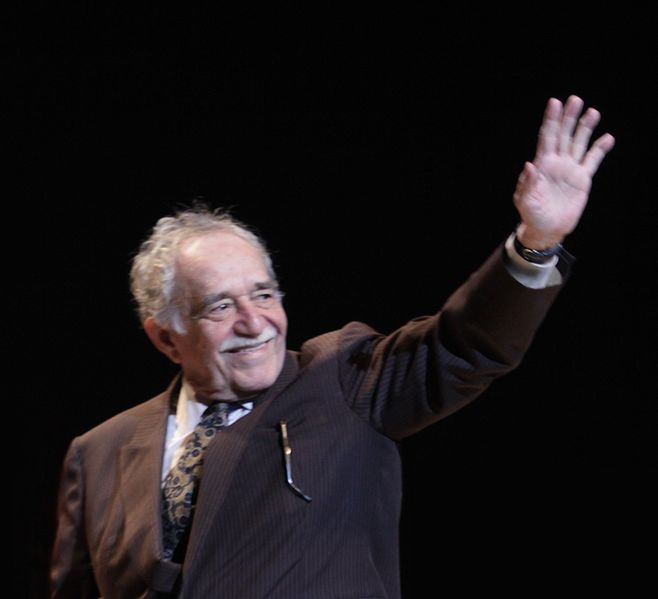
The creative heritage of Gabriel Garcia Marquez and the experience of reading his Russian -speaking reader Radio Liberty is talking with the Moscow literary critic, sociologist and translator Boris Dubin.
- What, first of all, is interesting Marquez - verbal scribble, a way of transforming reality into its "magical realism", the plot construction of novels, the ideology of creativity?
-Regarding the influence of ideology on the work of Marquez, I will not say anything, he is still an artist, first of all. Moreover, an artist of such scale that reduces “any” any ideological preferences, in particular, his friendship with Cuban leaders and the support of Cuba. This is just one side of his personality, but far from the most important. Of course, Marquez is an artist first of all, who created his world in any sense of the word; He invented the earth inhabited people, invented plots that unite and disconnect these people. Marquez created for this optics, poetics, style, which found recognition around the world. Of course, Marquez was one of the crests of the wave that caused the Latin American boom in the world literature in the late 1950s-early 60s. But mostly this wave, these achievements of the Latin American novel at that time, perhaps, were associated primarily with his name, and first of all - with the novel "A Hundred Years of Loneliness".
Moreover, the name of Marquez is associated with magical realism, he was an extremely diverse writer in a creative manner. The “chronicle of declared death” is not the same literary “story” that “one hundred years of loneliness”, and in the novel “Nobody writes to the Colonel,” is not the same poetics at all in the “Autumn of the Patriarch”. Marquez also possessed very large breadth, a variety of abilities. In many ways, he discovered Latin America for the world reader, I think that before him the prevailing part of the reader of the Earth’s population simply did not know what Columbia was. Markes has huge merits in the general cultural sense and in the sense of literary; The merits, which, of course, go far beyond the limits of Latin American literature and Spanish.
-The birth of the School of the Latin American novel is nevertheless caused not only by the fact of the appearance of the generation of talented writers, but also by the public circumstances of the post-war period: the growth of the left movement, partly-the anti-American struggle, the Cuban revolution, the liberalization of the Catholic Church. In general, it was a powerful renewal movement, closely related to politics. Marquez has always remained a politicized person, for many years he was simply a political journalist. Is it really not influenced by his work? Or a genius above such circumstances?
- You can say so. At least, a genius is wider and further than a momentary policy. I think that Marquez saw a lot in Cuba, I saw quite adequately, quite insightfully. The sympathy for the personality of Fidel and to one of the figures of the Cuban Revolution, some considerations of Polits and many other circumstances, of course, affected. But then the world was different then - the “left wave” swept during this period not only in Latin America, it raged both in Europe and in the USA. But this movement has subsided - and Marquez remained. Moreover, not only the Marquez, who wrote on the crest of the left wave, but also the one that was after it, up to the book “Remembering my unfortunate whores” and completely late works. Probably, this is the essence of high literature: it surpasses the person who makes it, in this sense, Marquez as an artist is much wider, more powerful, more interesting, than his reports on the festival of youth and students in Moscow or about the Cuban Revolution (moreover, in both there are a lot of Markes skills, his eyes, his feelings, his words, his understanding of man).
- Marquez left behind literary heirs?
Marquez gives some light of benevolence and warmth, maybe even Latin American ardor, but the heat of a favorable, not scorching the reader- I would say that Marquez in this sense has a different way of influence: not a chain of writers who follow him, but rather, the radiation of his literature in different directions. Perhaps I wouldn’t point a finger at anyone specifically - they say, here is the person who inherited the creative manner of Marquez and continues his business. But the fact that Markes brought literature in the "hundred years of loneliness" and in "Autumn of the Patriarch" (with a large difference in the poetics of these two novels), of course, was absorbed into the flesh and blood of Latin American literature. Now this influence of Marquez is already impossible to extract from the gut of Latin American literature. Marquez and in one other respect played a special role: the role, on the one hand, is a local, local writer, tied to his land and to its small piece, and on the other hand, the role of the writer is completely universal. No one else was able to connect the local and global.
- When you read difficult prose in someone else's language, it happens that it seems to draw you inside you. You can even not understand the meanings of individual words, but you are imbued with the essence, fabric of the text. And it happens that a complex language rejects the reader, you cannot get through the linguistic system.
- I, like thousands of Soviet and Russian readers, were lucky, I received Marquez in Russian. I was just starting to flounder in Spanish then. But Marquez had wonderful translators into Russian, alas, almost all of them are not among us - Valery Stolbov, Ella Braginskaya, and Lyudmila Sinyavskaya, not so long ago died in Spain. The fact that I tried from Marquez to read in Spanish, I did not reject me, did not cause either language or any other rejection. Not every writer is beam with such cordiality, openness and so easily accepts the audience, inside his language. In this sense, Marquez gives some light of benevolence and warmth, maybe even Latin American ardor, but the heat of a favorable, not scorching the reader. This, of course, causes a grateful sense of the reader who understands that he is not indifferent to the author, on the contrary, that the author of his hospitably invites and accepts. This is a strong magical feature of Marquez. I think she is not alone, but in many ways she will keep attention to Marquez for a long time, ”says literary critic and translator Boris Dubin.
Fragment of the final issue of the Freedom Time program