
Translated material
Marquez in the USSR
Our university years-the beginning of the eighties-coincided with the Latin American boom, and among classmates-philologists there was a joke: "Who do you love more, Borges or Cortasara?" - "Markes!" The names of the “Holy Trinity” could change places, but the author of the “hundred years of loneliness” most often found himself not in the question, but in the answer. His bewitching and angry novel, who came to Russia in the magnificent translation of Valery Stolbov and Nina Butyrina, was read as a poem - in one breath. He became not just a bestseller, but a password of an entire generation, which will no longer be surprised - having lived a whole century with Macondo - when the Soviet empire will be “swept off the face of the earth with a hurricane”, but not “erased from the memory of people”.
In 1990, McDonald's opened in Moscow on Pushkinskaya Square, and the first Coca-Cola advertisement in the country was lit over it. Carnavia honestly final of the era, captured in the non-prospectively correlated stitches of Garcia Marquez “USSR: 22,400,000 square kilometers without a single advertising of Coca-Cola!”, We gathered by Markesomans and went to the Druzhnaya Station Park. There, in 1957, a thirty -year -old Colombian, a delegate of the international festival of youth and students, planted a tree. The idea of a spontaneous performance was to lay a bouquet of yellow roses (the favorite flower of Markes) at that very tree. Of course, the right path will pave intuition, but in extreme cases, flowers can be handed to Cervantes - this is the benefit of the only monument to a monument to a foreign writer in the same park, and “a hundred years of loneliness” has long christened the “Don Quixote” of the twentieth century. They had fun, threw up quotes, someone assured that this spreading linden-well, just the spilled chestnut of Jose Arcadio Baendia, but then a flock of spring butterflies of lemonets flew from the next crown. Yellow butterflies are a clear sign from the wise gabo ... The tree was unanimously decided to consider the very same. On the way to the subway, someone shouted: "Look into the puddles, a goldfish suddenly emerges." The text “A hundred years” firmly grown in our lives - “Golden Fish” first called in the memory of Aureliano Buendia, and only then the Pushkin fairy tale.
The phenomenon of “one hundred years of loneliness” coincided with the most important shift of Russian consciousness. The last times of the USSR fell to us: Mirages of history crumbled with “foliage”, life froze in bad time, and the letters did not reach not only the colonel. Everything seemed painful to friends: trains with corpses that were not; sleepy disease erasing memory; orders to paint all houses in blue; generals and patriarchs. But gradually historical parallels faded into the background, as a “transparent or ghostly” city, and the main mythological reality itself turned out to be the main model of being, where any “large village”, from Moscow to the outskirts of the universe, is akin to the “World War” Macondo, and there will be its distillation cube of Melkiades on any history.
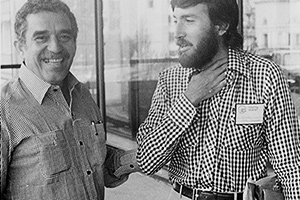
In the mid-80s, I was visiting the translator Ella Braginskaya. Behind the glass of the book shelf there was a photograph: Ella and Marquez were talking sweetly. What is the surrealism. “Yes, this is visiting Vera Kuteshchikova and Leo Ospnat, in 1979, he was then tired of talking about creative plans and asked how potatoes are boiled in us. Well, let's discuss folk recipes with him. Then his eyes lit up ... ”Then Marquez told Ella how his whole family“ sat on potatoes ”, while he wrote“ a hundred years of loneliness ”, and in order to send the manuscript to the publisher, he needed 160 pesos, and he had only 80, and had to be attributed to the hair dryer and a mixer. The patient’s wife Mercedes sighed: “It wasn’t enough for the novel to be bad” ... The amazing frames of this first “writer” visit to Marquez to the USSR were preserved by Yuri Grading, a consultant to the Writers' Union in Latin American literature. He accompanied Marquez with the family and, fortunately, did not part with the camera: meeting at the airport, Yevtushenko, autographs, Pushkin Museum, dinner with the Spanies, and a meeting in the editorial office of Latin America magazine. It was in this journal that in 1982 the only “pirate” Soviet edition of Marquez was published - the writer personally allowed Lyudmila Sinyanskaya to publish the translation of “the history of one death that was known in advance”.
In the third - and the last - since Garcia Marquez arrived in the USSR in 1987 at the Moscow Film Festival. He refused to go to the “heap” (his own expression), but the promised meeting with Gorbachev “hooked” the promised. The result of the interview was the verdict of Marquez: "You have not yet had such a smart, such large -scale leader." Gorbachev’s scale left a special trace in my Marquez history. At the Film Festival, I worked with the Spanish delegation, we had dinner at the Russia hotel, looking at the slogan “Communism is the Soviet government plus electrification of the whole country”, which flaunted at the CHPs opposite. Producer Enrique Gonzalem Machu, now the president of the Spanish film academy, waved his hand, and his familiar rather gloomy appearance joined us. I continued the story of mathematical operations with the slogan and the dream of living in “electrification”: communism minus Soviet power, you can’t think of it better. The gloomy Spaniard laughed with everyone, his eyes “turned on”, he said that he had not seen a more crazy hotel in his life and if private entrepreneurship allowed the USSR, he would have established a taxi service to transport guests along the corridors. He apologized that he was tired, that he had just had an unbearably officiary press conference, said goodbye. The Spaniards started talking about unsuccessful Markes films, and only then I realized that it was him. The story of one phenomenon that was not known about in advance. I remembered Ella Braginskaya and about potatoes.
In 2012, three times the anniversary for Marquez - 85 years since the birth of 45 years old, the novel “A Hundred Years of Loneliness” and 30 years of the Nobel Prize - at the Servantes Institute, we decided to expose the work of modern Russian artists based on the novel “A Hundred Years of Loneliness”. Honored artists responded immediately, but surprised the reaction of the young, who took up the novel after our invitation to participate in the exhibition: "The book is some kind of strange, did not capture ... tiring, exhausting." The problem of fathers and children? The answer was simple and sad. The first, classic translation of the novel “A Hundred Years of Loneliness” was created by Valery Stolbov and Nina Butyrina. They worked on the most difficult text for several years, all the objects in their house received the names of the heroes of the novel: the armchair of Ursula, the massive buffet Aureliano Buendia, with the characters - and about them - they talked constantly, honing the rhythm and style. This text, naturally and poeticly sounding in Russian, became “thus Marquez” for several generations. In his first publications there was a number of bills in erotic scenes, but then the missing text was restored. And in 1997, the Rusiko publishing house prints a new translation by Margarita by the Holyskina with an amazing subtitle: “A complete translation from Spanish.” The author of the new translation accompanies the publication of articles in the press about imperfections and sins of the previous one, and also reports to the literary agent of Marquez that the novel was previously printed in the Soviet cut -out translation and only now the errors have been corrected. As a result, when the AST publishing house finally acquires the legal rights to Markess’s publications, the novel “A Hundred Years of Loneliness” is printed only in the translation of Margarita Bylinkina. There is no place for a detailed analysis of blunders and errors with whom it does not happen. The tragedy in the main thing is in intonation and in the stylistic register. Recall the scene of the death of Remedios the Beautiful, causing love and bearing the death of it loved by it. Nina Butyrina and Valery Stolbova: "Storemen who ran to the noise from the dining room and hastened to take away the corpse, noticed that his skin exudes the stunning smell of Remedios Beautiful." Margarita Bylankina’s: “The rest of the uninvited guests, having heard a terrible noise, rushed from the dining room, raised a corpse and immediately caught how much the spirit of Remedios beautiful from him.” In the same translation, instead of “goosebumps” (the text of the original) - “flesh that has been puffed and burned.” The Marquez prose has a poetic, musical nature, the voice of an epic storyteller, archaic and fearless, sounds in it. Therefore, the erotic texts, especially “embedded” in the “full translation” of Margarita Bylankina, were in the first translation of Nina Butyrina and Valery Stolbov with a stylistic revelation for Russian literature. Garcia Marquez himself warned: “I always wanted this book to have a poetic value rather than the narrative” .... The Caribbean Mozart fascinates the reader, and if this does not happen, if the tonality of speech is lost, then even a “hundred years of loneliness” may seem “tiring and exhausting” reading. So the romance so far needs to be sought not in bookstores, but only in libraries, in the old translation. Although the AST publishing house confirmed that the model of the “new old” transfer is already ready and soon it appeared on sale.
A few years ago, in Guatemala, I came across a piece of ice at the beach bar. The block lay on a hot sand, shimmering in a cloud of steam. Here they are, “goosebumps” ... “It will take many years, and Colonel Aureliano Buendia, standing against the wall in anticipation of the execution, will remember that distant evening when his father took him to look at the ice.” There is nothing more natural than a miracle. To the question, asked in 1979 in the editorial office of the magazine "Latin America": "What do you believe: in magical realism or in the magic of literature?" - Garcia Marquez replied: "I believe in the magic of real life." May the inspired loneliness with one with cockerels of Ursula, goldfish Aureliano, the aroma of Remedios and the parchments of Melkiades will be inspired.