
Translated material
Andrey Sarabyanov: "Some articles will seem funny"
- Is the third volume the end of completion?
- The work goes and is gradually approaching the end, in the fall we will publish the third volume. In quotation marks are “third”, because there will actually be two.
- Two third?
- It's like a snowball that flies and becomes more and more as they move. We stated that this encyclopedia in three volumes, so we cannot say that we have four volumes. There will be the third volume, the first book and the second book. Too many material, even have to cut the number of illustrations, otherwise two more volumes could be made.
- Cut in favor of the text?
-Yes, in favor of information, because as they are introduced into the material, some new things are discovered, which were not known about. We have to read various sources - for example, old newspapers and magazines. They have new information. Say, I recently leafed through the newspaper “Fine Arts” for 1919, which was in a dilapidated form, and found that at that time a group of researchers - artists and art historians, led by Vasily Vasilievich Kandinsky, was organized at that time - in order to publish the Envvanisty Encyclopedia. Imagine! But nothing took place for many reasons: one of them was that Kandinsky himself soon left Russia to Germany. And, in general, the idea died out. But the fact that even then we wanted to do it, and we gathered almost a hundred years later, seemed interesting to me.
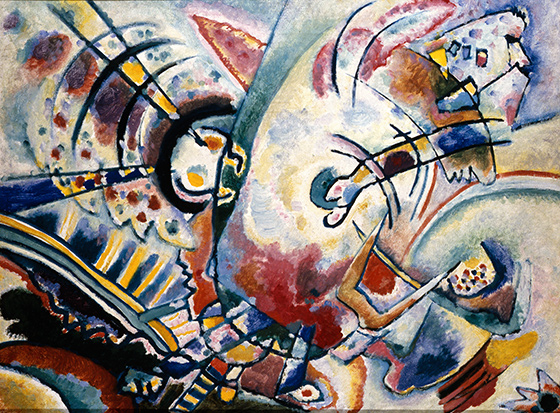 © Krasnodar Art Museum V.V. Kandinsky, "Substantial", 1910
- Apparently, even then they thought that there was enough material?
- Even then, these artists had to formulate the main postulates of their art, they wanted to do it on a scientific basis. Moreover, Kandinsky organized the Institute of Artistic Culture, the so -called Inhuk , the idea was not only to understand art intuitively, but also scientifically explore it. That is why they really needed the encyclopedia.
- Will there be more analytical and critical material, excerpts from historical archives in the third volume?
- Critical is unlikely, what criticism is here! This will be the most complete information about the Russian vanguard. In 1993, there was an exhibition "Great Utopia - Russian Art from 1915 to 1932." An absolutely wonderful exhibition, held in Europe in several cities, in Moscow, in St. Petersburg. The exhibition was published by the catalog, it was a certain stage in the scientific development and understanding of the avant -garde. A very important stage. There was a section where all kinds of information things were included: a list of basic exhibitions, a chronicle of the main events of the avant -garde, biographies of artists, terminology, explanation of terms, and in a word, a kind of vanguard dictionary. When we started our encyclopedia, we took the same principle. But if the first two volumes of our encyclopedia were biographical (that is, biographies of artists from A to Z), then the third volume that will now be published in two books included everything else, that is, art societies, periodicals, various publications, artistic cafes, disputes, society and grouping and much more. Almost every avant -garde exhibition has an article. All this information had to be clarified, because there were a lot of confusion, especially in the dates - when what exhibitions were opened, as they were called. And one more point-in any science there is this: someone one will open something, and everyone begins to borrow from him. And sometimes this is a mistake, and these mistakes are wandering from the catalog to the catalog, from the book to the book, and everyone knows that this is wrong, but still continue to refer to these materials. We decided to deal with this. They clarified a lot, found a lot of new data, but there weren’t without their own mistakes, errors in the first two volumes have already been found.
We stated that this encyclopedia in three volumes, so we cannot say that we have four volumes.
- Actual?
-Yes, some dates are wrong. No wonder all encyclopedias are regularly reprinted, because new information always accumulates, updating is required.
- With this volume, of course, errors cannot be avoided.
- Yes, impossible. It is important that we pulled out some artists out of oblivion, not a word is said about them anywhere, but now the memory is restored.
- And the author’s composition of the third volume differs from the first two?
- It practically does not differ, although in the third volume there are fewer authors than in the first two. But there is also a close -knit group, several dozen specialists who wrote blocks of articles.
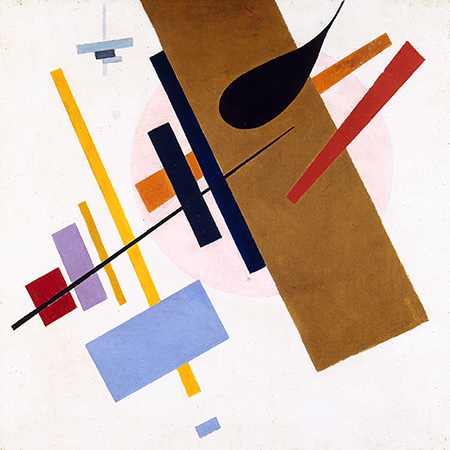 © Krasnodar Art Museum K.S. Malevich, "Suprematism", 1915
-Will there be any analytical analysis or assessment of the heritage of the avant-garde?
-We did not set such global tasks, we still wanted to, first of all, to expand the understanding of the avant-garde, and on the basis of our material we can already draw some analytical conclusions, but already to someone else. Or ourselves, but not in this edition. Still, the encyclopedia is primarily information.
Maybe some articles will seem funny. For example, there is an article about a wooden spoon, a Russian carved wooden spoon, which the peasants drank cabbage soup, ate porridge. This spoon has become a kind of symbol of new art for avant -garde. Here's how it turned out: Malevich in 1914 with his friend, artist Alexei Morgunov , went to the Kuznetsk bridge, they had red wooden spoons in the lapels of the jacket. It was a means of shocking of the bourgeois public, today we would call it a performance. It was at the same time a challenge to the bourgeois society, because then it was customary to wear an orchid, lily of the valley or something else behind the lapel, and they shut up the spoons. On the other hand, it was a symbol of simplicity, because at that time the avant -garde artists declared the return to the primary principles of art, peasant art, children's creativity, non -academic art, which is not taught from the soul. For them, a spoon has become a symbol of new art, simplified and very emotional. And then this spoon began to travel. In 1915, she became a symbol of the whole direction in the art invented by Malevich - alogism. His spoon appears in pictures, in drawings, as well as among other artists. For example, Morgunov writes a picture, it was not preserved, unfortunately, but evidence has been preserved about it. A spoon, a jug, some other objects were depicted there, and the picture was called "Chaliapin went to the bathhouse." This is where alogism manifested itself - the lack of logical meaning!
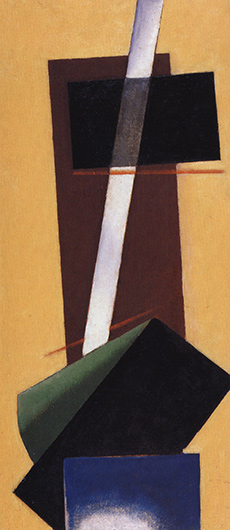 © Vyatka Art Museum A.M. Drodchenko, "Substantial composition No. 8", 1918
- You talked about the article from the 1919 newspaper. Archive materials are published as they were, or just excerpts?
- We try to use the archival material in all articles and refer as much as possible to the original sources, this is very important. Fortunately, we had a large archive in our hands. One of our employees a few years ago, before we started working on the encyclopedia, rummaged through almost the entire press from 1905 to 1917, looked at everything, made photographs, extracts, copies. Thanks to this, it was possible, for example, to clarify many exhibition events, because in those years they were covered in great detail in the press, and not in one newspaper, but in several at once. There were many correspondents who came to the vernissages, so you can set the exact dates of the opening and closing of the exhibition and even identify statistics, how many people have visited, what was sold and for how much.
- And on the Internet you are not planning a publication?
- Be sure to do this. Negotiations are underway, I think that we will live before that. But first, the encyclopedia must be published completely.
Our authors are the best forces that are today, of those who are engaged in the vanguard.
- What is the planning?
- I think the same as it was, - two and a half thousand copies. It is unlikely more. Moreover, the book is so expensive.
- Yes, very (prices for the encyclopedia of the Russian avant -garde range in different stores from 22 to 40 thousand rubles for two volumes. - Ed. )!
- Yes, but, on the other hand, you see, so many money was spent on this, because everything must be paid for everything. We pay fees to the authors, and we transfer books to museums for the right to print reproductions from their works.
- Is it not very profitable?
- This is completely unprofitable, however, we cannot leave museums, especially regional ones, most often not rich at all, they simply cannot afford to buy such books. We give them them. Also, each author necessarily receives a copy of the encyclopedia, regardless of how much he wrote articles and in some volume, one in one volume or twenty in all volumes.
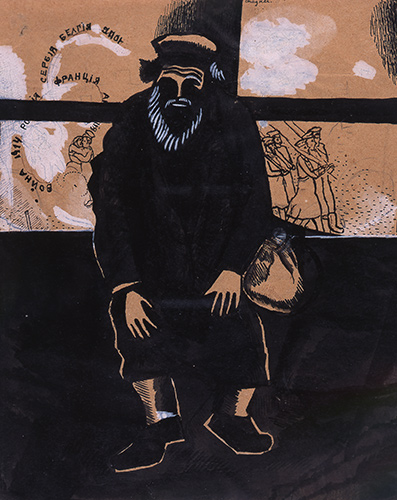 © Krasnodar Art Museum M.Z. Shagal, “War”, 1914
- That is, a few copies will remain in the public domain?
- Yes, there is not so much left for sale, we distribute a significant part. Such activities do not imply any commercial benefit. Maybe then, when it will be published on the Internet. But so far all this is just dreams. The main thing now is to publish the third volume as quickly as possible and make it more compact.
-If you return to the author’s composition, are these mainly museum workers or someone else?
- Museum workers write about museum meetings. But in general, our authors are the best forces that are today, of those who are engaged in the vanguard. By the way, not only art historians: there are philologists and historians - in general, there are a lot of people, everything, I think, will be there for two hundred authors in all volumes. They have a different number of articles, some wrote one at one, others more. All articles are signed, these are copyright texts, and first of all, the author is responsible for the information that is in his article. But we, of course, edited and checked what we could.
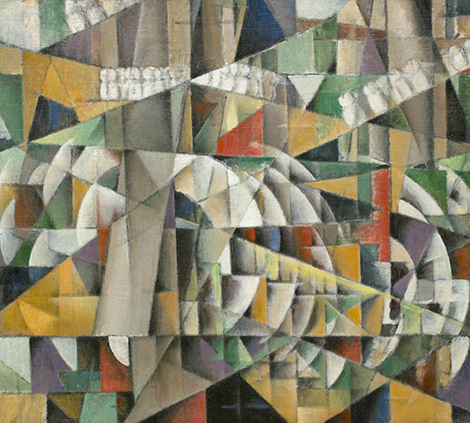 © Vyatka Art Museum I.V. Klyun, “running landscape”, 1914
- Probably, much of what was collected was not included in the final edition?
-Of course, I had to cut something, sometimes there were too large articles, but it was a pity to reduce interesting materials, sometimes completely new, for example, about the connection of music and color.
- Family scientific theories?
- Well, how can I tell you. After all, Kandinsky had the theory about the connection of music and color, at an intuitive level, and later this theory was developed at a more serious level, devices were invented that reflected color harmony in accordance with music. Skryabin wrote music for them.
-Surely about any things will be written for the first time? Will there be many surprises for specialists in the Russian avant -garde?
-We write about something for the first time. For example, about exhibitions that passed abroad. In America, there were exhibitions related to the Russian avant -garde, they know very little about them in Russia.
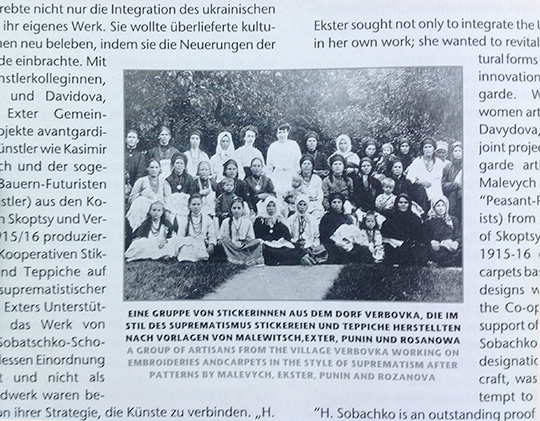 Embroiderer of the village of Verbovka
- Exhibitions of the last century?
-Yes, the 1920s. Then, there is a very interesting material about the connections of folk art and avant -garde, but not in theoretically, but in completely practical. In 1915, there was an exhibition of modern decorative art, at which Suprematic embroidery were represented, that is, silk embroidery according to the sketches of the Suprematists. Sketches were made by Malevich, exter, Rozanova, the most famous avant-garde artists. And the Ukrainian folk embroiderers from the villages of Verbovka and Skoptsy embroidered. They made pillows, towels, towels, ladies' handbags.