
Translated material
Ukraine: What is happening
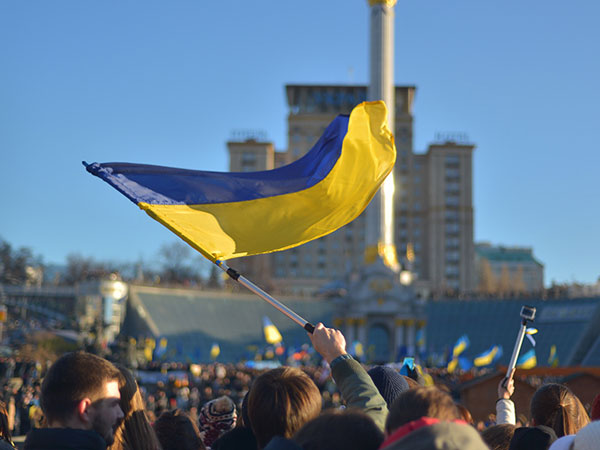
In addition to the local analysis of private events and configurations in Ukraine and in connection with it, on the agenda there is more generally the question of what is happening - and what this can lead to a more global level. Researchers and analysts are trying to offer some conceptual framework. With this text, we begin their review.
The threat of international security
According to political scientist Gerard Roland and economist Yuri Gorodnichenko (California University in Berkeley), the situation with Ukraine is ultimately fraught with the threat of world stability and, as a result, requires international efforts to prevent such a prospect. In this interpretation, a private level represented by the interests of the Russian authorities, and a more general international context, is distinguished.
“The main factor motivating Russian aggression,” the authors believe, “is that Putin seeks to provoke the failure of the February Revolution in Ukraine. For the second time in less than ten years, the Ukrainians rally in order to rebel against corrupt and authoritarian governments. Most Ukrainians, in turn, want to live with high -functional democratic institutions, as in the West. This is the true spirit of the Maidan and the February Revolution ... The success of this revolution is the worst nightmare for Putin, because such a revolution can also be transferred to Russia, where democratic aspirations are hidden behind the screen of the Putin's authoritarian regime. Putin, thus, is ready to go to anything, if only the young Ukrainian democracy did not take place. ”
However, according to the authors, Putin's propaganda did not work. At the same time, the international reaction to these events turned out to be unexpectedly strong, taking into account the insignificant geopolitical role of Ukraine as such, from the point of view of Western countries. The reason, according to analysts, is that the nature of the conflict is not so much in the actual contradictions between Russia and Ukraine, but in a larger clash of international interests. One of the key grounds for this clash is rooted in recent history.
In 1994, Ukraine, following the nuclear disarmament program, voluntarily lost an impressive nuclear arsenal. In response to this, Russia, the USA, the UK, and later also France and China, guaranteed it sovereignty and territorial integrity. Now one of these countries intends to violate obligations, and the intervention of the remaining participants in the agreement is already an issue of international security, which consists in whether the powers related to obligations can resist violators.
“Many countries - including Ukraine - have technical capabilities for the quick creation of nuclear weapons, as well as other types of weapons of mass destruction. If the world becomes more militarized, and the United States and its allies will not demonstrate enough desires or willingness to maintain security guarantees, then the number of armed conflicts at the regional level will increase, the probability of world war will increase with this. The attempt on Crimea can in this sense work as a trigger and entail a whole chain of events that threaten world security. ”
The mechanism of new revolutions
The analyst team Dmitry Dagaev, Natalia Lamberova, Anton Sobolev and Konstantin Sonin proposed a generalizing model to describe the revolutionary movements characteristic in recent years in different countries. The February Revolution in Ukraine, by a number of formal signs, resembles the events of the Arab spring. The revolutions were preceded by numerous spontaneous protests, which actually had no leaders. Coordination was carried out mainly through social networks, and among the protesters there were representatives of various socio-economic groups. This ultimately led to the expulsion of the odious president, but the protests did not stop there. The presence of dissatisfaction with the existing power in the absence of a common positive program also related to the Ukrainian revolution with the Arabic.
The prospects for the development of events based on the results of such revolutions are very unclear, since in none of the relevant countries certainty in their results has not occurred. Nevertheless, the authors offer a model based on four parameters to describe this phenomenon. First of all, the resources spent by protesters are evaluated. Further, the possibilities of odious power in terms of forceful suppression of protests (the more opportunities, the more massive there should be protests to be productive). The third parameter is how the position of the odious leader is different from what his opponents want to see. Finally, the latter is the availability of information about events and, as a result, the size of potential costs for coordination of actions.
Using and measuring these parameters in different combinations, the authors offer a common model to evaluate the results of protests (success/failure) and to predict certain consequences. So, for example, high indicators in the first, second and fourth parameters imply high probability that the revolution does not threaten the leader, even in the case of high indicators in the third parameter (dissatisfaction of public expectations). A decrease in at least one of the three mentioned indicators leads to a reduction in the “stability zone” around the authoritarian leader, that is, increases the likelihood of its exile.
Using this model, the authors establish the following characteristics of the Ukrainian revolution. Firstly, in all respects, it should be considered successful and fraught with repeated protests. The last paragraph is confirmed by the actual presence of protests after the expulsion of Yanukovych. Secondly, taking into account the fact that in terms of unjustified expectations, Yanukovych took a relatively moderate position (with the exception of the proper reaction itself), it is likely that the next leader can give higher indicators in this parameter. Thirdly, due to the spread of social networks, the reduction of military resources and a fairly high level of unemployment, Ukraine is a “zone of instability”. This means that in the future we can expect not the election of the permanent leader, as it was after the Orange Revolution, but the quick change of several leaders.
Redistribution of alliances
A number of authors, interpreting Ukrainian events, emphasize their role in what status some international alliances will have in the future, such as the European Union and NATO. On the one hand, the opinion was expressed that the conflict around Ukraine was a convenient reason for the deployment of a campaign aimed at shaking the European Union. The right -wing nationalist parties of European countries are interested in this, and the Russian authorities are in solid with them. In the least dramatic version, this is an attempt to cause contradictions among European leaders. In the maximum version - this is the complete destruction of the European Union as an alliance.
On the other hand, some analysts focus on the meaning of what is happening for NATO. This point of view is reflected by the editorial column in the journal Spiegel. The authors note that in recent years, often in one form or another, the question raises the question of whether there is any other meaning in the existence of the North Atlantic Alliance. Often it was expressed that this is a relic of the past, which is currently at best useless. After the withdrawal of troops from Afghanistan, this issue rose even sharper. When the Ukrainian conflict flared up, the NATO leadership, according to the authors, rose in spirit, as it saw a new area of activity in this. For NATO, the main motivation is to maintain its significance as an international institution.
At the moment, the position of the alliance has gained weight, as its rhetoric begins to affect relations between states. In particular, the authors note a sharp cooling in the relations between NATO and Moscow, the “provocative” statements of the Secretary General of NATO Rasmussen that there are no obstacles to Ukraine, and, accordingly, an extremely negative reaction to this from the NATO of NATO. Given the relatively weak military security, Germany is least interested in resolving the conflict by force methods or the transition to the Relations of the Cold War, while the Alliance is interested in increasing its international status.