
Translated material
Creative from Medinsky
New cultural policy as a step towards a total state
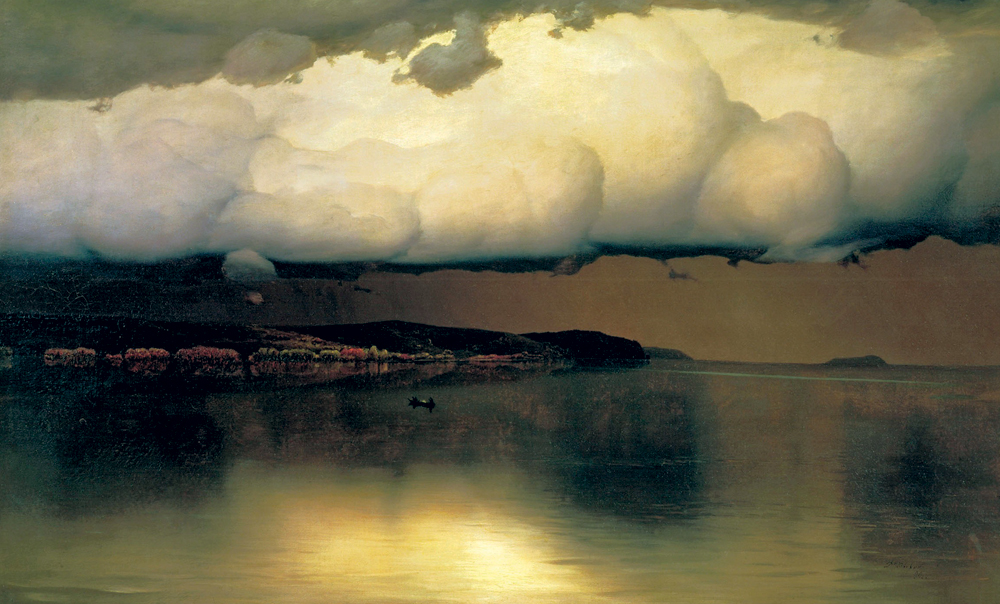
It seems that the clouds are thickening over the domestic culture. "Silent", Nikolai Dubovskaya, 1890 /Illustration: State Russian Museum
The traditional values of VS are non -traditional
Vladimir Medinsky, Minister of Culture of the Russian Federation:
“The image of Yaroslavna from the“ Word of Igor's Regiment ”. Write down? Here is a Russian traditional value. And if you put the opera “Prince Igor”, in which Yaroslavna dances around the pole, masturbates and begs Cox at the Polovtsian khan, this will be the destruction of traditional values.
We write down further. The values of honest service to the Fatherland, fidelity of the oath and fidelity of love, which humble the heart of the most hardened person even during the “Russian rebellion”. This is the "Captain's daughter." And you want to take off his “vision” about how Petrusha Grinev entered into an intimate connection with Pugachev, and the smoking Shvabrin roared him - do not hope for state support. I’ll add from myself - with a rental certificate you will also have problems. ”
From an interview with the newspaper Kommersant, 04/15/2014
| *The project “Fundamentals of State Cultural Policy” is aimed at revising the Presidential Administration |
“Materials and proposals for the project of the Fundamentals of State Cultural Policy”, emerging from the bowels of the Ministry of Culture*, themselves are not of interest. In addition to banalities about Russian (or Russian) cultural identity, commitment to traditional values and such idle talk in the document there is no filling. However, meaninglessness does not cancel the importance of this text, since it marks the milestone in the understanding of Russian statehood. More recently, on February 3, 2014, at a meeting of the Presidium of the Council for Culture and Art, Putin spoke of the need to create a “unified theatrical space” in Russia (the motive for the cultural unity of the nation - axial and for “materials”), but hastened to resort: “I mean, of course, not an ideological content, but the organization of work itself.” But today such a reservation seems completely outdated.
In “Materials and suggestions” we are talking about “consolidating the system of values characteristic of a given society”, that is, it is about ideology. True, this ideology is absolutely vague and is mainly reduced to the assertion that Russia is not Europe. The overall impression of the text is such that his creators would like to somehow outline the Russian cultural identity, but absolutely cannot come up with anything. Yes, we are Christian, we are good, we are conservative, not like anyone. That, in fact, is all. I believe that these empty declarations will not receive any positive content in the future. There is simply absolutely nothing to fill them, except for meaningless phrases about collegiality, love for power and high morality, that is, the same Uvarovsky triad - Orthodoxy, autocracy and nationality. European -educated Slavophiles failed to give the meaning of identity in the past, the less chance of this the second -rate thinkers from the environment of Medinsky.
Destruction of the contract
And yet this document is important. It finally records a departure from the policy of state non -interference to the field of culture. This revision of state policy in the field of culture, which has recently been energetically engaged in Medinsky, testifies to the rejection of ideas about culture as an autonomous social sphere. The idea of the presence of autonomous public spheres is characteristic of a liberal understanding of society. The liberal theory claimed that politics is only one of the spheres of social existence, equivalent to other spheres. For a long time, Putin's policy was based on the principle of separation of spheres. People were made to understand: if you do not go into politics, we (the state) will not go into your business, your private (including sexual) life or culture. It was a kind of unspoken public treaty of the first decade of Putin's rule. Today this agreement is trampled.
Friends and enemies
The philosophical meaning of what is happening can be clarified by a long -standing story. In 1927, one of the most significant critics of liberalism and later one of the creators of the Nazi theory of law Karl Schmitt published the famous book “The concept of political”. In this book, he introduced a “specifically political distinction to which political actions and motives can be reduced - this is a distinction between a friend and the enemy.” Policy for Schmitt is always a way to organize a kind of community (nation) by indicating the enemy of this community. This separation of the “enemy” and “friend” creates “intensity” in society, the tension that the state feeds on. Initially, however, the political area stood out by Schmitt as a separate area. The economy, for example, does not know the “enemy”, but only the “competitor”, the aesthetics also does not know the figure of the enemy and is located in the plane of another opposition - beautiful and ugly.
"
People were made to understand: if you do not go into politics, we (the state) will not go into business, private life or culture
"
| ** In the 1963 canonical edition of 1963, Schmitt reproduced the second edition of 1932 for obvious conjunctural reasons, ignoring the edition of 1933, in which there is too obvious influence of Nazism. |
Schmitt reprinted this book in 1932, and then in 1933, each time with important amendments **. In the period preceding and coinciding with Hitler’s coming to power, the “political” from the autonomous sphere becomes an attitude that permeates all spheres of society. “Total”, according to Schmitt, the state cancels the liberal neutralization and depolitization of the world related to the economy, technology and individual interests of people. Hobbes also believed that the state, establishing peace between people, leads to the emergence of “civilization”, that is, a world in which not war and confrontation reign, but peace and prosperity. Schmitt criticizes the concept of “civilization” because, ultimately, it makes the state unnecessary and leads to the loss of energy of antagonisms. In order to avoid the civilizational path, Schmitt calls on to abandon the understanding of the political sphere: “Political can extract its strength from various spheres of human life, from religious, economic, moral and other opposites; Political does not mean any of its own subject area, but only the degree of intensity of the association or dissociation of people whose motives can be religious, national (in ethnic or in a cultural sense), economic or motives of a different kind, and at different periods they entail different compounds and disconnecting. The real division into groups of friends and enemies is so strong and is of such decisive importance that the non -political opposite at the very moment when it causes such a grouping, pushes its previous criteria and motives to the background: “purely” religious, “purely” economic, “purely” cultural ones - and is subordinate to completely new <...> conditions and conclusions now.
Now, only the political division into enemies and its own gives meaning to culture, determines the degree of its intensity and seriousness. Such a philosophy captures a shift from the liberal Weimar Republic to Nazi totalitarianism. At the same time, she justifies the rejection of the liberal idea of civilization. Culture begins to be thought of as a form of primitive barbarism, that “natural” state in which not peace, but enmity reigned.
Culture as an instrument of struggle
Creative from the Ministry of Culture, these “materials and proposals”, for all their meaninglessness, express the very shift in the understanding of the culture that Schmitt defended in the 1933 publication. The purpose of cultural policy here is the development of cultural values that are able to rally Russian society against other cultures and civilizations, that is, against the “enemy” (it is not by chance that the theorist of the clash of civilizations of Huntington is remembered here). Culture is proclaimed by an instrument of political struggle. At the same time, the autonomy of the social spheres is denied, which all subordinate to the political imperative: “Globalization means not just the mutual influence of cultures, but their confrontation in all spheres-economic, political, cultural, etc. In this confrontation, our main trolley is our unique civilizational identity, expressed in our historical and cultural heritage and in our system of values. Thanks to this identity, the Russian state has survived throughout more than a thousand -year history; Accordingly, the preservation of this identity in conditions of global confrontation is the most important task. ” And among the ones that are supposed to be developed in the future program, it is: “6) external and internal threats that can prevent this [cultural policy], and ways to overcome them. <...> 9) Culture as an instrument of strengthening the domestic political influence of Russia and the achievement of its strategic interests. ”
Russians have proposed a radical manifesto that denies the rights of culture to autonomy, and the individual to freedom of creativity
"
The document has a link to Pskov’s Putin’s Pskov (Putin and one, “Materials” quote as holy scripture), in which the culture is given exclusively political significance. In this speech, in particular, there is a statement not quoted by the authors of the “materials”: “We all understand the huge role that culture plays in the development of Russia, in strengthening its authority, influence in the world, and in maintaining the integrity of our state and national sovereignty. Because if there is no culture, it is not clear at all what sovereignty is, and it is not clear then what to fight for. ” We all recently saw how the national culture was used to affirm the sovereignty over the territory of a neighboring country.
From the cultural code to the Criminal Code
Hence the criticism of tolerance as a typical liberal concept amazing for the cultural program. Tolerance is criticized from the point of view of "the surrender of Russian identity before the systems of values alien to it." The framework of tolerance are determined “based on a single cultural code”, supposedly characterizing the nation. Culture becomes a test for belonging to its own or enemies. In this, the document believes its main task. And this follows the conclusion: “No links to“ freedom of creativity ”and“ national identity ”can justify behavior considered unacceptable from the point of view of the traditional value system for Russia. This does not mean restrictions on freedom of speech and rights of a citizen, but requires refusal to state support to persons and communities who demonstrate behavior contrary to cultural norms. In case of violation of the current legislation and the rights of other citizens to such persons and communities, appropriate preventive measures should be applied. ” The cultural code thus smoothly turns into a criminal code.
The only positive content of “materials and proposals” is the statement of the right of the totalitarian state to consider culture as part of its political sphere, as an instrument of struggle for sovereignty and political hegemony. The Russians proposed a radical manifesto that denies the rights of culture to autonomy, and the individual to freedom of creativity. It is no coincidence that the document especially emphasizes not only the significance of the political unity of the nation, but also the need for the cultural submission of the minority to the majority: “The peoples integrated into the Russian state in the process of its creation accepted this general culture, at the same time abandoning the national culture of national features.” Russian culture should, in principle, become the culture of the Russian ethnic majority. And "the enrichment of Russian culture in cooperation with the cultures of other peoples is permissible only insofar as this does not erode the basic value core of our culture." This idea of the cultural dominance of the majority contradicts the whole history of art, which moved forward loners who entered into the fight against established traditions and “cultural codes”. But not about art and not about culture here, of course, we are talking. The document shows declarative misunderstanding of the mechanisms of the functioning of culture, which, however, is typical of the intellectual activity of experts of the current Ministry of Culture. “Materials and suggestions” should not be perceived as an analyst in culture, but as the brightest evidence of the transformation of the Russian state into a “total state”, as Karl Schmitt loved to express himself. There is simply no other content in them.