
Translated material
Discussions in history can last centuries
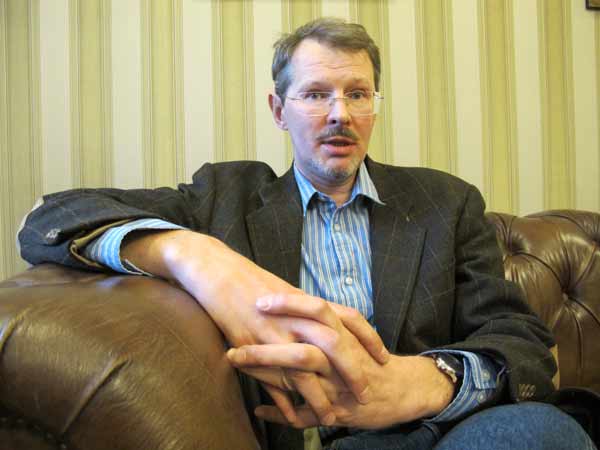
A series of interviews with Ukrainian scientists continues the first part of the interview with Alexei Tolochko , a famous media historian, doctor of historical sciences, member of the National Academy of Sciences of Ukraine, senior researcher at the Institute of History of the National Academy of Sciences of Ukraine. Talked by Natalia Demina.
How did you become a historian? Have you had any choice between history and some other area of science?
In fact, I always wanted to be an archaeologist. My father is an archaeologist, and, of course, I spent my childhood all my childhood, and I spent my student years in archaeological expeditions, and grown there. And therefore, of course, I considered archeology - the most worthy occupation for a man. But the archaeologist did not come out of me, so the next step is a medievist.
And where did you go in childhood, what did you manage to see, what excavations?
I remember the expeditions in childhood vaguely, but already in my student years I constantly went to the Novgorod archaeological expedition, worked at excavations in Novgorod the Great, led by Valentin Lavrentievich Yanin, it was both very interesting and very important experience. It was a very good scientific school. In addition to the fact that some discoveries were constantly made there, there were birch bark letters, it was still customary for senior colleagues to hold weekly seminars at which the finds were made, their interpretation was immediately interpreted, reading many letters.
Did the stall participate in the expeditions?
Then, in the 80s, there was both Andrei Anatolyevich Zaliznyak, and of course he took an active part in reading a letter, precisely in the philological component. Have you been to Novgorod?
I came there, but not for excavations.
For the archeology of Rus', Novgorod is important in that there is a bad climate: damp, wet, disgusting, there are rains, Volkhov nearby, therefore the entire so -called archaeological layer is wet, and the tree is remarkably preserved there. In Southern Rus', where we are now, dry, the tree is decaying, and archeology deals only with the traces of its former life. In Novgorod, all this is preserved remarkably, the XI century tree has been sawn to date the find with dendrochronological methods, it smells. You can even imagine what the estate looked like, what the street looked like. This is a rare place for medieval Slavic-Russian archeology, where all this can not only be represented, but also touch. So for me participation in these expeditions has become a large and serious school. Well, and, of course, to a large extent, therefore, my main specialization was defined as the history of medieval Rus'.
It turns out that archeology has remained a field of your interests?
You see, for the X, XI, XII centuries, archeology and history are very closely connected, since archaeologists interpret the found material finds in the light of written sources, and historians involved in a written history cannot but take into account the discovery of archaeologists. So these are in this medieval world these two specialties are very closely in contact, and, of course, people always step back and back in order to create the right picture of the past.
That is, they act as theorists and experimenters.
Yes, if we draw an analogy from some physical sciences, then these are experimenters and theorists. In addition, history is a science that reads sources, written reports on the past. We know them well and on our present day-newspapers and so on, they are not always honest, not always true, they always have some kind of ideology, some direction. And archaeological sources are silent and therefore reliable. If you are digging something and dating it to the XI century, then this is definitely the XI century. In this sense, archeology is a more firm science than history.
It is easy to go for a medieval author, take his point of view, take his view of the world, and the archaeologist works with what he sees, with the fact that the material is left from the past. In addition, how many sources have we preserved? One, two, three ... We can list them on the fingers. And archaeologists make more and more discoveries, and they have all the new and new mass material, in archeology you can use statistical methods, which is close to natural science disciplines.
Of course, I took part in some Dnieper expeditions here, on the Dnieper. He studied castles, small settlements in Khersones, in Crimea. Having moved from North Novgorod to dry, often hot Chernomorye, he fell into another estim of medieval archeology. The medieval Byzantine Kherson is a city founded by the Greeks and entered this Mediterranean civilization. This is another archeology, a different type of history. These "extreme", these extreme points give quite a lot to understand what Eastern Europe was in the Middle Ages.
Do you have experience not only here, but also in Harvard, how would you assess the state of science in the study of ancient Russia in Ukraine, in Russia and abroad? Is there a lag or are we going at the level?
This is another experience. Here I work at the Institute of History of the Academy of Sciences of Ukraine, and this is a research institute where people explore some topics, write articles, publish books, but do not teach. Harvard is a university where, first of all, I had to teach. And teaching is a completely different type of scientific activity. So if we compare academic and university science, you will turn out a little “apples vs. Orange ".
But Harvard is among the largest, richest research universities. This is not just a school for adults where they are told, and then they repeat what the teacher told them in the exam; This is a teaching and teachers of a slightly different type. Because they, of course, are conducting scientific work and of course they are published, being the largest quantities in their field, including in history. Teaching in Harvard is a completely different type than we are used to in Soviet and post -Soviet universities. There are much less authoritarian didactics, ex Cathedra, when some “immutable truths” are proclaimed, which the student must memorize in pairs and remember all his life.
Of course, there are lectures, in particular, for junior courses. But they occur in the form of a problem discussion. The teacher draws the attention of students to some complex things, students speak out, not always correctly or clever, but try to interpret in the course of business. The teacher leads, directs the discussion, because, among other things, the Anglo -Saxon idea is based on this form of training, what education in the field of Liberal Arts (we would call it humanitarian) should educate critical thinking and grow the value of the critical interpretation of the world in a person. Young people are not taught to "tablets", but are brought up by the ability to interpret an independent interpretation. So Harvard is a completely different experience, and it is difficult to compare with our universities.
I don’t know Russian universities so well, but I think that things are more or less good in the largest of them. Moscow State University, more or less St. Petersburg State University, is now beginning to sound the highest school in the economy. From the Ukrainian situation, all this, of course, differs radically. Even in the largest universities, even at Kiev National University. T. Shevchenko, near which we are now sitting, it differs radically. Because our universities still continue this Soviet tradition, and so far are far from real research universities.
It is clear what this is connected with: with the lack of money, with the unfortunate history of the last twenty years, with the fact that the prestige of science in our country has fallen catastrophically. Not only humanitarian, but also any science - and engineers. Science is a very expensive pleasure requiring huge investments, and therefore requiring the attention of society. It is one thing when a society according to allocation of this money and have first -class science, another, when it believes that it is only for rich countries.
0.3% of the state budget - survive as you want.
Yes. In Ukraine, science began to fulfill the so -called social function. There are some thresholds of organizational efforts, financing, below which science ceases to be innovative. She ceases to bring new knowledge, she ceases to make discoveries, she serves the social needs of society. Namely: to ensure the existence of a sufficient number of teachers in order to gain enough students so that young people spend five to six years not on the street, but in business. It can serve some ideological needs of the government, political regime. It can create a form, imitation that there is both philology and linguistics. But this is quite far from the borders where this science is actually located.
And we know this world level very well, because all disciplines, including humanitarian ones, have become international. Even our, it would seem, such a Russian-Ukrainian discipline as the history of Kievan Rus has become international. There are people who are engaged in this in the USA and France, magazines are published, and we can judge what people who perceive this discipline as research are talking about. We can judge what people who teach this discipline at some provincial Ukrainian University are talking about. And these are completely two different languages, two different approaches to the past.
Can you give an example a topic in which the difference in approaches will be clear?
What is occupied now (if you look at the array of research and articles) of Ukrainian historians in the history of Kievan Rus? They are mainly occupied by the question of whether the Ukrainian was a state or not Ukrainian. Can we consider Kievan Rus and all the acts of the Kyiv princes, all campaigns on Constantinople, Oleg’s shield part of Ukrainian history or not? Of course, we can. And so, a huge amount of literature, which endlessly and tautologically proves that yes, these are our ancestors, this is Ukrainian history.
Meanwhile, such issues are not interested in the research international discipline of the history of Kievan Rus, because scientists have metaphorically live in the XII-XIII century, to Ukraine for another seven centuries, Russia is also quite far from Russia. Retrospectively overturn the future that has not yet taken place, and in its light to begin to perceive the Middle Ages, this, in general, is a violation of the rules of research. People who are professionally engage in this are interested in a completely different type of issues, and they only shrug their shoulders when they are approaching them with the question: “So tell us the truth.”
And what is now in the forefront in the studies of the history of Kievan Rus, what problems worry historians?
Do you know what is the most difficult in any historical discipline, even though this is rarely admitted? In fact, the most difficult thing is source studies. How to read the old text correctly, how to interpret it correctly, how to understand where it came from when it arose? Take the annals - our main source, in fact, thanks to which we know this story of Kievan Rus. “The Tale of Bygone Years” is a complex monument that speaks of the events of the 9th-10th century, and discussions are underway about whether it was written at the beginning of the 12th century. That is, between the past and the moment of its fixation-200-250 years.
Can we believe that the monk in the XII century wrote about the X century? How did he know that? How did he know that? Whether he told us correctly or is it his own ideas about the past, fantasy. There are several rather complex textological theories that are trying to explain how he knew this. Say, he could have previous chronicles, more ancient, which he read and partially transferred to himself. How to find fragments of another in the text of one chronicle?
Can I do such an analysis?
Humanitarians still love to work with less accurate and more vague things, but there is a science of textology, it tries to compare texts, highlight common places in them, analyze where these common places came from. All these are very important things that are still conducting complex and sometimes, it would seem small and a person from the side of not very understandable discussions.
As you know, in Russia last year there were debates associated with the 1150th anniversary of the Russian state. The previous time, such an anniversary was celebrated under Alexander II in 1862, next time in Russia for some reason decided to celebrate this in 2012. The Russian state is taken as a basis for the Varangians in 862. This is evidenced by the "Tale of Bygone Years", which we just talked about. What is it, a historical fact or a myth?
A lot of social ideas resonate here. Is it good that the Varangians founded the state or is it bad? Only with us such a misfortune happened or other medieval states founded the dynasties that came from somewhere? And if this is a myth, legend, a legend describing the formation of this state, then what Kievan Rus was in the 9th-beginning of the 10th century? What was the social nature of this state, what is its original device?
The study of this issue poses a lot of complex and important problems. The humanities do not relate to the Discovery Sciences, as biology, where new discoveries occur, which completely replace what the previous generation was doing, and the new starting point begins with which the researchers go further. History is such a humanitarian discipline where discussions can exist for a hundred years. People can discuss the same, as it seems to them, important things, offering new interpretations that are not necessarily better or worse than the previous ones. We have no experimental criteria to check how it really was, we cannot return and survive the past again. Historians, like philosophers, can still debate about the issues that Plato and Aristotle thought over.
The current situation when we ended up in different states, each of which is trying to build a national history and understand the past in national categories, leaves a strong imprint on what historians think about. They do not have to participate in ideological debate, but, nevertheless, everything that happens around puts the framework for what to pay attention to, what is considered important, as they try to talk about it. So this period is very important.
Eastern Europe was divided into three states, in which there was a medieval Kievan Rus, so "border battles" occur. How to divide this Kievan Rus? Who does she belong to? Maybe to do “honestly”: who now has, he owns them? Last year, such ideas arose at Medvedev’s meetings, they say, let's make such a historical scheme that there is Ladoga - Novgorod, and then the whole history of Rus' immediately flows into Vladimir and Moscow. This was not said aloud, but let's pretend that Kyiv ...
He was not there.
Well, yes. Similarly, we have been undergoing discussions for twenty years to take the south - that which fell into the geographical limits of Ukraine now, the central territories of Kievan Rus. Or claim to Novgorod and Vladimir on Klyazma, because our princes were born here, and they went to rule there. Here, again, we are not talking about the issues that scientists are engaged in the silence of the cabinets and which discipline itself considers to be important for itself, but about those that society, the social atmosphere, our power imposes on historians, and which historians should give some answer.
What is reliable in the history of Ancient Rus'? Is there that we can take for a fact or there is no solid building?
Still, there are some firm things, right? We cannot say that the whole history of medieval Rus' is unreliable, and there is no accurate knowledge about it. There are some more reliable segments of this story. Here is a very simple criterion so as not to go into complexity: the closer the event by the time of its written fixation, the more reliable it is. For example, if a chronicler of the XII century speaks of the 9th century, we may have doubts. But if he talks about his time, it is more or less reliable. We have sources of the XI, XII, XIII centuries, and this is a more recorded time. Plus, again, we talked about archeology, which somehow confirms the conclusions that we draw from the study of written sources, and sometimes strengthens them. So we have quite firmly installed things. But the earliest story is mobile: whether there was a calling of the Varangians, there was no - it was an open question so far.
What do you think?
The Varangians, of course, were. The Scandinavians were here, we absolutely know this. Here, the conclusions of historians and archaeologists coincide, we know this from various sources, including from very important documentary. Of the contracts of Rus' with the Greeks, these are unique documentary sources. The only contracts of Byzantium that have been preserved from the 10th century, by some miracle, came to us in the annals. There are a lot of names of those ambassadors and merchants of Rus' who came to sign these agreements, negotiate, and they are almost all Scandinavian. So from this we can conclude that the elite of this Kyiv state was Scandinavian. But archeology tells us the same thing.
We are now sitting, in fact, on the edge of a huge burial ground, where there is a large number of burials of warriors with very characteristic Scandinavian things. In archeology, a separate discussion is conducted, as far as things are markers of ethnicity - not fashion, not the prestige of social, but ethnicity. But, nevertheless, in these burials a huge number of Scandinavian things that make us understand what it is: a) or Scandinavians, b) or their descendants, c) or people constantly communicating with Scandinavia, where these things come here, far to the south.
There are archaeological monuments in today's Russia. Gnezdovo near Smolensk - a huge burial ground of the Scandinavian appearance. Rurikovo settlement near Novgorod - there is a settlement, a cemetery, a burial ground yet. On the Upper Volga there are several archaeological monuments that make it clear that the Scandinavians were quite active in the 9th-10th centuries. So the preserved written and archaeological monuments convince us that the calling of the Varangians is not only a legend, metaphorically, describing these processes in some kind of poetic plane. In any case, a significant part of the elite of this emerging state education was Scandinavian. So in this sense we know something, we guess about the rest, what we don’t know about, we assume, well, and then the freedom of interpretation begins.
See continuation in Part 2.