
Translated material
Contemplation grain
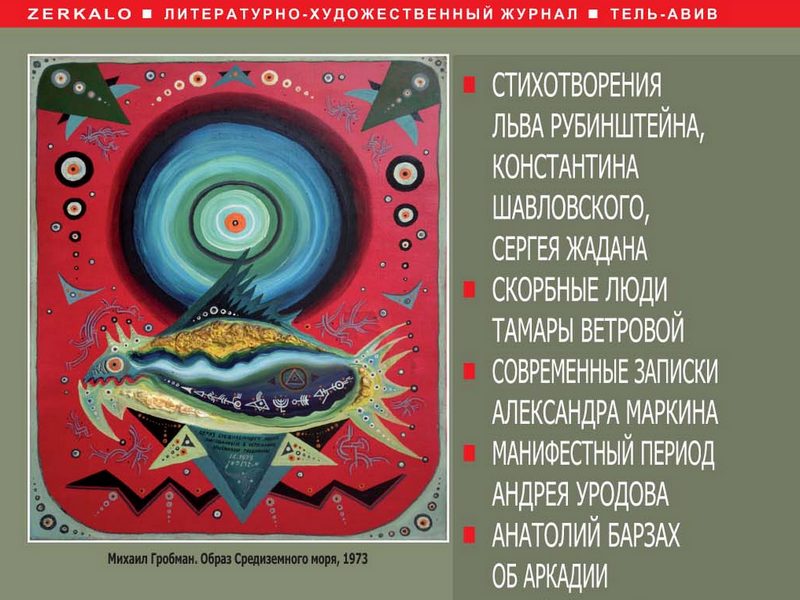
The next two numbers “Mirrors” - the avant -garde magazine, completely strange, reflecting various faces of non -life expression, came out or, let's say, the next two numbers. For most of the local texts, “action” is an abusive word (nishkni, action!), For the form, as the ancient German philosopher claimed, is already the content. The editor-in-chief Irina Vrubel-Golubkina has long been leading its line (Zigzag Grobman) in a given direction, selecting scripts and stanzas to taste-and it turns out granular, icryano, certainly not boring, and for a mighty pile of authors-the only joy.
Number 41
As usual, at first - poems, which is easier for a tired reader's ear.
Nail Yamakova: “The sea licks the curb of the southern tel Aviv, /The trash bin in the windows bursts in the windows ...” Oh, a sweet picture, how you are relatives! .. “Somewhere in the south, the tumor of the Gaza sector, /indifferent sea, the sun is already at zenith. /Eternal clash of the cargo and blue eye, /leading to the complete victory of the carriage, sorry. " I admit on a blue eye - I like it.
Dmitry Vedenyapin: “We went along the highway past the meadow with a distant goat./ The descriptions are meaningless, this is understandable,/ How, for example, Shalamov in Montra, and Nabokov in a pre -trial detention center./ Tomorrow we go back.” Good bucolic poems. Or here: “What if the Jew,” I thought then. -/Jew-man, for some reason, too?/Will you kill him, and it will only be worse .../Although what is the benefit of the Jew? .. ”Either by the verbrome:“ Only five people came to the collection of our poetic section, except me, anticliards, mudillers, Mudyakin, Mudykinko and Mudakov ... ”I think it is mighty of Moscow Miriskia!
Mikhail Grobman: "Lay off the furry paws/ on the bald your head/ Turn into the dirty rags/ plunge into the case of the Neva." Such is the fiery hello to St. Petersburg from the Grobman-a salute to the visionaries! And then - also recognizable: "Snail open your wings/ shake multi -colored mucus/ and in our earthly powerless/ never return." As usual, the Panteist Grobman’s poet has love for our less and aversion to unreasonable sapiens: “When the blue sogdianes/ Arabs with a dope in the pocket/ already appeared in the Golden Sogdiana/ already seemed far away.” Well, further the fool is clear - do not wait until they are near! “So now you understand children/ how dangerous people are on the planet.” If you have not been healed yet, do not yawn, more often read the creations of the cofformalman - see the truth.
Leo is reinforced: “A compressed field. This is where the rain of autumn falls./ Poured for two weeks. Happy Sunday./ Here is the field - the bottom. The fish peck grain./ Birds all drowned. The fish also peck them. And huli?/ Now there is an lake, lake, lake, lake, lake. ”
And here we have a patient reader, still-a mirror, a mirror, a mirror. And in the magical Amalgam of the magazine the past is resurrected: the “diaries” of Igor Kholin arise - reading is really very entertaining, unusual, immersing with the head in the Soviet surreal reality of 1966, on which this avant -garde and creative non -mental unions, as I understand it, was to spit deeply. He lived on his outflow, naoine, gathered a penny on a cooperative closet, and know he wrote in a notebook: “On 25.9.66 he read Rilke. The houses are warm. Surrounded the stove. Tomorrow to Moscow. I read Shershenevich. A strange poet. Original. But some mixture of vulgarity and real poetry. ” And even the next, more lyrical and spaced: “November 23. I woke up in the morning in my room, lit the light. The picture appeared before me. Near the bed of a puddle of vomit. It has my suit and table lamp. Sheets and a duvetel are also in the vomit. At the wall, the cot on which Korotenko is sleeping ... We realized a quarter of vodka and six bottles of beer. " Yes, the poets lived! They wrote - they didn’t walk ... In a word, a sort of echo of Kholin reaches, warmly ringing.
In Pandan, the “Moabit chronicles” of the Moscow Berlinsky Yuri Leiderman are also entertaining hermeneutics. The author stubbornly does not make “a deal with normality”, while enjoys football and is engaged in painting: “It is nice to think about your next works, to hope that they will be even more piercing in their worthlessness.” Good deed, useful. Along the way, I caught a football flea: the famous Liverpool Stephen Jerrard at Leiderman for some reason Gerald (then Musa Galilda is already Moabite!).
Keita Dzin, “Exile of bad dreams” (translation from Japanese Lena Baibikova). Such a good, strong, fleshy, harucular-murable prose: “And here is what I found out: good dreams enter people through the auricle and nostrils, bad ones-seep through the anus (anus) and rise from there in the head, falling into the brain.” Well, we will know.
Valery Aizenberg, "green bread". Moscow is New York, a curvature of space and dassagles of the prison, everyday gravity and the sadness of being, eternal emigrant disorder and impudence, embarrassment and fucking: "I do not need to be thrown into a garbage bag, but directly from the window to the street." Yes, in whole columns, the last wave of emigration should be sent to colonoscopy - obviously bad dreams entered and took possession of!
Nikolai Bokov, “Saturday of the Barbar” is an elegant novel, and not an essay, about one day of the Russian writer, who is now living in Paris. Building on a bicycle - between the Boisonsky forest and the municipal pool, with the tarra of the French forty and the visor of the casual swimmers: “Ah! As life itself, my story was born in the water, from the excitement caused by the ideal ellipse of the hips, from ready to wake up in love. Eros is a lining of all attention, its carrier, motor. At least in this, Dr. F. was not mistaken - and his other fantasies are interesting to read. ” I agree that this same Dr. Faust with his Margaritic throwing was clearly the forerunner of Sigmundism.
Sergey Volchenko, “God forbid” street. Here I am perhaps just vital, humanly (as Leonid Andreev used to say) I will give a quote: “A simple chance that I was not on the lower platform opened by the cold wind, the views and lights of the city, but on the upper one, which was already reliably covered from the world and where the darkness, emptiness, loneliness and horror arose, and they managed to tear my head, and when it was loud, and when it was sobbing and when it was wound I hit the plank floor, despite the darkness, I saw my body from the side, but I could not understand whether it was still alive with my eyes and sees it, or the soul was separated, and I see my soul ... ”No, not in power, I will go three hundred drops of something stronger ...
Valentin Vorobyov, "Naked Valka". The peculiar memories of the artist Robert Rafailovich Falk and many, many other workers of the palette: “The phrase of Khrushch has become a winged phrase: - What kind of daub is? - This is a "naked" falk. - Naked Valka? But who wants to climb such a rolle? " Valentin Vorobyov, describing this nasty joke, passage in the arena, severely irony: "The non-curved fool Nikita-Kukuroznik, like a bear on the voivodship, began to break and destroy historical Russian shrines." Here - "Government Holy", "Millennium collective farm!" However, nearby: “Robert Falk,“ a man of Cezannic nationality, ”rose to such heights of the human spirit, from where the permutations in the Kremlin and the leadership of Isophront were perceived by the mouse of the fuss, the unworthy of the attention of genius.”
Alexander Brener, “Provocation and Culture”. The article printed in Tel Aviv Time Run in 1991: “Postmodernism is one of the stages of a grandiose avant-garde provocation directed to the future. For what can the Kabakovsky communal coffee pot hanging on malevikic infinity lead to? To the Grobmanovsky “forward on Baghdad!”, That is, to that monstrous provocation, which, in fact, is culture. ” Oh, it was a long time, time is running, however, according to rumors, art is forever ...
Alexey Plutzer Sarno, "Pagan Bacchanalia of Ancient Rus'." If you believe the author, this work is an incomplete sketch of the chapter from the book “The Sources and the meaning of Russian drunkenness” - a very timely book, Berdyaev fluores both Berdyaev! .. “Modern ideas about alcohol as a drink that frees a person from the“ reality ”of this world, which gives ecstatic fusion from all over the universe, which gives the illusion of immortality, can be considered as rudiments of pagan rituals.” In the Von, Otkudova, according to Plucer-Sarno, their legs grow and braided!
Victor Osipov, "something more (introduction into the art of conversation)." The philosopher and the writer living in Moscow generously shares his thoughts, indicating that from disgusting reality you can also escape to a sober head: “If the real world is cramped, then the path of the master of conversation lies in imaginary worlds. He inspires interlocutors to create fictions - fictional works of art (mass culture). Almost everyone watches cinema, some read books or play computer games. Interlocutors usually know the main samples of genres and may not be averse to try themselves in creativity, being in a safe game mode. ”
“Optimal society”, Irina Vrubel-Golubkina’s conversation with Arkady Wede living in Paris by a prose writer, philosopher, student of J. Derrida. Conversation for the wide masses of intellectuals. Here again the narrowing reality and the expansion of consciousness are reminiscated: “But what does it mean to be obedient? Do not think about whether our method that we are aware of reality is the only possible and whether this reality itself is the only one. Yes, everyone read about dark matter and additional dimensions ... But these things are too remote from us physically, they seem too inaccessible and obscure ... And we rarely think about the fact that in fact any inaccessibility is quite overcome if we turn to our consciousness. ”
On the facade of the magazine book - the painting "Drucksland" (1974) of conceptualist Michael Druks. The Israeli artist lives in London - such conceptualism, such things. With the covering of the cover-“madhouse” (2002) of the Muscovite Leo (in our opinion, Arya) Phenre-a very picturesque image, lying (non-duke) realism, immobilly climbing from the House of the subconscious.
Number 42
This issue of the "mirror" is visibly different from many previous ones - both the authors are different and the aura is different. However, we recall Georgia Ivanov’s reassuringly: “Mirrors reflect each other, mutually multiplying reflection.”
Leo Rubinstein, "that's all." A verse from 1975, as an old kind, travel card found behind the lining.
Leonid Schwab: "Our sea fits into the acorns/ and schoolgirls throw money into the water/ construction workers are asleep under a white tent/ wind spreads sand." In this spirit above the water.
Stanislav Lvovsky: “Leviathan is trying to problem,/ Lord how to feel sick/ they always return./ (And warm vomiting spills over linoleum).” In general, a Lviv person is a very talented language, his elite texts must be read in the mass, I dare to recommend it.
Konstantin Shavlovsky, "City flowers". A thorough selection of poems, I immediately remembered and made a lawsuist: “I went out a coffin for water/ I shout to him/ I promise to die/ I will see that the living/ this river is not Neva/ words fall in the throat/ Like in a well as a well/ stones over the water, they don’t sleep under water/ on the platform/ on the throne/ leaving Leningrad.”
Sergey Zhadan, “Radio Shanson (eight stories about Yura Zoifer)”, a translation from Ukrainian Elena Fanailova. The poetic cycle, written by the author in 2007 for the Kharkov Theater "Arabesques". Yuri Zoifer (1912, Kharkov - 1939, Buchenwald) - Austrian journalist, poet, actor. In Buchenwald he managed to organize a theater troupe, he died there from typhoid. The author of the camp anthem is "Song about Dachau." Elena Fanailova is recognizable stylistically and believe, adequate to the original of the original: “Your hell, I would say, when you die/ on the street and grab/ havka from your hands, having grunted to bending,/ the end of the world is when you are ramping for three days,/ then you are cut down, and you don’t find anything better than wake up.”
Tamara Vetrova, "mournful people." Very non -trivial prose using how the author notifies, the Nietzschean product "said Zarathustra so." It is not good to absorb the text without seasonings by Herra Friedrich, delicious: “And where in the future, a refrigerator may become, as long as weightless garbage and light mold ... winter mountains in hoarfrost silver film, spurs, lilac air patterns, winter cherries, apples, damn it ... She does not know where meat, ha ha! And with which it was submitted by subtext ... ”There is enough subtext of the wind, to the joy of gourmets, and sometimes he even grabs the soul, yes, as for me, a very successful writing.
Alexander Markin, “Orszh (and/O)/you/the banalities” (from the diary of 2012 - 2013). The writer living in Zurich and the translator moves around the world with a lovely friend, reflecting on the nutryan and the outer: "In Venice with N. The unimportant hotel: out of good, only a huge baroque mirror: while I wash in my soul, n jacking, looking at this mirror." Well, the text, as they say, is the mirror of the magazine, this number. I’ll also notice Zoille about the heading that “chewing” is still written through “e”.
Andrey Urodov, "Manifest period." The youth story about Alex, Marcus and “Cute Lawrence” are easily fluid, flooded with obscene vocabulary and puberty maxims. In the end - everything is like large - the author appears and in the old -fashioned manner of Viktor Olegovich Pelevin explains, "that he wrote all this."
Anatoly Barsah, Cold Dream. Fragments of the correspondence of Barzach himself with Arkady Dragomchenko. I ardently recommend, rarely interesting - “absurd” dialogue, turning into philosophical prose, reasonably built and entailing catharsis: “Yes, I am also inclined to this. Cleansing: neither the reader, nor criticism, literature in the style of smart prayer. ” Hear me, author! ..
Alexander Sobolev, "Anna Gudamanova: Unreleased and unaccounted." The literary critic Alexander Sobolev opens to us (albeit me), lazy and unkindly “missed” the poetess Anna Semenovna Provumanova (1892 - 1960) - in fact, naturally, Anna Priman, who lived in the silver century in Moscow, and then, having given the round through the Emigrant Berlin, in Paris. Poetic products are also given: “The waves of flowering air are languishing with aromas,/ Pale green lace caresses the languid apple tree .../ and trepidable birds, impulsively winged,/ Buds are rocked in it.” Balmont-Severanian unheard of simplicity! I, a great fan of the work of Vasily Travnikov, is ill that if Anna was not Anna, Showmanova, she should have come up with ...
Finally-about the iconic-chartin sides of the cover. In the backyard, in the rearguard - Arkady Greenman, “Lady disappears” (2013). Well, maybe someone somewhere and that (such as Karenin at Astapovo station), but Irina Vrubel-Bolubkina’s credo is always! And just, as always, in the vanguard - Grozny’s husband, Mikhail Grobman with the picture “Image of the Mediterranean Sea” (1973). I like the brush of Scripture of the Granny since ancient times - they beat the brain, approach the head of the head. Dmitry Bavilsky, a thin and exquisite prose writer, recently wrote about the tomb: "A fun and optimistic artist." Yes, like the entire Mirror magazine - read.