
Translated material
After Sochi. City
The second part of the report from the postolimpian Sochi: the transformation of the city, pressure on civilian activists, migrant problems
Continuation of the report of the Radio Liberty from the post -Olympic Sochi: a conversation with civil activist David Khakim, the transformation of the city as a shift in the barrel, migrants left without money.
Sochi - pressure - migrants
To get from peaceful to Sochi, I go to the Olympic Park station - a huge construction of a good modern architecture, which was recently former the main gates of the “coastal cluster” of the Olympics. To the right after the traditional fence is the construction of stands for the new Formula 1 highway, which resemble Sambadr in Rio de Janeiro. In his entire finished wall, the wall says: "Russia. New. Open." A person in a Cossack uniform, on duty at the framework of a metal detector at the entrance to the station building, waves his hand - "go through". Rising on an escalator to a huge hall, I look forward to a half -hour trip 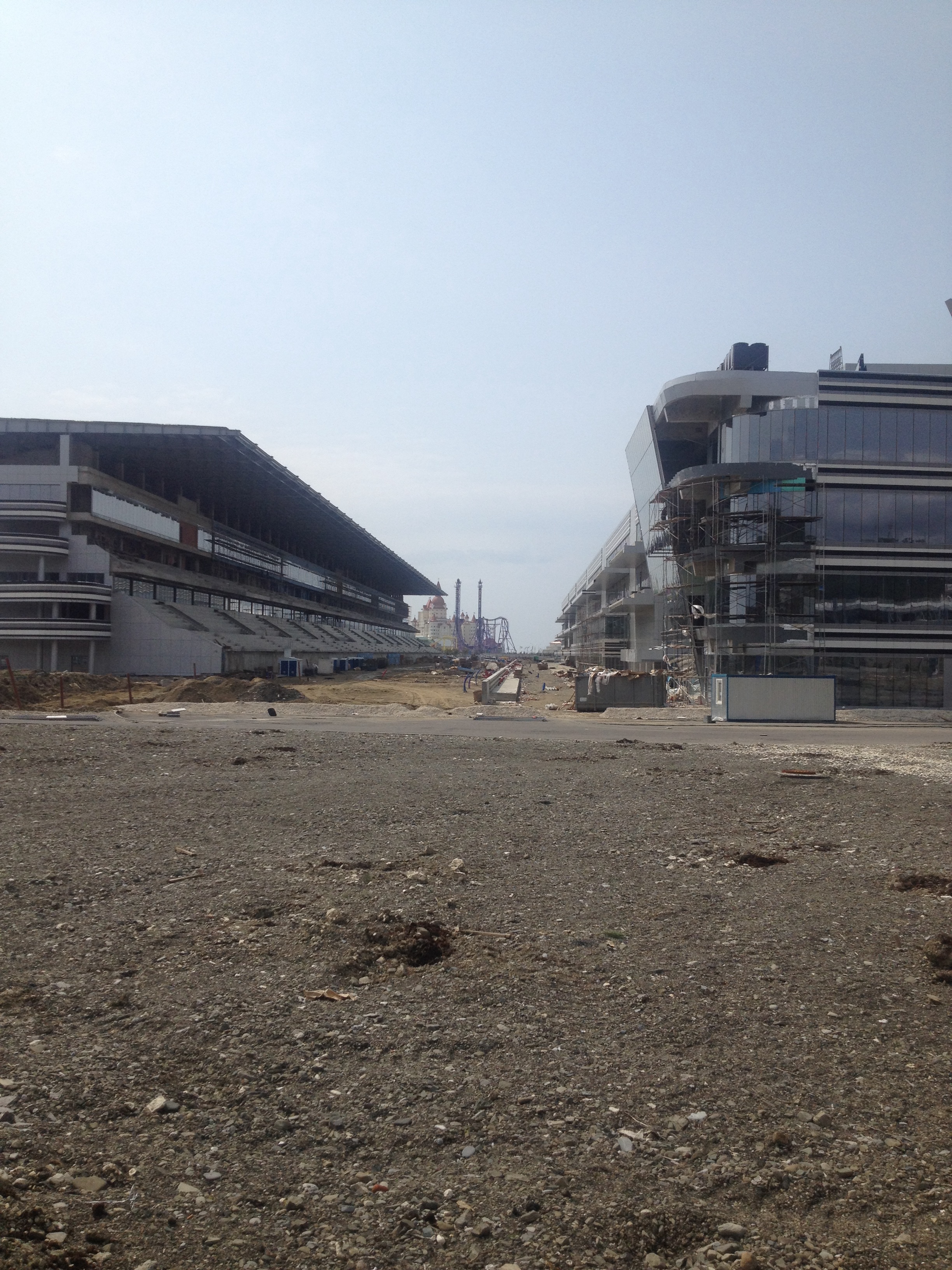
More and more passengers are stuffed at frequent stops in a shaking bus - in stuffiness, slowly, from time to time stuck in so far small pre -season traffic jams, we get to the city. For a resident of Russia, there is nothing unusual on such a trip, but it is precisely such everyday life that it is a pity to see in the city where the most expensive in the history of the Olympiad has just passed.
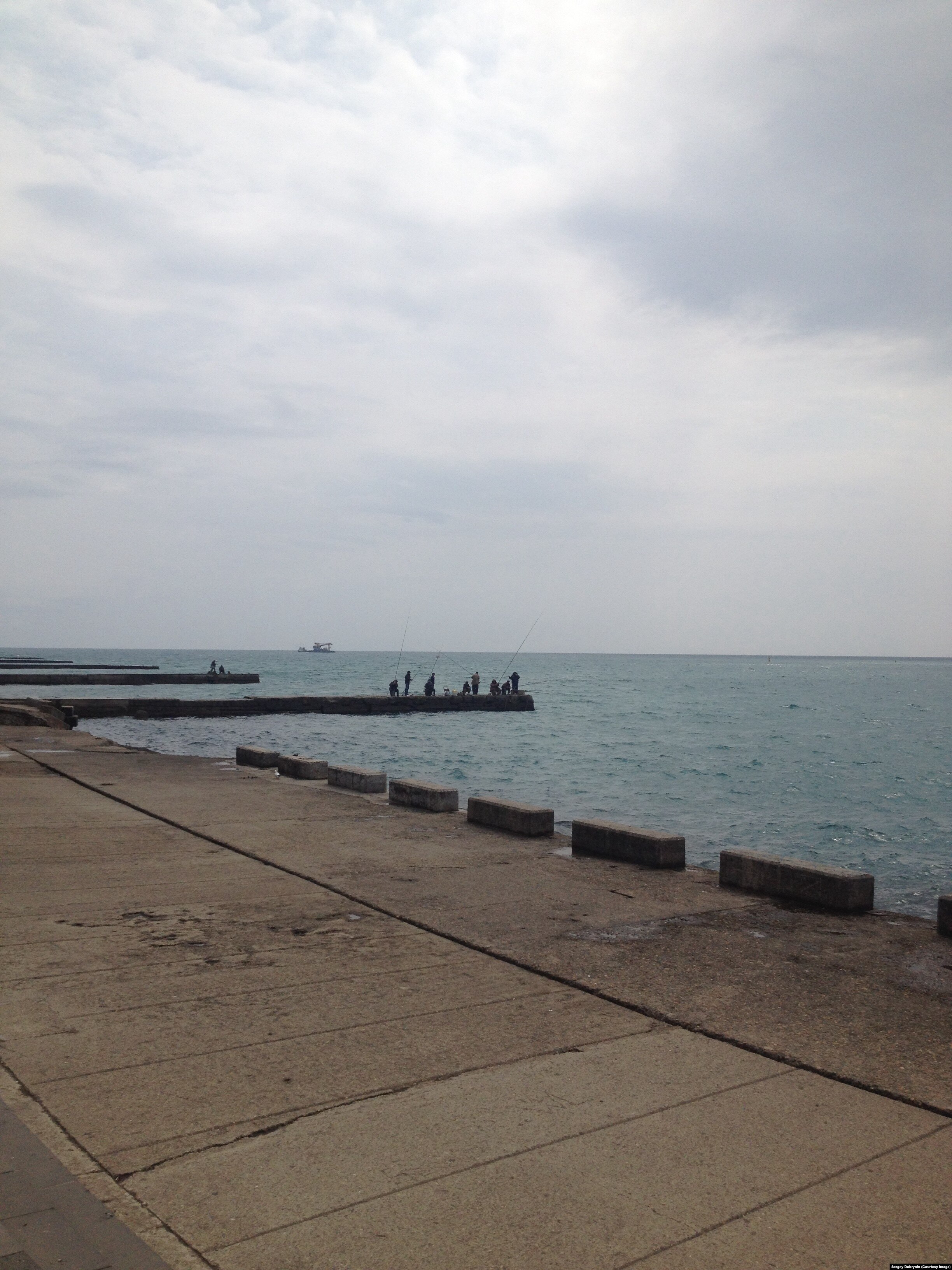
In the Sunny April Sochi, it is surprisingly good and little bitter: parks, boulevards, Empire Soviet sanatoriums drowning in greenery. Here the worker draws out a bamboo grove that grew up on the site of an abandoned ring of a children's railway, here are fishermen, the owners of the coastal strip-in a month or two they will dissolve in a half-naked army of beach. Pure sidewalks, roads with fresh markings, drivers, who are still reading for a long time, apparently, unusual rules for paying for parking. There is a special charm in a slightly sleepy resort off -season. It is most pleasant to observe well-dressed and not in Moscow often smiling and in no hurry citizens.
An hour later, I sit on a bench under a palm tree on a pedestrian street in the very center. We agreed to meet here with the local civilian activist David Khakim. Fifty meters from me - a small square in front of the city hall. Olympic rings are still on the square. It was at this place, right in front of the rings, in the midst of the Olympics (February 17), Hakim stood with a single picket in defense of the Sochi ecologist and public figure Yevgeny Vitishko, convicted of "damage to the fence" - the illegally established fence of the Kuban governor Alexander Tkachev in the Tuapse area. Hakim, an artist by education and a designer by profession, depicted Olympic rings made of barbed wire and a bear with handcuffs in his paw on his poster. However, few guests of the Olympics managed to consider these images: police officers detained David Hakim just a few seconds after the start of the picket.
- I made a poster with the inscription "Freedom to Evgeny Vitishko - an environmental prisoner." He told several friends that I was going to arrange a single picket, called a couple of local journalists. I decided to go to the place on a bicycle, because I thought that if I go by bus and go from the stop on foot, they will be detained before I have time to deploy the poster. It was a reasonable precaution, my friends called me and said that police officers were already waiting for me in the square.
- How did they know?
- Probably my phone is listening. When I had girls from Pussy Riot (on the same days, David accompanied Nadezhda Tolokonnikov and Maria Alekhina in Sochi, they stopped at his house), people from the ED center were on duty near my house. They all had to know about me.
In a word, I arrived, immediately took out a poster. A lot of the press gathered around, ten to fifteen people, there were journalists from the world's leading media. Literally a minute later the police came up, they behaved very culturally in front of the cameras, but they detained for an inconsistent picket. Together with lawyer Alexander Popkov, I was taken to the department, then to the court. According to the law, a single picket does not require approval. The ban on single pickets can 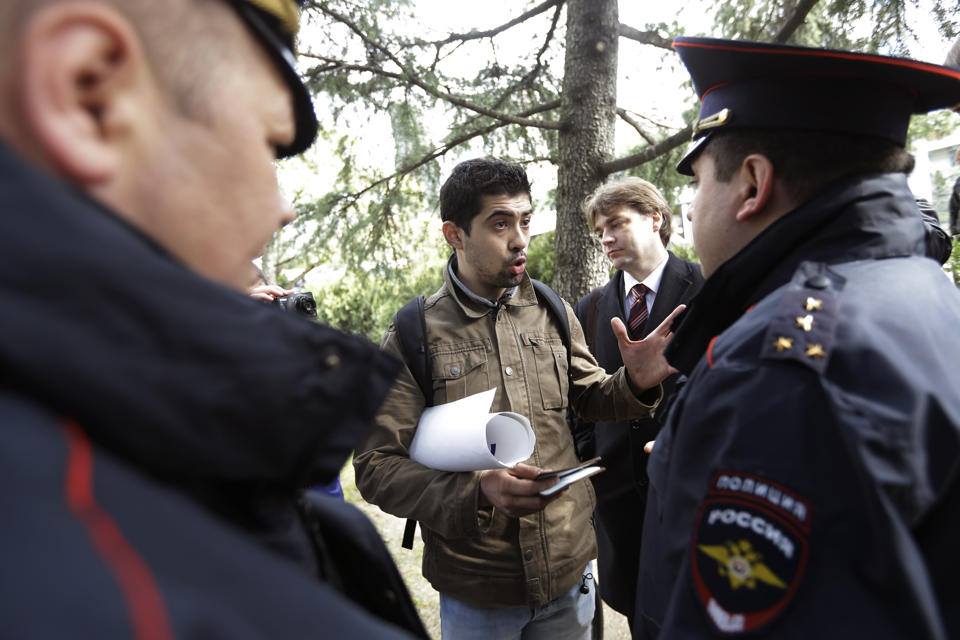
[Already after my return, on April 15, the re -court ordered Khakim to pay a fine of 20 thousand rubles. Hakim and his lawyer Alexander Popkov plan to appeal to this decision].
Hakim and at our meeting comes on a bicycle. He explains that he moves on two wheels not only from physical education reasons:
- For me, traveling by transport and walking around the city on foot, especially not in the center, it is unsafe. The bicycle is less likely that the police will stop.
Police delay Hakim with amazing regularity. On the closing day of the Olympics, he agreed to meet with the Sochi ecologist Olga Noskovets.
“When I came to the place,” Hakim says, “the police immediately approached me, demanded to present documents.” I showed them a passport from my hands, it did not suit them, they began to tear it out of my hands, did not let the lawyer call. They took them by the hands and took it to the car, claiming that I refused to fulfill the legal requirements of police officers. In court, the reason for the detention was named the lack of passport of the fan - this, supposedly, seemed suspicious. As a result, they gave me four days, which I served in a special detention center.
David believes that this was revenge for helping Pussy Riot. The pressure of law enforcement agencies did not stop even after the end of the Olympics. The next time, Khakima was brought by his security security - a bicycle.
- The bicycle broke, and I walked with him, already near the house along my street. The car stopped, a policeman came out of it and demanded to show the passport. They have such a formal occasion that they can doubt the authenticity of documents and on this basis to be taken to the station. On the way in the car, they told me that I was too actively behaving in the city.
Hakim explains that a formal reason for detention is not difficult to find, there would be a desire. The police showed him a focus on a person of about the same age and growth, "Caucasian appearance." Although David has Afghan roots and his appearance cannot be called Caucasian, there was enough that he was not a Slav. “Actually, half a city is suitable for this description,” Hakim rightly remarks.
However, the number of migrants, tens of thousands of which were attracted to work at the Olympic construction projects, began to sharply decline last summer. Semen Simonov , coordinator of the Sochi point of the Migration and Right network, told me that until mid -2013, the migration service looked at foreign workers whose lion's share (according to approximate estimates, about 50 thousand people) did not have work permits and labor contracts, through their fingers. But in June, the first raids began, and in September, the governor of the Krasnodar Territory Tkachev, without restraining in expressions, said that the city was planned to be cleaned from migrants.
“Expelled people,” says Simonov, “will not be able to return to Russia for several years.” And they and many of those who were not deported, but were forced to leave after the end of construction, still have not received any money. The authorities mainly answer our requests that the fact of labor relations has not been established, or that the fact has been established, but the salary was paid. People most likely will not receive anything, and it is very difficult for them to go to court, as a rule, they were not registered.
For these people, without whom there would be no Olympiad, the Sochi aftertaste turned out to be bitter.
- I can’t say what the total amount of debt to the builders, but those who turned only to me should be a total of 35-40 million rubles. Of course, this is far from all, these are only about 700 people out of several thousand, ”says Simonov.
Most of these workers have now returned home. Given the constant raids of the migration service before and during the Olympic Games, it would be very difficult for them to stay in the city. Now, when the Olympics has passed and the “stripping” is over, in many points of the migration service, according to Simonov, there are lines of migrants who want to get work permit, return to Sochi and work here further, despite the risk of not getting any money for it.
“If our bodies do not control the process of employment, paperwork, it will turn out the same - a huge mass of completely disenfranchised people,” Simonov notes.
Both Simonov and Hakim agree that the city itself, thanks to the Olympic Games, has become buried:
- The center has become much more beautiful, although it is difficult for me to judge how much this corresponds to the financial investments made. They defeated the squares, made bike paths in some places, put benches. Infrastructure was built, for example, barrier sidewalks when you can drive around the city on 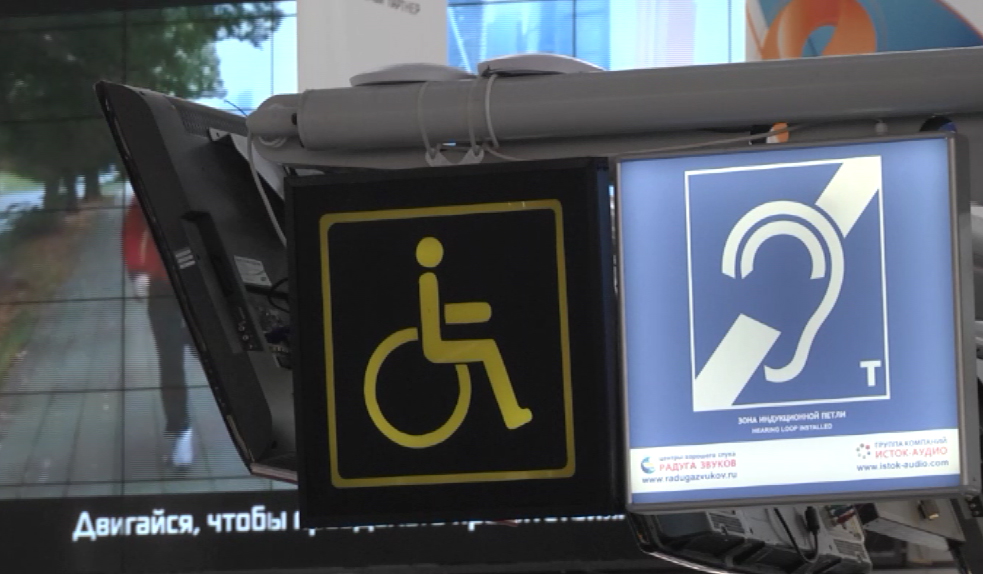
Many improvements were made hastily for the look. Not all ramps, a wheelchair user can rise without outside help.
“Many stores were equipped with special buttons, by clicking on which the disabled person can cause help,” Hakim says, “I heard that in one of the stores such a button turned out to be just a sticker and imitation.
Hakim calls a lot of a show -off and gives another example: public transport stops were equipped with electronic displays. In a good way, GPS transmitters should be installed in the buses, then the actual time of their arrival would be displayed on the scoreboard. "We just show a formal schedule, which, especially in a city with large traffic jams, of course, does not mean anything - it could be written on a piece of paper."
If you ask a taxi driver (is there a best way to find out the opinion of the average citizen?) What has changed in the city for the better, the first he will call a new ring road. The fact is that resort villages around Sochi are strung, like beads, on a single narrow highway, on which, especially in the season, huge traffic jams occurred. Now a bypass highway has appeared, which can at least slightly unload the road situation. However, David has claims to him:
- There are too few trips to the city to the city. For those who need to get from Sochi, for example, to Adler, this is convenient, but it is almost impossible to go around the new road inside the city itself to get from one district to another. Therefore, the townspeople use this road very little. She could very much unload the movement in the city - it would only be necessary to build more congresses.
I tell Khakim that even all the nonsense made with the hasty preparation of the Olympics could not deprive this edge of the main advantage - the nature of incredible beauty.
“Our nature has suffered very much over the years,” he objects.
David invites me to go to the valley of one mountain river near the city.