
Translated material
Bank formation
How to rob customers and not be punished even a ruble
How to rob customers and not be punished even a ruble
If you rob the bank, you will most likely find and put you. But if you are a banker and robbed customers, then in nine cases out of ten you will lose only money. And not because law enforcement agencies will force you to return their legal owners - this will not happen. They will simply take their share and solve all other problems for you.
The Moscow Arbitration Court refused to satisfy the requirement of the Deposit Insurance Agency (DIA) to recover 3.108 billion rubles from the former chairman of the board of Electronics Bank Vladimir Romanov and his deputy Yevgeny Mayorov. The final text of the court decision appeared on April 2. Last Thursday, April 17, the DIA protested the ruling of the Moscow Arbitration Court in the appeal instance.
The story of one bankrupt
The Bank "Electronics" was declared bankrupt on March 6, 2009. After the license of the “electronics” license, the functions of the Provisional Administration of the Bank were entrusted to the DIA, which, in turn, attracted the National Reserve Bank (NRB) to return the money to private customers, whose deposits did not exceed 700 thousand rubles. The NRB returned to 17 thousand private customers Electronics 1.6 billion rubles. To do this, he had to spend his money - about 700 million rubles.
Unsupported clients were less fortunate. According to the DIA, the requirements of more than 1 thousand customers of the bank in the amount of 11.3 billion rubles remained unsatisfied. At the same time, the bank’s unrealized assets remained only 300 million rubles. It is noteworthy that among the customers of the Bank "Electronics" the main victims were enterprises included in the structure of the Ministry of Communications and Rosatom. One and a half dozen banks, including foreign ones, which issued Electronics, interbank loans suffered.
Immediately after the recall of the license from Electronics, specialists of the DIA and NRB began to study banking documents. And they soon came to the conclusion that bankruptcy of the bank occurred not so much due to the financial crisis of 2008, but due to the actions of the top management of the bank and the persons affiliated with it, which withdrew about 10 billion rubles.
The DIA experts found that shortly before the recall of the license, Electronics issued 49 loans worth 3.108 billion rubles. It is noteworthy that all loans were provided for the acquisition of securities - bills. At the same time, the protocols of meetings of the bank’s board on the issuance of loans were signed by Vladimir Romanov and Evgeny Mayorov. During the internal investigation, there was a suspicion that the ex-heads of the "Electronics" signed the protocols alone, and information about borrowers may have signs of falsification. All these circumstances of the DIA set out in a statement of claim submitted to the Moscow Arbitration Court in September last year.
But the arbitration judge Oleg Mishakov, having examined the lawsuit, recorded in the court decision that the arguments that the protocols were “indicated by false information cannot be recognized as reasonable. These circumstances cannot be considered established, since such acts are criminal, and there is no court verdict on this fact. ”
And this is the judge Mishakov is right. There really is no sentence regarding the leaders of the collapsed "electronics".
The criminal prosecution of bankers and their accomplices involved in the withdrawal of assets, ruin and bankruptcy of banks rarely reaches court. Because it is very difficult to prove, for example, the direct connection of the collapse of the bank with the management decisions of bankers on the issuance of unsecured loans to firms with signs of one -day. Or with the ingenious schemes for the sale of non -financial assets, when everything looks quite legal outwardly, but the bank does not receive money from the transaction, and the asset is rapidly moving from hand to hand and after several such transitions is owned by the “conscientious acquirer”.
But even when, as a result of a painstaking study of the documents of a ruined bank, it is possible to find confirmation of the possible involvement of managers in the collapse of a financial and credit organization, it is not always possible to send them to the bench of the defendants. Especially if the corruption factor begins to work and the patrons of the grief bankers manage to ruin criminal cases.
Bankruptcy of the Bank "Electronics", it seems, is from such cases.
At the disposal of Novaya Gazeta were documents, from which it was clearly visible that the Bank was happening immediately before on December 25, 2008, the Central Bank withdrew the electronics license, and three months later the bank was declared bankrupt. And we have the opportunity to make a clear idea of how the bank assets were displayed, how a criminal case was instituted and how it was quietly closed.
Who counted the "Electronics"?
The Chairman of the Board of the NRB Anton Dorokhov is sure that the ex-head of the battery "Electronics" Vladimir Romanov may be involved in the withdrawal of assets:
- It seems that in the actions of Romanov and his accomplices there are all the signs of the crimes provided for in Articles 159 (“Fraud”) and 174 of the Criminal Code of the Russian Federation (“Legalization (Making) of funds or other property acquired by other persons by criminal means”).
The owner of the NRB Alexander Lebedev, in his statements to law enforcement agencies, suggested that the Bank "Electronics" could become a victim of the organized criminal group specializing in illegal financial transactions to withdraw assets. According to Lebedev’s assumption, the criminal “banking” could create in the early 2000s the former head of the operations department in the stock markets of Sberbank Alexander Altunin with the participation of the chairman of the board of “Electronics” Vladimir Romanov. Somewhat later, according to Lebedev, the group also included others. For example, Pavel Luchkin (former Executive Vice President "Electronics") and Igor Redister (ex-armed for Multibank). Firms controlled by these characters were issued huge loans that did not return in the future.
Anton Dorokhov calls specific organizations through whose accounts money was withdrawn:
-This is Overtrade LLC, LLC “Delack MTK”, LLC “FC Rosbytsuuz-Invest” and many others.
How assets were displayed
The scheme used to withdraw money was extremely primitive.
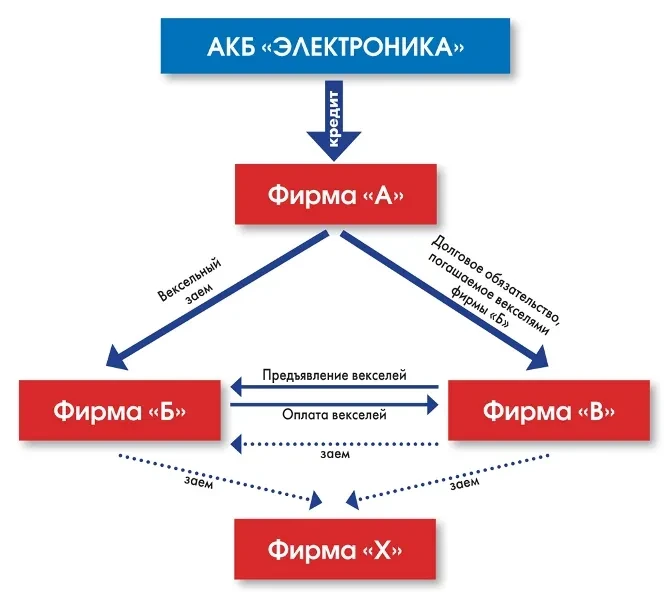
It all started with the registration of one-day firms (the scheme is designated as firm “A”). These firms opened the bank account at Electronics and set the Bank -Client system, which allows you to perform operations on the account, exchange documents and information with the bank without visiting the office of a credit institution. Of course, to open an account, either the personal presence of the client is necessary, or a notarized power of attorney.
But after the recall of the Electronics license, it turned out that most of these companies had fake founders and leaders who seemed to not even know that they were turning a hundred millions of rubles.
The next step-loans were drawn up on the fiction company, which were immediately thrown into the accounts of other enterprises under bill loans ( most of the 49 loans that we have already talked about were issued to these firms. - I.M .) these organizations (the scheme are designated as firm B) could be both legally operating and the same phantoms, both fantasies, like firms "A".
Further, the company “A” under the guise of the supply of non-existent goods or the provision of any services artificially created financial obligations to organizations of the next echelon of a criminal financial scheme (the scheme is designated as firm “B”). The calculations on these obligations were carried out either by the transfer of bills received from the firms included in Group B, or firms from group “A” sent letters to firm “B” asking to pay off the company “A” at the expense of bill loans.
After some time, the company from group “B” presented bills on the debts of the company from group “A”. But to pay off the bills was offered to firms from group “B”. As a rule, companies from group “B” issued new bills, very rarely the calculation was carried out by real money.
Real money was thrown into the accounts of organizations of the next echelon of the financial scheme (the scheme is designated as the company "X").
Since organizations from all four groups opened accounts at the Electronics bank, a powerful cash flow was created. Which allowed Electronics to submit quite decent reports to the Central Bank.
But as a result of the movement of money for a very short time, legally operating organizations from group “X” received financial resources from firms from groups “A”, “B” and “C” at their disposal. However, they did not have any obligations to the "electronics". And the bank had no legal grounds for executing complaints to organizations, except for firms “A”, because the other participants of the scheme formally did not provide any borrowed funds. There was nothing to take from organizations to which loans were originally executed, their accounts were resurrected.
Experts of the DIA and NRB, who analyzed the movement of money, had every reason to assume that organizations included in all four groups of the output of electronics assets were controlled by Alexander Altunin and Vladimir Romanov.
Here are specific examples.
By the time of bankruptcy of the Bank "Electronics", a certain Audit-Omega LLC was supposed to a bank of 437.8 million rubles. Yurservisconsalt LLC owed 438 million rubles, LLC TechnogrammService - 437.8 million rubles, Novy Yakimanka LLC - 70 million rubles. At the same time, the debts of these enterprises were recognized as hopeless, that is, irrevocable.
Formally, Audit-Omega LLC was led by Marina Ovsyuk. According to the “random” coincidence, Ovsyuk part -time worked as a representative of Eurotex Consalting Ltd , registered in the British Virgin Islands. And the final beneficiary of Eurotex consalting Ltd was ... Vladimir Romanov . Romanov himself wrote about this in a letter to Latvian Krājbanka , when, after the bankruptcy of Electronics, in November 2009 he issued a credit line in Latvia for the construction of a cottage village in the Shakhovsky district of the Moscow region.
“Technical School” and LLC Novy Yakimanka can also be associated with Romanov. Because the founder of both companies was the Elim-Invest CJSC, whose founder was Elizabeth Romanov, the wife of the ex-head of Electronics. Maya Filatova, who was completely “accidentally”, was among the founders and leaders of CJSC Kronkus, who owed “Electronics”, 424.5 million rubles among the founders and leaders of Elim-Invest.
Another serious participant in the withdrawal of money "Electronics" is Overtrade LLC. Through the accounts of this company, Bank formation pumped hundreds of millions of rubles. Mainly in transactions with bills. At the same time, no traces of the existence of such an organization could find. When the enterprise’s accounts (including foreign currency) were opened in Electronics, even such documents as a certificate of registration of the company, constituent documents, a certificate of tax registration, copies of documents certifying the individuals of the organization entitled to signature on payment documents were not submitted to the bank.
The accounts of LLC “Overtrade” received money from firms included in group “A”. In return, Overtrade LLC wrote out bills that she assumes obligations to redeem these securities at the first request. The accumulated funds on the accounts of this enterprise were not delayed, but were rapidly thrown into the accounts of LLC “Financial Company Rosbytsuuz-Invest” and LLC Alvoennomezhontijetgroup, which was controlled by Alexander Altunin.
I managed to look into the constituent documents of LLC “Financial Company Rosbytsuuz-Invest” and find out that the company has three founders. 88.06% (40.11 million rubles) of the authorized capital belongs to Alvoenjetroup LLC, 10.98% (5 million rubles) - the wife of Alexander Altunin Olga Vladimirovna and 0.97% - LLC Ordos. In turn, LLC Alvoenjetroup has two founders - Altunin controlled by Altero Limited (99.03%) and IMPENSUS LIMITED (0.97%).
Not accomplices?
The DIA and NRB transferred all the materials of their investigation to law enforcement agencies, and on July 1, 2009, the GSU at the Moscow Central Internal Affairs Directorate opened a criminal case No. 304286 under article 196 of the Criminal Code of the Russian Federation (“deliberate bankruptcy”). The investigation was forced to admit that from October 29, 2007 to October 20, 2008, the bank issued 8.992 billion rubles of loans without security in the form of collateral or guarantee. But the employees of the Mainual could not be found at the place of registration of the company that issued loans. And in March 2013, the criminal case was closed. The press service of the GSU at the Main Directorate of the Main Directorate in Moscow reported that as a result of the examinations, there was no corpus delicti in the actions of the bank’s employees. The investigation did not see or did not want to make out that the money of the "electronics" was withdrawn through organizations that, as we might assume, Altunin and Romanov, controlled. Each participant in the withdrawal of money had his own role. And it would be impossible to turn these dubious operations if the actions of participants in the withdrawal of bank assets were not agreed and the “bank formation” would not have an informal manager.
At the meeting of the Interregional Banking Council at the end of last year, a whole range of measures was proposed to reduce criminal risks in the banking sector. Including the introduction of criminal liability for the falsification of banking and financial statements. But among the huge number of proposals there is no main thing - to consider as an organized criminal group of bankers and their accomplices, together withdrawing assets from banks.
Where is the money?
In the course of searching for assets of Electronics, I managed to find out that at least part of the money withdrawn from Electronics could have been supposedly invested in the construction of a residential complex in Sochi.
Let me remind you: on December 25, 2008, the Central Bank withdrew the Electronics license. And on February 18, 2009, the Sochi city administration issued a “building permit” of the Blue Dali housing complex, located 600 meters from the sea. The resolution was issued at the Zheleznodorozhnaya ZhSK, which back in 1998, on a parity basis, was established by Alexander Altunin, his wife Olga, his father Alexander Ivanovich and the influential Sochi businessman Ushangi Kvashilava.
PS In the course of preparing the publication, I attempted to contact the key heroes of the investigation - Alexander Altunin and Vladimir Romanov. But, according to my information, they went beyond Russia.
Under the text
"Nobody is stealing less than 500 million"
Alexander Lebedev, chief of the Bureau of Investigations of Novaya Gazeta:
- This is not the first and not the last publication of the “new” on the topic of the criminal withdrawal of money from the banking system. There is no reason to believe that the situation has somehow changed recently or that it will improve in the near future.
For example, Vladimir Putin arrives at the FSB college, one of the main topics is the fight against corruption. They offer to use citizens wider in it and even pay them money for identifying corrupt officials.
But listen: each article of “new” about bankers-canorships is actually a statement. And I personally write from myself every time and the actual statement about the crime, but they all go to the same table in the very department where Putin came to the college. Previously, Colonel Frolov was sitting behind him, he was fired, because he discredited the service, but the principle of work did not change.
Moreover, the bankers relaxed and insolent - no one is stealing less than 500 million. The scheme is simple: you collect customer money from the market at high rates, withdraw it and go to rest. Knowing that no one will really look for either you or money.
I constantly call the surnames of the bankers in the media, but for some reason none of them still sued me, neither in Russia, nor in England. Obviously, because everything that I am talking about them is pure true.
Help "New"
At the end of last year, at a meeting of the Interregional Banking Council, a report was announced at the Federation Council on the results of inspections of the Deposit Insurance Agency (DIA). The key conclusion of the report: presumably up to 80% of bankruptcy in the Russian banking system is criminal. But it is extremely rare to bring bankers to justice. According to the Central Bank, in 2005-2013, only 20 former owners and heads of bankrupt banks were brought to criminal liability. And in total five - under Art. 196 of the Criminal Code ("deliberate bankruptcy"). Eight more bankers received deadlines under Art. 159 ("Fraud), six - under Art. 201 ("abuse of authority") and one - under Art. 160 ("Assignment and embezzlement"). In relation to 24 former bankers, the investigation continues.
But over 10 years of the DIA, about 200 criminal cases have initiated the initiation, of which 50 - under Art. 196 of the Criminal Code.