
Translated material
Five years of "Eastern Partnership"
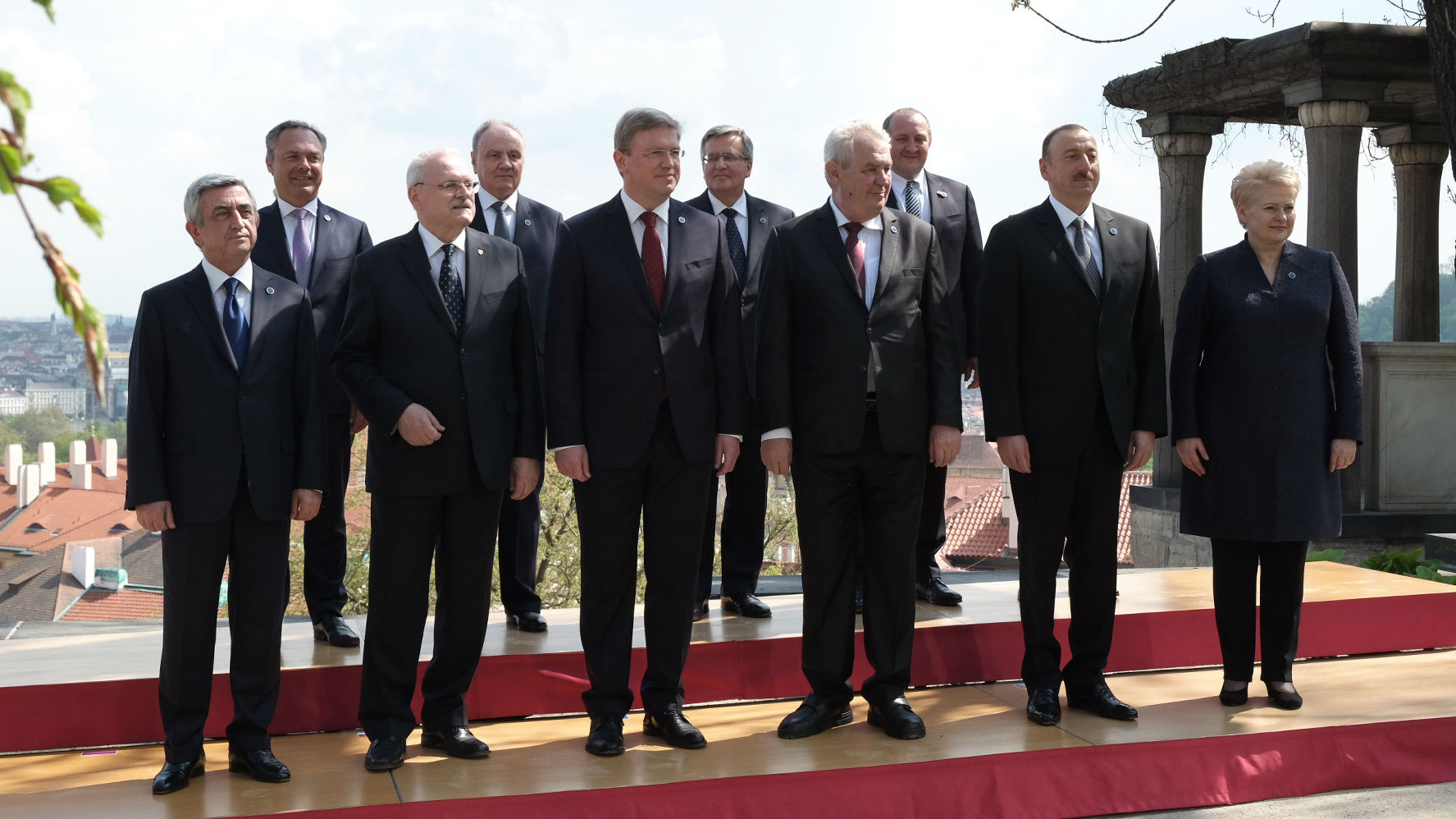
In Prague, the Summit of the EU cooperation program with the countries of the former USSR ended
In Prague, the two -day East Partnership summit was completed, dedicated to the five -year anniversary of the European Union cooperation program with the former republics of the USSR. Participants are representatives of the five states: Azerbaijan, Armenia, Georgia, Moldova and Ukraine, as well as several EU countries - in the final document they made a number of recommendations, primarily relating to the conflict de -escalation in Ukraine.
During a speech on the occasion of the closure of the summit, President of the Czech Republic Milos Zeman said that we are talking about several recommendations. First of all, this is a call to Russia to withdraw troops from the border with Ukraine. Further, we are talking about the recommendations of Ukraine - on the basis of agreements reached in Geneva - to implement a reform aimed at decentralizing power and hold free presidential, and subsequently parliamentary elections, without external pressure and with the participation of international observers.
In addition, Czech diplomats invited Moscow and Kyiv to act as intermediaries in negotiations on the removal of tension in the southeast of Ukraine. As Milos Zeman emphasized, a group of intermediaries could begin work only on condition that both sides support this proposal.
In Prague, it was also about the possibilities of the purchase of gas from Slovakia by Ukraine. Slovak President Ivan Gashparovich confirmed that negotiations on this issue have been completed and the final document will be signed on April 28.
According to President of Poland Bronislav Komorovsky, the annexation of Crimea, as well as the current events in the southeast of Ukraine can be called a kind of punishment by Russia of Ukraine for the desire to establish closer cooperation with the European Union. Participants in the summit see certain parallels in what is happening now and events around Georgia, when she announced her intention to sign an agreement on trade cooperation with the EU. At the same time, the meeting participants noted that what is happening also indicates an increasingly worsening relationship between Russia and the Western world. In these conditions, the EU confirms that it will provide the necessary support to Ukraine and other Eastern Partnership countries.
About what was discussed behind the closed doors of the Prague Summit, in an exclusive interview with RS was told by the European Commissioner for the Expansion and Politics of Good Vedency Stefan Fules :
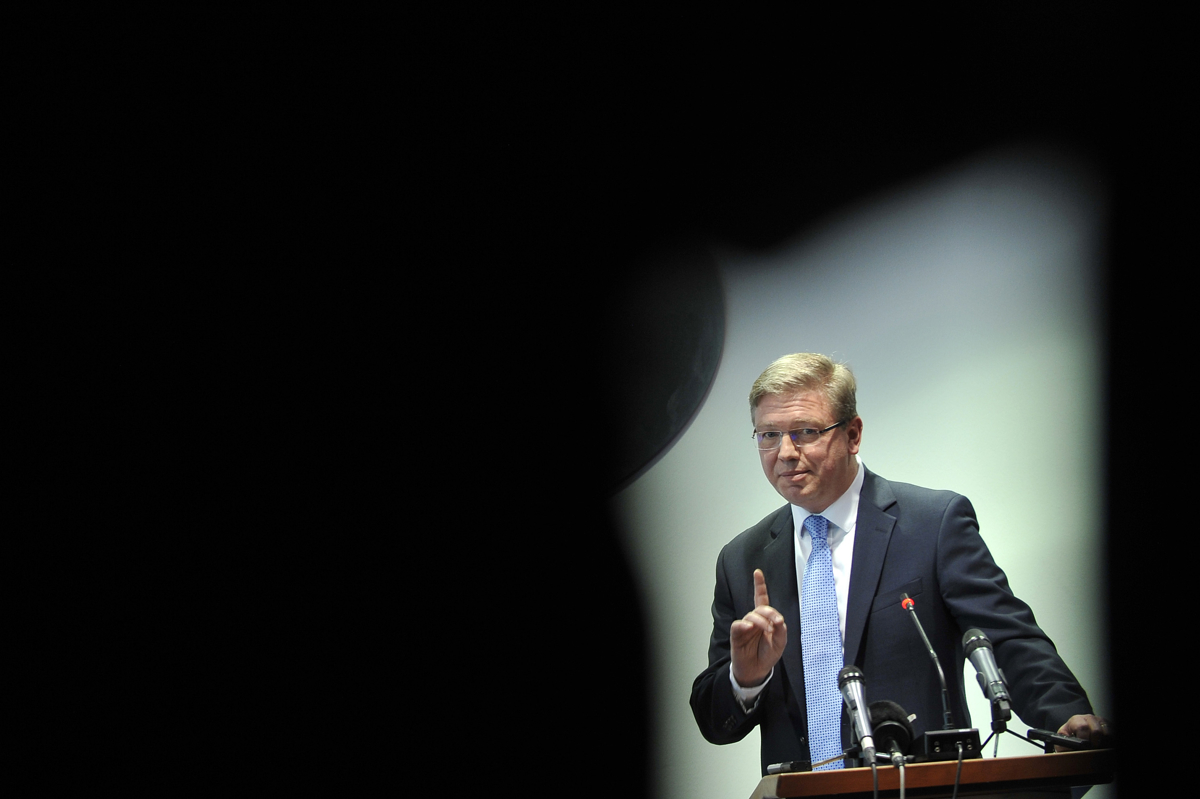
- when it is planned to sign the economic part, an association agreement between the EU and Ukraine. As far as I understand, this agreement was ready even when Viktor Yanukovych refused to sign it. Does this mean that it is only about putting a signature or there will be some more additional agreements?
- No, I think that the decision of the heads of the EU member states is very clear. We decided to divide the procedure for signing the contract into two parts, but the contract remained unchanged. I think that the time you have to use to debunk some myths about this agreement. It is expected that the signing procedure will be completed after the presidential election in Ukraine and it will be held simultaneously with the signing of the Association Agreement with Moldova and Georgia.
- What caused such a sharp reaction of the former president of Ukraine Viktor Yanukovych, which forced him to refuse to sign this agreement?
- He must answer this question himself. I can speak only on two questions that I still have not found the answer. Firstly, why Russia - instead of constructively responding to our proposals to conduct consultations on the economic part of the agreement between Ukraine and Russia - abandoned these consultations and instead decided to impose economic sanctions against Ukraine. The second question is why President Viktor Yanukovych during the last preparations all the time
When I asked why Viktor Yanukovych speaks only to me, and not to Ukrainians, because it primarily concerns them, he answered me: "And this is almost a secret, we do not want to make a big scandal out of this"He expressed his readiness to sign an agreement, and only 10 days before the summit did not speak out against the signing of the contract, but to postpone the signature. I was surprised that he referred to the economic data of the negative impact of measures applied by Russia. When I asked why he talks about this only to me, and not to Ukrainians, because it primarily concerns them, he answered me: "And this is almost a secret, we do not want this to make a big scandal." I told him then that the reaction of Moscow has no basis. In the Association Agreement, there is nothing to in some negatively affect the relationship between Ukraine and Russia. Russia for the EU is a strategic partner. If in such a situation we expected from Ukraine not the same strategic partnership with Russia, there would be no logic in this.
- In other words, do you confirm that Russia refused to take part in bilateral negotiations on the agreement between Ukraine and the EU?
- There were several of these offers. I personally sent an appeal on behalf of the European Commission during a meeting between the European Commission and the Russian government in February last year. Then, during very interesting and very important negotiations for Russia and the EU, we also talked about the "oriental partnership". We openly discussed the issues regarding the agreement on the Association, the Customs Union, as well as the future of the Eurasian Economic Union. We made several oncoming offers, but neither during the course of our discussion, nor after these conversations, there was no reaction either from the Russian Prime Minister or from the government.
This is not only about propaganda, but even about the psychological war that is waged against the Association Agreement
- Do you feel the pressure of Russia not only in Ukraine, but also on other countries that take part in the Eastern Partnership?
- What we hear from our partners, from our friends, speaks not only about propaganda, but even about the psychological war, which is waged against an association agreement.
The situation in Ukraine, not only related to the current crisis, but also other areas of cooperation, discussed two days in Prague city. The day before, a special duty -free regime began to operate in the export of Ukrainian goods in the EU, which will become an additional help (half a billion euro) for the country's economy at the most difficult moment for Ukraine. This regime will be valid until November, but it is expected that by that time the economic part of the association agreement will be signed, which will lay the foundations of long -term trade cooperation of Brussels and Kyiv.
The current meeting is dedicated to the five -year anniversary of the Eastern Partnership program, the beginning of which was announced in 2009 in the Czech Republic, where representatives of the six countries were invited: Azerbaijan, Armenia, Belarus, Georgia, Moldova and Ukraine.
For five years, much has changed. Belarus began to boycott these meetings, Armenia and Azerbaijan refused to further integrate with the EU, Moldova achieved the abolition of entry visas to the EU for its citizens and, together with Georgia, plans to deepen a trade partnership with Europe. Ukraine also achieves the same, where, from the refusal of the former president Viktor Yanukovych, to sign an association agreement with the EU began protests that led to the current protracted political crisis.
Despite the fact that the former republics of the USSR are differently related to interaction with the European Union, in the framework of the Eastern Partnership program, cooperation continues with each country, as mentioned during meetings in Prague City. The current summit sums up the results of five years of work and is the start of a new stage, the implementation of which will be allocated 1.2-1.9 billion euros. These funds (the amount of the amount will still be specified) are intended for all participants in the program - to support economic reforms. They will be distributed depending on the activity of cooperation between a country with the EU.
The Eastern Partnership program, as emphasized in the EU, is not built exclusively on economic cooperation or political relations. This is also building relations between representatives of civil society. The second day of the summit was dedicated to them. On Friday, April 25, the International Conference “East Partnership” began work: time for a new strategy, ”at which, along with politicians, scientists and representatives of non -governmental organizations performed. One of the discussions was dedicated to the relations of the member countries of the Eastern Partnership with Russia. Moscow believes that the EU cooperation project reduces the level of Russia's influence in the CIS countries.