
Translated material
Power and opposition
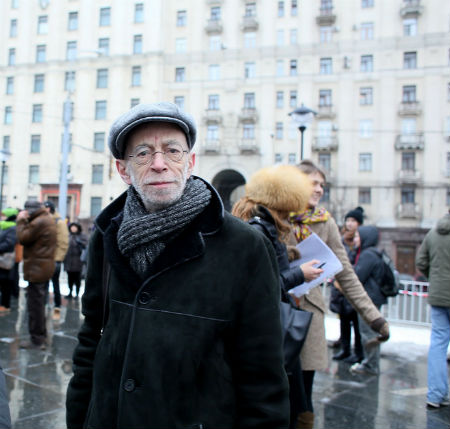
Leo Rubinstein. Photo by Evgenia Mikheeva/Brani.ru
The key concepts used in the current official propaganda rhetoric are just seducing those that were in the course of Soviet times. Only now the once stable conceptual opposition "Soviet - anti -Soviet" was replaced by "Russian - anti -Russian".
In the first case, this opposition was more or less understandable to everyone, including those citizens of the late USSR, who themselves designated their views and beliefs as "anti -Soviet". But some ambiguity existed then. The fact is that the word "Soviet" had two meanings. One of them was quite neutral and objective. It was purely geographical and legal, because there was a state called the Soviet Union inhabited by Soviet citizens. The second value was purely evaluative, because the word “Soviet” was also marked with the Soviet, that is, communist ideology, and at the official, legislative level appointed only true.
In the late Soviet years, that is, during the years of my youth, this word became an epithet, denoting various signs of social and cultural life, assessed by different layers of the population, to put it mildly, not quite equally, and sometimes directly opposite. Such an antonymicity of the word in relation to himself designated the ideological, moral and aesthetic split of society. For some, the word "Soviet" meant something advanced, reliable, only correct and victorious. For others, something bastard, provincial, cruel, stupid, immoral, ugly, stylistically retarded.
In the everyday social discourse of those years, these two values constantly intersected, floated on each other, confused, demanded clarification.
"You are a Soviet guy!" - once, once, in the deep 70s, a policeman who demanded documents on my street, clinging to my external- hairy and bearded- appearance on my street. “The Soviet guy,” he said. “And you go like ...” But, not finding a word that at least approximately describes how “what” or “who” I go, he portrayed something amorphous with his hand.
"Of course, Soviet!" - I readily agreed, in confirmation of which I took out his red -skinned passport from narrow trousers. “I don't mean that,” the policeman said. "And I am!" I said. We talked what is called.
The flickering of these two meanings turned some stable phrases, such as, for example, "Soviet dissident" or "Soviet unofficial art", into the cutting eyes and ear of Oxymorons.
In any case, in the assessment functions of the word “Soviet” between the carriers of the Soviet ”and“ anti -Soviet ”(or, more often, simply“ non -Soviet ”, that in the conditions of the totalitarian state it was regarded almost the same) consciousness existed a certain consensus, despite the fact that the assessments of this concept were different in order not to say the opposite.
With the "Russian - anti -Russian" there is no such consensus and cannot be. At least because there is no mention of any "Russian" ideology. Yes, and it cannot be, what kind of antediluvian imperial “scrapes” it would never have been sewn, what black television masses would never beat the soap foam of a strained provincial patriotism.
One could agree with his "anti -Russian" only in one case - if we admit that "Russian" is all that belongs or is inherent in the Russian authorities, that the current Russian government is Russia. But to admit this, even if you try very hard, is impossible. How it is impossible to understand what “Russian interests” are, what is “actions or statements directed against Russia”, what, finally, “Russophobia” and other concepts from this series are just as widely used these days.
All conscious native speakers know that words and phrases have, in addition to vocabulary, and those meanings that are displayed, so to speak, through the context or motivation of their use. But the fact is that the discourse of the authorities, striving for total influence on society, does not imply a category of understanding. What the authorities say do not need to be understood. It is even harmful to understand. Even dangerous. Do not understand, no. It is necessary to either involuntarily inflate the gills of the "pride of greatness", or in accordance with the vigilant genetic memory, sprinkle nervously, feeling how "the chill runs behind the gate."
The meaning of such words as “National Defense” or “Fifth Column” does not need to be understood. It is enough just to restore the old Soviet films about spies and saboteurs or the stories of grandfathers and grandmothers about the sensations that they experienced in the sounds of automobile brakes in the night yard. And do not even try to understand what such specific can mean such spectacular, but painfully meaningless words as “Russophobia” or “betrayal”.
In modern civilized societies, suggesting ideological and stylistic multiplicity, words such as “betrayal” or, say, “patriotism” sound helplessly or even comic, because they require detailed and convincing clarifications. In totalitarian societies, they sound ominous and frightening precisely because of their semantic emptiness. Due to the same emptiness, they sound so loudly. The heart of a sensitive person is compressed when they are pronounced in much the same way as with a sudden - in the middle of the night silence - the roar of a fallen copper pelvis.
In the rhetorical opposition "Russian - anti -Russian" there is no element of rational. For example, no one can convince me that such a category as “Russian interests” can be filled with intelligible content, can exist outside of such categories of unconditional for me as my interests, as the interests of my family, my friends and many other people who are citizens of Russia, whose interests and outlook on life do not coincide with “Russian interests” in the minds of their radio studies. No one is able to prove that his interests and beliefs are Russian, but mine is not.
And it is still necessary to talk and understand. Because the need for understanding, the need, even if desperate, rationalize the irrational one is an internal need, and it cannot go anywhere. If this need for someone wants to qualify as Russophobic or treacherous, then this, in general, is his problems, not mine. Not ours.