
Translated material
Technoprom-2014 as a center for solving the problems of "intergalactic" nature
Institutes of the SB RAS hope to find on the second “technoprom” investors and partners for development in the field of biotechnology, geophysics and alternative energy. The forum will be held on June 5 and 6 under the motto “The era of technological transformations: the time of new victories” and will collect more than 150 experts from Russia and Europe.
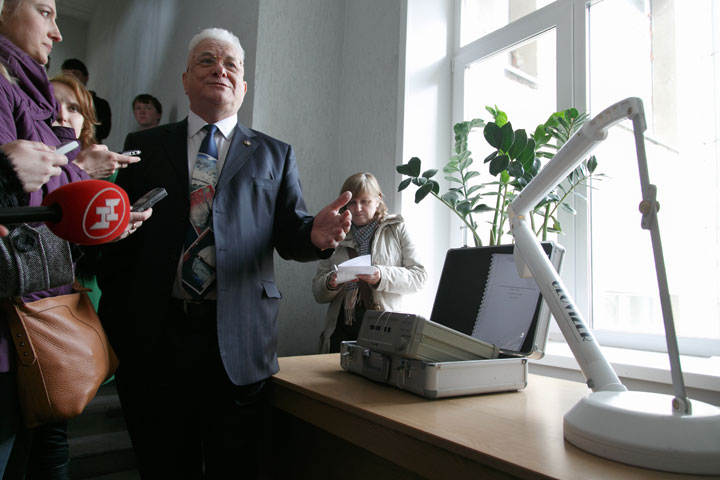
The strengthening and creation of new partnerships in the field of high technologies between scientists, investors and authorities will be the main goal of Technoprom-2014, the coordinator of the forum, assistant to the acting governor Marina Ananich, said on April 29 during the press tour of the institutes SAI. The chairman of the Technoprom Organizing Committee, as in 2013, will be the deputy chairman of the Russian Federation Dmitry Rogozin.
The second “technoprom” will be devoted to bio- and cellular technologies, alternative energy, intelligence management and modeling of virtual space. In addition, the forum participants are discussing the development of the GLONASS system and research for the Arctic.
“These are the technologies that were practically not illuminated last time,” explained Ananich. - It turns out that we become a center for solving the problems of the geopolitical and “intergalactic” character.
Novosibirsk physicists, geophysics and biologists, according to representatives of the organizing committee, “know why they work and what they are doing”, and the forum should help find investors, partners and consumers for their development.
The Institute of Heatophysics of the SB RAS will present fuel elements at the Technoprom, which recharge electrical appliances away from sockets. “The main demand for them for the Ministry of Emergencies, the military, climbers and tourists - that is, wherever electricity is and there is no way to take it from stationary networks,” said Boris Ilyushin, senior researcher at the Institute. - This source of electricity has the highest efficiency: chemical energy in it is directly converted into an electric one. And they are more compact and environmentally friendly than analogues existing in the market. ”
Novosibirsk physicists, geophysicists and biologists “know why they work and what they do”, and the forum should help find investors, partners and consumers for them
Scientists from the Institute of Oil and Gas Geology and Geophysics of the SB RAS will demonstrate to the “Technoprom-2014” devices of underground electrical maintenance. With their help you can not penetrate the ground to see what is happening there. The portable “geovizor” allows scanning the soil at a small depth and, according to scientists, has no analogues in the market, the Elektrotomograph “Skala-54” can scan rocks for half a kilometer deep into it.
“Imagine that you are a resident of Russia living in an Arctic city, and your house is built on an eternal permafrost. Due to errors in the design, the soil under the basement began to thaw, and the house-to fail. With the help of the device, you can see which side the shade is on, how much it spreads and what needs to be done so that the house does not fall, ”Yuri Manstein, one of its creators, explained the practical value of the“ geovizor ”.
Biotechnologies that allow you to grow any body tissues from the skin cells can be most likely to enter life after 20 years, says Oleg Serov, the development of the Institute of Cytology and Genetics of the City of RAS. “From one cell you can grow a kind of spare part for each individual,” said Serov. - It remains to learn to manage this process. We are specifically engaged in cellular technologies, study the development of the cell and how the body develops from it. ”
Recall that the first International Forum of Technological Development “Technoprom” was held in Novosibirsk in November 2013, about 5,000 representatives of the scientific community, innovative companies and authorities from 19 regions of the Russian Federation, experts from Finland, Germany, Korea, Great Britain and the United States participated in it. The area of the exposition of the second “Technoprom” will be twice as much as the first, for today about 150 companies are announced.
In the Novosibirsk region, the provision of higher education to the population is carried out by 47 universities. In the Akademgorodka there are dozens of research institutes, Novosibirsk State University, the NSU Physical and Mathematics School, and the Institute for Research of Circulatory Pathology. Not far from Novosibirsk, in the Koltsovo science city, the State Scientific Center for Virology and Biotechnology "Vector" is located. In the village of Krasnobsk, the Siberian branch of the Russian Academy of Agricultural Sciences is located.
In Novosibirsk, there are a large number of libraries, the largest of which are the State Public Scientific and Technical Library of the SB RAS (GPNTB SB RAS) and the Novosibirsk State Regional Scientific Library (NGNB).
The economy of the region is atypical for Russia. Since the mid-2000s, the service sector is ~ 61 %of the gross regional product, with a relatively small share of industry 20-24 %, agriculture 6-9 %. In total, in the Novosibirsk region there are 523 deposits of various minerals, of which 83 are currently operated.
In the region, reserves of such minerals as stone coal were explored (Gorlovsky basin, where high -quality anthracites are mined, explored reserves - 905 million tons, forecasting about 5.6 billion tons, also the Zavyalovskoye Kuzbass field with coke coal reserves of more than 50 million tons), refractory clay, peat.
Peat reserves are estimated at 7.2 billion tons, however, due to the high cost of its extraction and processing, the development of peat deposits is practically not conducted. A large deposit of non -ferrous metals - titanium dioxide (about 1.7 million tons) and zirconium dioxide (approximately 7.2 million tons) was found in the region.
Industrial reserves of gold are small and are estimated at 17 tons. Divorced one ore and 24 placers. 4 deposits of marble with reserves of more than 8.5 million m³ have been opened, and the marble of two of them refers to highly decorative, which is in increased demand.
There are significant resources of underground fresh, thermal and mineral waters. Of the 9.5 thousand wells, more than half a million cubic meters of water are extracted daily. The total area of the forest fund of the Novosibirsk region is about 4,490,000 hectares, including the area of the territory occupied by coniferous rocks - 977,300 hectares (21.76 %). The total margin of wood of the main forest -forming species is estimated at 278 800 000 m³.