
Translated material
Lviv: Everything is complicated
“... there was Nigoyan there, there were others there. You are their memory, heavenly hundreds, do not respect ” - approaching, I hear a fragment of the conversation. The person I see from the back is the head of the internal policy of the Lviv Rada Andrei Shevsiv. The arguing ones are in a dense ring of photographers and cameras. “We agreed - you go without posters, without party paraphernalia, without slogans.”
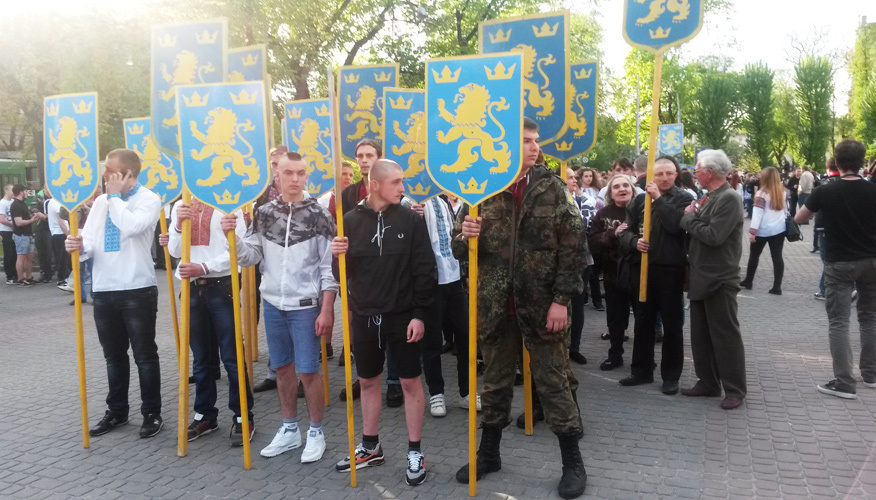
Several hundred people stand near the monument to Bandera in Lviv. This is a parade of embroidery, in memory of the Galica division , April 27. The most controversial event in Lviv, an eternal stimulus and an occasion for accusations of "fascism". According to the organizers, this year in front of the columns had to carry a banner, which depicts a stylized heavenly hundred. Relatives of those who died on the Maidan are against, because (quote) "Heavenly Hundred has nothing to do with the SS" Galicia "." Against and the author of the drawing. OUN-UPA veterans are also asked to refuse to hold a march-many listened to them.
As a result, the march still passes, but without a banner. As symbols - only shields with a yellow lion and two crowns. Leo is a symbol of the city, but for those who know, this is also a symbol of the division.
 © Andrey Arkhangelsky
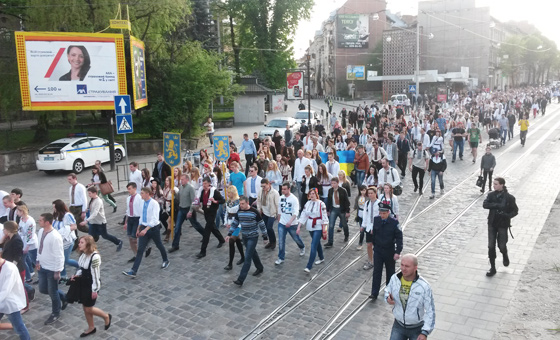
As a result of negotiations with the mayor's office, it was decided that there would be a “uniform of the course”, a silent procession - in memory again about the heavenly hundred. The first fifteen minutes go silently, then they begin to chant “Glory to Ukraine - Glory to the heroes” and so on. The slogans mint in a megaphone guy in a red shirt and sunglasses. A gray -haired old man begins to hunt for a man with a megaphone, looking like Rostropovich. He is trying to take a megaphone. A crowd interferes with him. The activist skillfully evades, avoiding physical contact, without stopping screaming into a megaphone. Finally, the old man got to the activist, pushes him several times: everyone was waiting for this moment - the police pushed him and surrounded the darkness of photographers. Grandfather, however, is not delayed. The most popular word now in Lviv is not a “revolution”, not “war”, but “provocation”. Everyone is afraid of provocations, and everyone is waiting for them; First of all, the nationalists themselves. On May 1, on the 9th. A provocateur is a person with a megaphone. Of course, the grandfather of Rostropovich is also considered a provocateur.
Neither one nor the other, however, do not interfere and do not prohibit anything - so as not to provoke.
Breeds and linden bloom provocatively.
The procession lasts only half an hour, passes along one single street-from the monument to Bandera to the monument to the victims of communism. Here is a guy with a megaphone and grandfather, each surrounded by the press, give comments. The guy explains that he screamed in a megaphone - and thereby violated an agreement with the mayor - in order to "neutralize possible provocateurs." Grandfather Rostropovich so explains his behavior: “I am Zvinya Ukrainian. The stench did not shout! Ale stinks shouted - both about Bandera, and about Shukhevich! Tsee with a microphone - provocateur! ”
 © Andrey Arkhangelsky
“I don’t understand why such a tantrum has risen, why we are forbidden to honor the memory of heavenly hundreds. I myself participated in Euromaidan. My boyfriend was wounded there, ”says one of the organizers of the march Oleen Tarasov. It was decided to complete the march here because they began to chant the slogans. After 40 minutes, everyone diverges. There were no more than three hundred people.
People who see Lviv through the eyes of the same Kiselev or Mamontov represent him with something politically solid, monolith of ultranationalism. This, of course, is not so. Lviv was never a monolith, and the ultra -rationalists are clearly not dominant and certainly not the only force. Another force is those who are commonly called both with us and their “civil activists”: people who have passed through the Maidan, Lviv and Kiev. Nationalists also, of course, were on the Maidan, but now between them and “civilian” valuable conflict.
The Lviv nationalist immediately, in the square, argues with the conditional Lviv hipster. He: “In Odessa, Kharkov, the same patriots live ...” - “Well, these are quite specific patriots ... Have you read Bandera's work? He wrote that we do not need common symbols, we need to use our own. ” The girl is pushing the theory; Bandera, of course, had something on the current moment. It means that borrowing and flirting with someone else's culture are harmful to nationalism. Around, as always, a crowd is quickly formed, twenty people.
The most popular word is now in Lviv is “provocation”. Everyone is afraid of provocations, and everyone is waiting for them; First of all, nationalists. Breeds and linden bloom provocatively.
This conflict is now typical of Lviv. For four months now there is a dispute between the conditional Maidan and the Nationalists of the Old School. Lviv lived for a very long time his closed, regional life, was busy only. All this time, the local agenda dictated Oldskul. Their tactics came down to symbolic actions like this march, which aimed not so much to change the present as to be compensation for all the past 40 years of Soviet power. In this version of the “rebels” of the 1940s and 150s that fought with the Soviets, it was customary to be considered a standard for a real Ukrainian and the Ukrainian idea as a whole. “Being a Ukrainian” meant to be true to this particular version of the past. This cult, however, was never dominant even in Lviv and certainly not the only one. But the admiration of the "Heroes of the UPA" was very narrowed by the horizons and the image of the city. The past here is 23 years in essence the present. Everything around resembles a large reconstruction-"what life would look like if Ukraine had gained independence in the 19th century, in 1918, in 1930." This delay was probably subconsciously related to the fact that Western Ukraine did not have “its own 19th century” or “own XX” and here they wanted to live them as it were again. Perhaps now this utopia is just ending.
The second most popular phrase here, on the street, at the rally - “Channel One”, a generalized image of Russian propaganda. In general, of course, the first channel would be amazed at how they care about it. He is invisibly present here - although, it would seem, disconnected. Sounds of Kiselev and Mamontov, who work on Russia 1, sound - but for the gathered all this is a generalized first. Everyone knows that there is an information war. Everyone already knows that with careless actions or statements you can "give a picture to the first channel." And everyone knows that it is impossible to "give a picture." They shouted: "The glory of the nation is death to the enemies." “Well, they joke in the crowd. “Now on the first channel they will say that Orthodox priests were again beaten in Lviv.”
 © Andrey Arkhangelsky
Lviv has changed over these months - if only because he began to look at himself from the side. With other people's eyes. Some people believe that this is correct, because it is impossible to “provoke”. Others believe that if everything is now done with an eye on the first channel, then this is called schizophrenia. After all, the very existence of independent Ukraine from the point of view of the mass Russian viewer also seems to be a provocation. “They did not want to provoke in Crimea. Now the Donbass is asked not to provoke ... ” - a person in an embroidered shirt resembles gloomily. The organizer explains why the march still decided to spend: “Are we, Lviv, Ukrainians, we have no right to walk in embroideries when and where we want? On the native land? "
... The rally passes near the Museum “Turm on Lonsky”-in the building where the Gestapo, and then the NKVD and the MGB were located once. On the very building-memorable boards: so-and-so tortured in 1948, such and such was killed in 1950. Some of the nationalists are sure that this cult should be continued to pod - this is exactly the young generation of ultra. "We showed that we are not afraid of anyone." Another part, moderate, believes that for a national consensus it would be possible - at least for a while - this cult is tortured. Ukraine now has new heroes who have an impeccable reputation.
A new cult appeared - heavenly hundreds. He is here, tangible here. Their photos are everywhere. Heavenly hundreds are new apostles, and they argue with the former cult, archaic and non -obvious. The new cult is wider - if only because it is international: the first among the new martyrs is a man by the name of Nigoyan. This name as an argument in disputes about a new identity often sounds - precisely because it is Armenian. Among the dead there are also a student named Alexander Plekhanov (his surname is pronounced here with a soft “e” to emphasize Russian origin). Among the heavenly hundreds there are other surnames - Russians, Jewish and others. This all complicates the Ukrainian national idea. But this makes her universal. Nationalists are forced to reckon with this. On the other hand, they dreamed about it. In the last novel, Oksana Zabuzhko, dedicated to the UPA, it is also important that the units of the rebels were multinational.
The Maidan did not lead to the triumph of a conservative idea, but to its modernization.
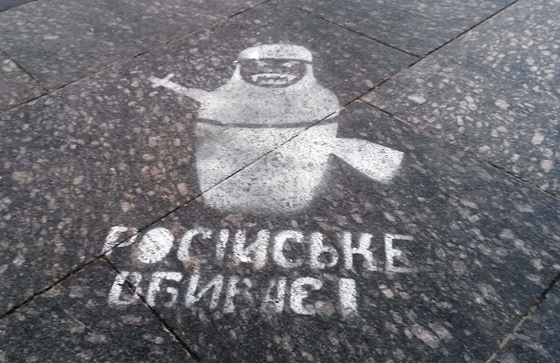
I already wrote about the essential that happened in Lviv back in November. There really was no question in Lviv "For whom?" - In the confrontation with the authorities. But Lviv decided another, internal conflict. Our political scientists wrote not without gloating then that the ideal of Lviv nationalists is not at all democratic Europe in the 2010s, but totalitarian Europe of the 1920-30s. But it was then that the Lviv hipsters drove a local nationalist from the rostrum, after which a polemic between veterans and “snot” unfolded in the press and social networks; It turned out that for the current Lviv students who grew up in an open world, patriotism and love for their homeland no longer mean automatically “death to enemies”. For a year, about that, strange inscriptions on the walls appeared in Lviv: "To finish Boti a hero - be a people's person." It was a passive resistance to the cult of the "Heroes of the UPA." For old nationalism, this was unexpected. The nationalist, who demanded the Death of the Vorogs, was formally driven because the rally was student, extra -political; But this can be considered a symbolic sunset of the “cult of death”. The transition from ethics of the XIX century to ethics XXI. The usual civilizational discourse stood in the place of archaic.
 © Andrey Arkhangelsky
Lviv is not so much about nationalism as about conservatism. Actually, the procession of ultranationalists is the same conservatism. The local nationalism, like the local religiosity, is only a consequence of the basic local conservatism. In this sense, traditionalists in Ukraine, in Russia and anywhere else are very similar; Lakmus here is the attitude, for example, to same -sex marriages. At the time of agitation for the European Union, even under Yanukovych, in early 2013, Lviv occupied just to hear it - a restrained position. Demonstrations against same -sex relationships were regularly held here. Here they scared juvenile justice (after all, she put control of violence within the family). “Europe is the same -sex marriages” - the posters of the Freedom party were hung along the streets and in public transport. But now the Maidan happened, and this fear of “same -sex Europe” gave way to real dangers, and then the topic disappeared at all. The revolution makes you make a choice - between Europe as a value and its "disadvantages." And even local conservatives were forced to make this choice, and they made it in a matter of days, since then no one has been afraid of “same -sex Europe”. For Lviv, this was also a revolution - one of many.
The Maidan did not lead to the triumph of a conservative idea, but to its modernization. Take the same question with the UPA. People of the older generation, veterans, are ready to refuse, at least for a while, from glorification. In the end, this is a memory of dead relatives, a personal matter. They do not want to turn this into a "picture for Kiselev." These people recall that Ukraine lost in 1918 precisely because every chieftain then achieved some personal goals, and not general. I thought about myself, not about Ukraine.
New revolutions in Ukraine were made under the slogan "we will show what we are better than thinking about us."
23 years of internal conservatism led to his pupation. Now he has to think about his own person; He is forced to become suitable, tolerant. Forced to reckon with the world. This will inevitably lead to its internal transformation.
This can be considered a mimicry, as many people tend to think, in the face of Russian aggression. You can, on the contrary, see in this the natural transformation of the Ukrainian politicum - under the influence of internal changes.
New revolutions in Ukraine were made under the slogan "we will show what we are better than thinking about us."
Lviv survived the “Anger Night” relatively calmly. In essence, the essence of revolutions manifests itself in these three days after the change of power. Police plots defeated almost everything; In the building of the prosecutor's office, stained glass windows were knocked out, which were made to order in Poland. Stained glass windows - but not people. They wanted to smash the shops that belong to the regionals; But other people who began to protect these potential victims to protect. They quickly organized hundreds; I remember the broadcast on Gromadsok TV, when these people with microphones in February called for order and asked to prevent pogroms. In the same way, out of nowhere, the patrols of the automatic carrier arose. The degree of self -organization, "the whole world is looking at us", the slogan "Near is not a barbarian." In this revolution, those who wanted to be better, and not worse, won. I see on the streets of Lviv, relatively speaking, potential titles of the Western type, the same declassified element. In a different situation, it was they who would lead the "revolution of anger." But the story was different, and local gopniks were forced to follow the general trend for tolerance.
 © Andrey Arkhangelsky
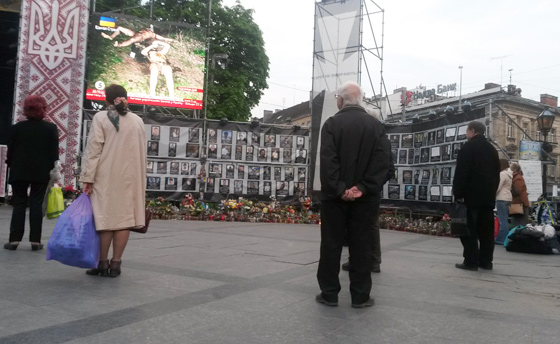
Naturally, the external threat today plays into the hands of old nationalism; Militarism and nationalism always work in pairs. Russian pressure is now strengthening the positions of local nationalists. On the local Maidan (it was just dismantled on April 28, it stood for 5 months) a large screen, show the bodies of those killed in the Donetsk region, deputy and student, show naked bodies with broken tumbles. People look silently, diverge silently. The conditional Donetsk were the most frequent tourists in Lviv. Until March 2014, the southern part of Ukraine went to rest in Lviv and Transcarpathia, and the western one - respectively in the Crimea. Now it won't. It will be somehow different, but so-no longer.
The psychology of a local person is different - not because conditionally his grandmother remembered how it was “for the Polish”, that is, to the Soviet regime. It is important that the local layman knows that nothing in history is forever. And the current grandmothers, who are unlikely to remember life under Poland, nevertheless resemble the grandmothers of the 1940s, who sat in the same way silently near the reproduct and listened to the news. When the “history” begins, the inhabitants of small countries, non -political ones, always felt like passive participants in history, objects, and not subjects. Now - for the first time - they themselves have become a subject and even a catalyst for history. They were not going to go so far. And they themselves, it seems, still cannot understand what this means and how to relate to this. But there is no way back anymore.