
Translated material
Burning the absence
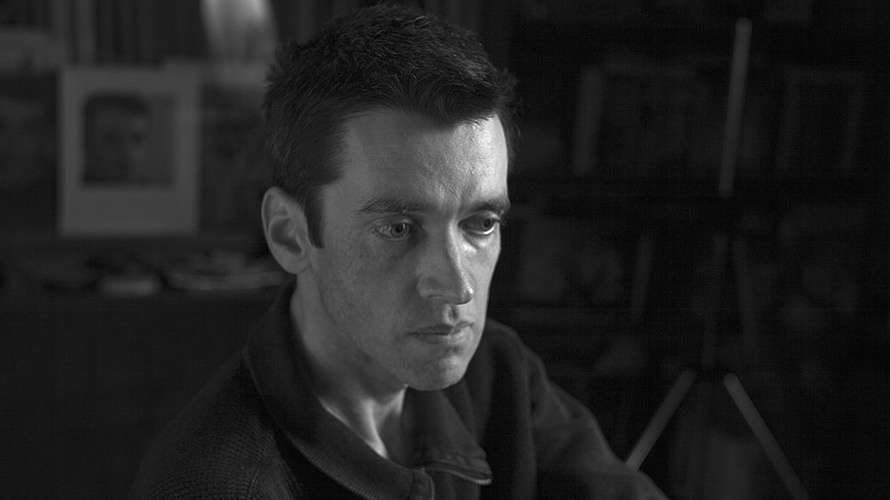
Until everything smart and mental, to everything that can be said about it, death affects us as a meaningless and inexpressible absurdity, the ultimate lack of meaning. Resisting any metaphysics, this screening is expressed by pure grammar, the replacement of the present - the past: “there” was “was”. In the expression to understanding, in addressing the void - poetry of the first finds the path and is left alone for a long time. And even when metaphysics comes to make its judgment, find a formula in which the soul grinning about someone else’s - or its approaching - death could stop the search for the impossible meaning and find relative peace, metaphysical poetry is always possible to slip into the abyss of despair, a mournful cry, and the appeal is nowhere.
In the preface to the “Duma of Ivan-Lei”, this manifesto of new Russian poetry, under which he might have signed not one, Grigory Dashevsky formulated the need to write poetry in a new way. Consciously simplifying this deep and important text, one could say that. A poetic technique characterized as a legacy of romanticism identifies the author with a lyrical hero, forming a “innocent and special” lyrical self with which the reader can merge. “Just poems”, naively written in the first person, are actually written “Idol I”, invisibly standing behind the author. It is me, always pre -justified by myself, distorts the world and other people, bringing them, with all the relations and things of the world, to the sacrifice of imaginary poetry, which is actually interested in me alone. A phenomenologically -minded reader could say that the departure from such a “non -critical” attitude should give a place to “things themselves” - and, of course, not in their genuine reality, which is impossible and illusory, but as they are given - and given not only to me, but to everyone. A transition from the internal to a kind of objectivity is required, from I to a common and non-person, from a naive lyrical position to a “true look”, realizing that the visible is just visible, and not reality itself. (Poems, perhaps, would say the phenomenologist, interpreting Dashevsky, should be written on behalf of the “transcendental ego”, fixing “the little correct that everyone already has.”) And above all, the poetics should change, stopping to search and invent and start using “one -dimensional” and “general” words, “which are obviously belonging to everything and which are therefore equally funny and to be equally funny and considered their own quotes, and consider their own own " [1] .
 © Caspar Hauser Publishing House
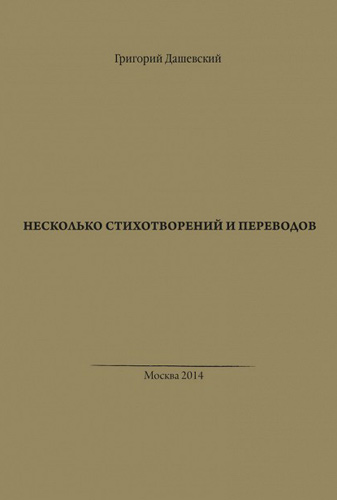
In Dashevsky’s last book “Several Poems and Translations” , compiled by him in the minds of close death, the abolition of I becomes a direct life experience. Life and poetry are confused, change places, and the abolition of the lyrical poetry begins to resemble the gradual erasure of the poet himself to the oddity. This is one of the essential difficulties of this book, which we, with all the desire, cannot perceive simply as a text among others. The point is not only that the history of the author’s illness is, as it were, about the illness in the book itself), we are dealing with his story about his own dying, that is, we are talking about the coincidence of the thought of death and living of dying, practical intake in death, and the development of its territory.
The composition of this small book is extremely verified. It opens with five short poems of 2003-2009, then six undivided translations from English and Latin are going on. The book ends with a standing mansion of the Narcissus poem, written in 1983, that is, even before the “metaphysical turn”, but with the last two stanzas in the editorial office of November 2013, that is, just before the author’s death [2] .
The topic of absence is declared immediately, in the first poem (“neither yourself nor people / there is no here, it happens”). The radiance of the law, as in the parable of the gates of the law from the “process” of Kafka, illuminates the deserted world, which, however, is full of natural life (“the commandment is illuminated / dreaming, burdock, mosquito”), buzzing insects - the antithesis of human society traditional in Russian literature. The commandment here is most likely a commandment to love his neighbor as himself, and the author’s woeful joke that it is perfect when there is neither one nor the other. The patience of the innocent sufferer is devoid of any kind of atoning meaning, and the ethical law reaches perfection only in the absence of a person - both the executioner and the victim.
The absence was directly named in the poem "Mart shameful Roy Snow Crimea" [3] , which ends with the line “you are definitely absent”, where continuous “y” is like a wolf howl, a line that freezes on this terrible verb with a passage of stress in male rhyme or with two stresses [4] . The internal rhythm slows down here, highlighting the absence of the author as a semantic dominant [5] . The threatening “Roy Snow Crimean” with his whining “O” and “U” is an inverted “not swarm of another hole” with a replacement “another” with a tangent “Snow”, in which an inevitable “coffin” is heard, for which the hole is intended. The first two lines are read as a sad joke: a call to the heat (“Roy Snow Crimea”) and pity for sunny bunnies perishing at sunset. The re -quoted from the “Tale of Bygone Years” (“We’ll Lie Bones, Dead Bo are not having a shame”), together with the “shameful March”, they say, as it seems, about the shame of slow dying from the disease, contrasted with heroic death in the battle. A piercing cold (as in the expression “freezing to bones”) makes it possible to feel that life lasts with its shame - mastering the world in which I may not be, inhabiting the absence .
This poem exactly realizes the program outlined by the Dashevsky: the continuous “common words” woven in an extremely delicate structure allow the poet’s own voice to remain “behind the scenes”, making “narcissistic” I am beyond the scope of the poem.
In her necologist, Dashevsky, Maria Stepanova, tied the line “We don’t torment us” from the perhaps the most famous poem of this book, “Martians in the dungeons of the General Staff”, with “phantomism of any art, its inability to save”. In the poetics of Dashevsky, after the “turn”, I am non -controversial, he has no replacement, no new truth replacing the old lie. You cannot save anyone, there is only concreteness of suffering, a reality of pain and a call for pity.
Even in the book there is a strange poem “Alien Bayuccal” is a hermetic myth, the key to which would like to find. What does it mean to give your eyes, the only one, like a cyclops or grade? According to Elena Schwartz: “The poet is an eye, you will find out later, - / a moment associated with a roaring deity. / Eye torn - on a bloodless thread, / For a moment, pain and glory. [6] . In this strange giver of the eye, the central point, the whereabouts of me, we see the same gesture of self -self -suffering, deliverance from our poetic self, which lives Dashevsky’s poetry after “turn”. Should you recall the blinding of himself Oedipus here?
Life and poetry are confused, change places, and the abolition of the lyrical poetry begins to resemble the gradual erasure of the poet himself to the oddity.
Finally, the last of five small poems is a prayer built on the confluence of two quotes from the “Epistle to the Jews” AP. Paul: “Our God is the appearance of the appearance” (Heb. 12:27) and “It is terrible to fall into the hands of God Zhivago” (Heb. 10:31). This is a detailed metaphor for the literally read meaning of the word "inflammation" ("itching dry burning") as a fire in which the patient burns. “Waster that I am your dear chick” - this extremely intimate, piercing line ends the fifth poem, the author’s own speech. The “chick” makes us recall the “bunny” from “Martha shameful” (located on the same turn), and both obviously threatens the trouble, and both are sorry for tears. In the "Proploni" and "whispers" of the last two lines, the echo of the "Roman elegy" of Brodsky is heard ("Bend, I whisper in your ear" [7] ), as well as the last poem Rilke ( “ Nun Aber N ä hr ' ich dich und Brenn in Dir ... ” And further: “ O leben, leben: druußesein. / Und Ich in Lohe. Niemand der Mich Kennt " ) [8] .
Translations deserve a separate big conversation. The fact that they occupy half the book is most likely not by chance: someone else's text gives the translator a legal opportunity to stand in his shadow, to hide behind the identity of another poet. The first in the book are translations from Victorian English poets Swinburn and Hopkins. The famous penultimate strip was translated from the "Proserpin Garden"-thanks for the fact that life full of suffering inevitably ends someday. (The last, unequesty, stanza ends at the final dead point: “ Only The Sleep Eternal / in The Eternal Night . ” ) The resolution from suffering is connected with the disposal of I, and it is necessary to thank precisely for the fact that“ that the ocean [someday, finally] will flush / [even] the weakest of streams. ”
Hopkins is one of the most virtuoso and difficult poets of the Victorian era, the innovator in rhythm and ducal, the poet is surprisingly modern, directly of Tsvetaevsky sound:
What Hours, O What Black Hours We have Spent
This Night! What Sights You, Heart, Saw; Ways You Went!
Turning to Catholicism and accepting monasticism in the Order of the Jesuits, he burns his poems out of fear that they will become an obstacle to the spiritual path. In the next eight years, he writes only with the blessing of his mentors. Self is a topic that is very important for Hopkins, which has invented neologisms “ To Selve , to Unselve . " The poem translated by Dashevsky (the two lines of which are quoted above) - from the so -called terrible sonnets - not so much about the flour to be about the flour of the Self, about the flour to be Y. The convicts in hell are punished by them (“Beach to them, / I am in sweat,” just like that, where there is an intensively physiological “ SweATing ” Selves " ). Dashevsky puts this sonnet Hopkins after an excerpt from the very traditionally long long poem by Swinburn (by the way, who studied in the same balloon-college in Oxford several years before Hopkins, but lived a completely different life). In this gesture, you can see an unexpected turn of the through topic of the book: I can be abolished because he has an indistinguishable business - to suffer. Having abolished the principle of organizing a poetic world, having broken the “idol I”, we cannot, however, completely get rid of ourselves, just as we cannot get rid of suffering: “I have become bitterness”.
Dashevsky avoids an unambiguous, direct speech that would violate his subtle poetry of incredited. What the poem is aimed at should remain beyond.
This is followed by the translation of the Horace, classically contrasting the cyclic change of seasons, the limb of human life (" Inmortalia Ne Speers ") . Analysis of the translation of the famous poem by Emperor Adrian and the entire translation strategy of Dashevsky was made by Anna Glazova in her article . There are also many examples from this book, where the interweaving and mutual substitution of death and sleep occurs: “deep sleep” from the poem “Alien Bayuccal”; the line “that the dead will not wake up”, which translates “ that Dead Men Rise Up Never » Swinburner; Awakening in the middle of the night in Hopkins's sleep; Finally, Frost's “Five Dream” (“ OFT - Repeateded Dream ") . The translation group ends with an excerpt from the “ash environment” T.S. Eliot. This passage did not get a prayer, which the corresponding part of the poem ends [9] , as well as in the translated passage from the poem of Swinburn, her final stanza was not included. Dashevsky avoids an unambiguous, direct speech that would violate his subtle poetry of incredited. What the poem is aimed at should remain beyond.
The topics of vision, ambiguity (contrasts and identification) of sleep and death are combined in the poem "Narcissus", which serves as the result of the book. The beginning of the poem retains the 1983 editorial office, before the “turn”, and the topic of reflection, self -observation, mirror reflection dominates here - the deepest image, central for the entire European philosophical tradition. The double visible in the mirror is the guarantor of my existence, and in this sense I exist, because I see it. I am not one, it broke up into the I observed and the observer. Vision, thus, becomes a metaphysical support, confirmation of my being. When I sleep, closing my eyes, I lose this support, but at the same time I am free from the monitoring of myself, which pursues me all my life, from duality inside the I. But is it possible to merge with my reflection?
The poem begins with an invitation to the movement: "Well, let's go." This is the beginning of a certain way, perhaps just walks along the cemetery (a favorite poetic route), but maybe some meeting will occur along this path - a meeting with a double [10] . The tone of the conversation of the lyrical hero with his Alter Ego is somewhat reminiscent of the "school for fools" Sasha Sokolov. In the second stanza, the sky flies into narcissism, which “looks” (here is the interruption of rhythm, that is, a semantic accent) into the sidewalks wet from rain. Eyes are reflected in puddles, but a speech facing a double is an endless speaking, which is essentially unmasis: "Rain / is silent: not / nor no ." We come to the cemetery. The inscription "Sleep calmly" in the poem is read as "calmly sleep / without dreams and nobody with anyone." The ambivalence of “yes” and “no”, sleep and death is transformed into the symmetry of the world of the living and the world of the dead, those who are on this one, and those who, on the other side of the mirror grave plates, those who dream, and those who see the dream. There is another level of metaphor - “to see in a dream”, and we finally lose our heads in this metaphysical abyss: who dreams to whom and who sees whom? Who is the “real” I, and who is only his double?
The design of meanings, supporting their inconsistency, anti -relation, is finally closed in the last two stanzas (editorial office of 2013). Here, the “cold look” of the sky comes closer to the gaze of the lyrical hero (“the sky is light as a daffodil”). Earlier, we read that under this look the “eyeballs” of reflections fall and flow in the flows of the puddle “already blind”, reproducing the return of vision in the poem “Alien Bayuccal”. There is no more vision in the dark or blindness that sees the visible one (“which he looked through the whole evening / ... merged with him in one / lightest dumb body”) - including, perhaps, mainly with his behind the grinder from the other side of the grave plate, almost like in the story of Kafka. Life replaces death in an ambiguous dream-like-death or death-kak-like: "He is alive, blissfully breathing." Closing his eyes, the lyrical hero coincided with his double and, having lost the constant addressee of an endless speech, found the desired dumb. Perhaps I was the purpose of the program declared in the preface to the “Duma of Ivan-Tiy”-to take the author’s from the space of the poem in order to free the place of poetry itself. And here we can, as it seems, explain the paradoxical return of the Narcissus as the last poem of the last book of the poet. It is impossible to eliminate me, which is the subject of suffering, the torment of conscience or physical torment, then I who asks for pity (“Do not torment”). Closing the eye therefore frees the self -tyranny of the self: from I, spying behind myself and finding in myself all the new lie.
In the last stanza, the present is replaced by the past and eternity occurs. What is happening here with a lyrical hero is best transmitted by the word “Assumption” - that is, a dream under the guise of death. A stream as an image of eternal life, as a symbol of living poetry speaking on the other side of death, will rest in his “deep darkness” by his “lightest body”, gaining blissful reassurance.
The author is deeply grateful to Mark Grinberg and Anna Yampolskaya for a careful reading of the preliminary version of the text and numerous comments and sentences.
[1] The radicalism of the author’s preface to the “Duma of Ivan-Tiy” deserves a separate and detailed analysis. Dashevsky formulates the principles of poetics, which is simultaneously repelled from both conceptualism and poetry, writing "on behalf of some higher power (" language ", etc.)." The poet will best say the productivity of this new reform of the poetic language for the most poetic work: “Since this is possible, the surface of the tongue is extended as a dining table” ( Maria Stepanova, “Our Sun”, “Kommersant”, 12/19/2013 ).
[2] Comparison of the two options, see the article by Anna Glazova “Narcissus” (on the latest collection of verses by Grigory Dashevsky), Colta.ru, 02/06/2014
[3] sending to the textbook poem Bloc “May is cruel with white nights” (remark of Tatyana Levina and Maria Stepanova). “Mart shameful,” as Kirill Golovastikov noted, comes from the thieves “shameful wolf”, which is connected with the “bunnies” in the second line, the block of bloc's origin indicated by Tatyana Neshumova (“The bunny of pink / on flowers on the wall”).
[4] Words with two stresses are found in Dashevsky and in other poems (the remark of Tatyana Levina, cf. “About nine” from the poem “near the metro” with two stresses in the word “near”).
[5] It is this shift, the mismatch of real stress in the word “absent” with the position of rhyme and models the “absence in the presence” in question. Возможно, что читать это слово надо в соответствии с его обычным акцентным контуром, и тогда метрическая схема сама даст нужное полуударение в конце, отвечающее приглушенному, но звучащему голосу (замечание Марка Гринберга).
[6] «Подражание Буало», см. также ее «Некоторые виды звезд (малая фуга)».
[7] Я благодарен Анне Ямпольской за эти замечания.
[8] Замечание Марка Гринберга.
[9] «Две последние строчки из фрагмента Элиота Дашевский не перевел — и это, наверное, самый пронзительный из его переводов, какой-то совершенно запредельный жест волевого безучастья, превращения чужого слова в действие» ( Николай Эппле, «Памяти Дашевского», «Гефтер», 20.12.2013 ).
[10] Анна Глазова отмечает важность короткого рассказа Кафки «Сон» для понимания этого стихотворения. В рассказе прогулка по кладбищу заканчивается для героя трагически, хотя в последний момент, «восхищенный картиной» собственной могилы, «он проснулся». Глазова приводит фразу Дашевского из письма к ней: « Но в Вашей фразе, что, пока “Сон” бодрствует, Йозеф К. не умирает, есть что-то страшно утешительное, буду ее помнить ».