
Translated material
"We saw an open face of Russia"
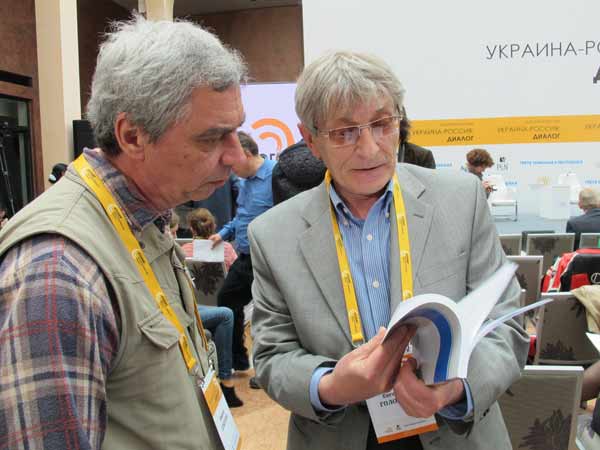
On the results of the Congress “Ukraine-Russia: Dialogue”, held in Kyiv on April 24-25, 2014, we talked with the doctor of philosophical sciences, deputy. Director of the Institute of Sociology of the National Academy of Sciences of Ukraine Evgeny Golovakha . Talked by Natalia Demina .
See also:
- “ Ukraine needs radical peacekeeping negotiations” (February 20, 2014)
- “The conflict of Russia and Ukraine extends the agony of the USSR” (March 19, 2014)
What does it seem to you the most important result of Congress?
Congress became one of the few sites where Russia and Ukraine did not meet as enemies. They met as respecting partners who did not understand each other in many ways, and, nevertheless, a negative attitude has not developed in any of the parties. We all understood what a long way to solve our internal and external problems we have to do. We understood how different we are still with all our proximity.
Sociologists would say about our two countries "how close we are, so different." And the more we understand this complexity, the inconsistency of the situation, the easier it will be for us to communicate. We can increase our differences, but we can increase our proximity. Everything is in our hands.
In addition to the fact that democratically tuned people in both countries looked into each other's eyes and realized that it was not all over for democracy, Congress played a certain psychotherapeutic function. As in the famous joke, when a therapist says: “I have a simple criterion for the success of treatment. If it became better for me after the session, then it probably also became better for the patient. ” I think that if it became better for me after meeting with Russian friends - and in many ways opponents, then I really hope that it became a little better for them.
We saw the open face of Russia turned to us. Open for discussion, for discussions. And they, I hope, saw, albeit a difficult, though in many ways, is now wary of Russia, the face of the Ukrainian intelligentsia, which can be open to Russia, but with the condition that both sides understand all existing differences.
You participated in discussions about Russian and Ukrainian languages, including Mikola Veresen. He expressed the opinion that the Ukrainian language will die if the Russian statute is given to the Russian.
I do not agree with this. I believe that in the open democratic world only that is artificially losing competition. In an uncompetitive environment, everything is dying - this was shown by the experience of the same Soviet Union and all totalitarian states.
This is a famous problem - a task with a zero amount. When in the economy people believe that if someone has earned something, then he only took them from them, then this is a path to nowhere. And if there are people who are guided by the principle that if someone has earned something, then he created the conditions so that I honestly earned, then the economy is developing.
The same situation is for me in the language environment. If one language develops, this does not mean that another one immediately loses, it means that it creates a competitive environment for the development of another. This is the first premise. The second is that Ukraine is now in the threat of a split. And the reason for this may be a language problem. It is necessary to meet Russian -speaking people so that they at least not consider themselves unequal in these conditions.
The formation of a political nation is more and more based on having less and fewer ethnocultural barriers. And in this sense, in the context of a certain threat of loss of statehood, this cultural factor becomes very important. Measures for gluing a country in an external threat should rest on both sides compromises, and in this case, a compromise from those who really received power.
I said in direct text that it is better to get one country with two languages, competitive and capable of creating conditions for the development of both than two countries that have two different languages. There will be not even two countries, but two fragments of one country. Yes, everyone will have a mono -language and mononationality, but then they will never converge back.
Photos from the Congress "Ukraine - Russia: Dialogue" (April 24-25, 2014)
Alexey Levinson (Levada Center) and Evgeny Golovakha (Institute of Sociology of the National Academy of Sciences of Ukraine)
Sociologists Victoria Sereda (Lviv National University named after Franco) and Vladimir Paniotto (Kiev International Institute of Sociology)
Yulia Kadenko (Polit.ua) and Georgy Satarov (Indem)
Politheograph Nikolai Petrov and sociologist Vladimir Zvonovsky
Politheograph Dmitry Oreshkin
Political scientist Tatyana Vorozheykina and biophysicist, co -chair of the Council of the Society of Scientists Andrei Tsaturyan