
Translated material
Shit Happens
One of the significant exhibitions of contemporary art in London has recently become a wide overview of the work of the Scottish artist, laureate of the Turner Martin Creed Prize in the Hayward Gallery . Creed is known as the author of such works as No. 88 (a sheet of A4 paper is twisted into a ball), No. 227 (light turns on and off) and No. 1029 - a two -minute video that shows the “in profile” a rising and descending penis, thus acting as a kind of barrier. The obligatory exit from the exhibition in Hayward is not “through the souvenir shop”, but through the small cinema, where there is a show of several video work of the artist. The longest among them is the work No.660 . The script is simple: the girl enters the white space, squatted down, defeats for a long time and with obvious labor and leaves the stage, leaving her dark feces on a white background. Thanks to the location among other exhibits, the work of no.660 will be perceived by willy-nilly as a kind of climax of the artist’s exhibition or even his work.
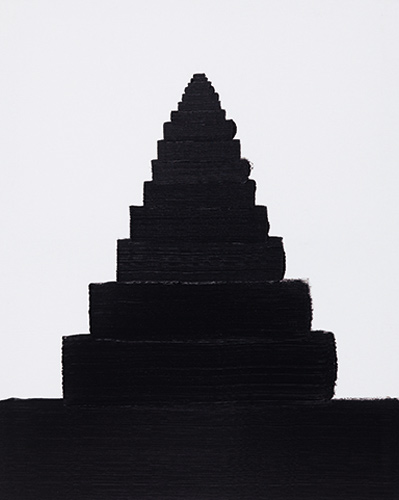 © Martin Creed Martin Creed, No.958, 2008
No.660 Creed is not the only work of the Selebriti artist in recent years, which considers the process of bowel movements and the matter produced as a result. In the long-awaited epic of the American artist Matthew Barney, almost a six-hour film called “The River of the Apat of Exit”, shown in February in New York , the viewer meets, among other things, the man licking her anus stained with feces; Barney himself, smeared with feces and at the same time taking the penis of another man in his ass, is also only in feces (the penis is covered with sheet gold); And a woman who writes abundantly on a set table with dinner.
Of course, the two films do not make a trend, but they make the question: where does the artists come from in excretory functions and what are its roots?
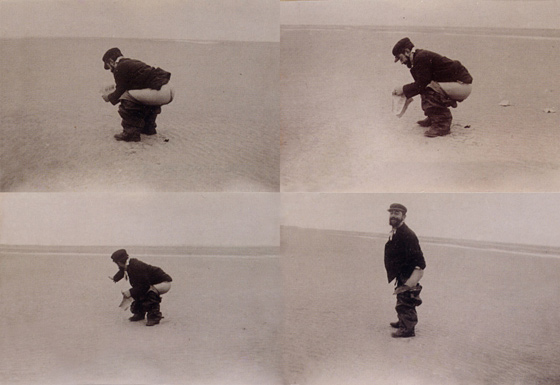 © Maurice Joyant Henri Tuluz-Lotrek on the beach in Le Krota, Picardia, 1898
In fact, a demonstration of real and depicted excrement is an integral part of the practice of art avant -garde since the end of the 19th century. In 1898, Maurice Zhuayan, a Parisian galleryman, took a picture of his friend, artist Henri Toulouse-Lotrak, while he defecated on the beach in Le Crota in Picardia. The images captured by the camera were subsequently published in the form of postcards and sent by mail. Already in these old black and white pictures, we discover the implied analogy between the process of bowel movements and a creative gesture, between the traces of the feces and the picturesque smear. Pokashka Lotrek is a remarkable phenomenon on the pale, almost empty expanse of the beach, that is, on the "canvas" of the artist. Just as in the work of NO.660 Creed, traces of bowel movements are “other” painting, the pristine distortion of a clean surface and clean space, UR-swimming, the first and last example of an expressionistic texture.
Marseille Dyushan managed to introduce excretory functions directly into the art gallery. Its Redi-Mide Fountain, an ordinary pusser with a mysterious signature of R.Mutt , was exhibited in New York in 1917. Just as the feces of Lotrak is a deliberate overthrow of painting, the name of the Pussuar Duchan indicates that he is not only the next “slap in the face of social taste”, but also the overthrow of the established form of art - the public fountain. (Dyushan continued to be interested in the metaphors of the garbage. In 1918, he created Tu M ' - work on a canvas, the name of which is a reduction in the phrase “Tu m'emmerdes” , “You will bind me” (there is another version of reading . - Ed .), And as if he was reducing painting as a whole.
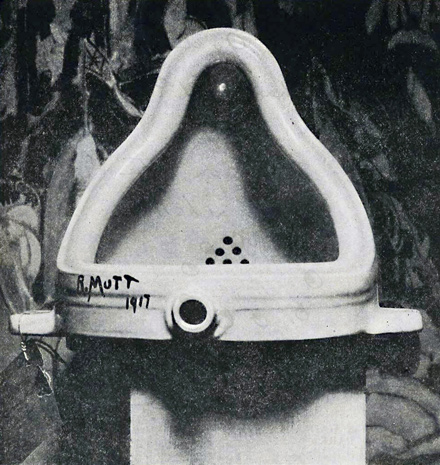 © Alfred Stieglitz Marseille Dyushan, Fountain, 1917
In 2004, a jury of five hundred British artists, curators and critics chose the Pussar of Duchan the most significant work of art of the twentieth century . The influence of the radi-meads of Duchang and, first of all, the Fontana, of course, is huge: there would be no Dyushan, Martin Creed’s work would look different, and with it a number of stars of modern art. Leo Castelli, an outstanding New York Galerist of the second half of the twentieth century, called his artists (including Robert Raushenberg, Jasper Jones, Frank Stell, Andy Warhol) the “Duchan school”. There are many direct reactions to the "fountain". One of my loved ones is the action of two Chinese artists Yuan Kai and Jian Ji Xi, who in 2000 tried to sign a copy of Pussuar at the exhibition at the Tate Modern Gallery. The action can be viewed at YouTube : Urine jets do not fall into the target, since the pusser, which has long become an idol of the art pult, stands on a high platform and is protected by a showcase. It is impossible not to note the prophetic power of the Pussuar in connection with the recent scandal around the new art gallery of FIRSTSITE , built by the state budget in the city of Kolchester in the UK. During the audit of the new gallery, it turned out that of the annual 147,000 visitors, the good half spends only about two minutes indoors. In fact, they do not come in to watch art, but only to use toilets. Such a transformation of the role of the gallery would pleased Duchan.
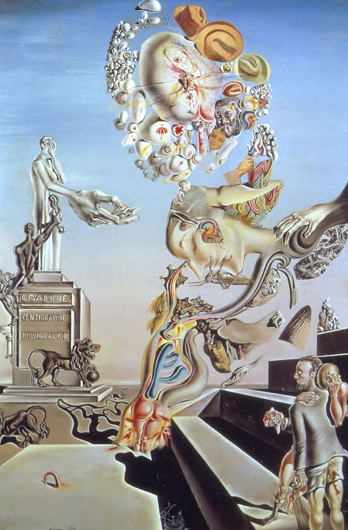 Salvador Dali, Gloomy Game, 1929
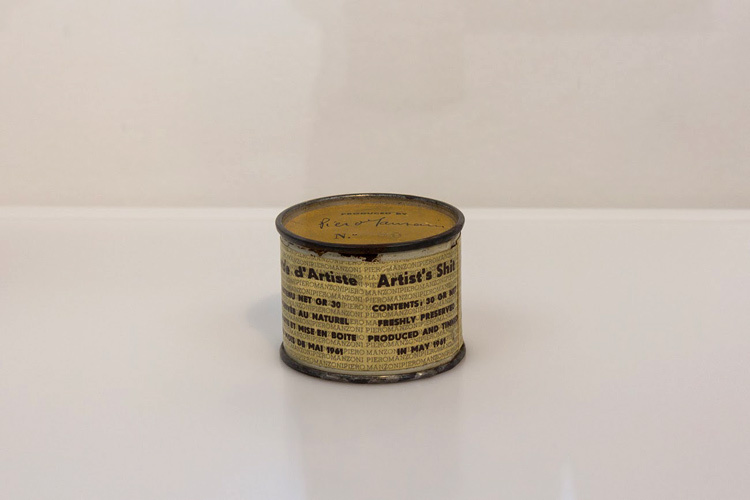
Pablo Picasso, they say, tried his own feces. But what just does not say about Picasso ... The main thing is that the legend is considered not a sign of madness, but by proof of genius. But the shit of shit sometimes shocked even the most terry avant -garde. Both Andre Breton and Georges Batai were puzzled by the picture of Salvador Dali Dali “Gloomy Game” (1929), where in the foreground a man is depicted in shorts stained with excrement. In 1961, Pierrot Manzoni had a brilliant idea: seal his own feces in metal banks, thereby removing the disgusting appearance and smell and at the same time creating the most typical and convenient object of market consumption. Manzoni sold banks by weight, relying on the current cost of gold. But banks have long surpassed the coefficient given by the artist. Relatively recently, in 2013, at the Sotheby's auction in Milan Merda d'Artista , “The artist’s shit” left for 115 thousand dollars.
The theological problem was once also shit: Gnostik Valentine in the II century AD He came to the conclusion that Christ ate and drank, but did not show. It is traditionally difficult to make a noble image of a person with the awareness of his excretory functions. It is not surprising that since the time of the ancient Romans of the Empire, they are proud of their sewage. Effectively remove waste, to make them invisible is a way to civilize ignorant peoples. Accordingly, insisting on their show is rebellion. Dominic Laport in his book “History of Govna” (1978) quotes the Irish patriot of Professor MacHu from James Joyce’s novel “Ulysses”: “Builders of Closetes and Cloka never be the gentlemen of our spirit.” From the point of view of oppressed Irish, reliable English sewage is a form of hegemony. Also in contemporary art, the show of excrement means a rebellion against hegemony, say, a petty bourgeoisie. But not only. Quite often, it seems, the use of not only images or alternative, inhuman feces (elephant, for example), but also a real human means a protest against the internal hierarchical structure of the world of art itself.
The Toulouse-Lotrek experienced a serious career decline at the moment when he made his performance on the beach. With this gesture, he seemed to say Art Mir: "Hove is with you!" The practice of Alexander Brener, who came to exhibitions for many years and defecated there, can also be attributed to this category of artistic statement: anger at the establishment, which at this time, for example, Oleg Kulik, and not him. The 2013 Exhibition of the artist Gregor Schneider called Shit Emails was a series of canvases in which the artist reproduced a number of emails with his own feces, where officials discussed the artist’s project they have rejected.
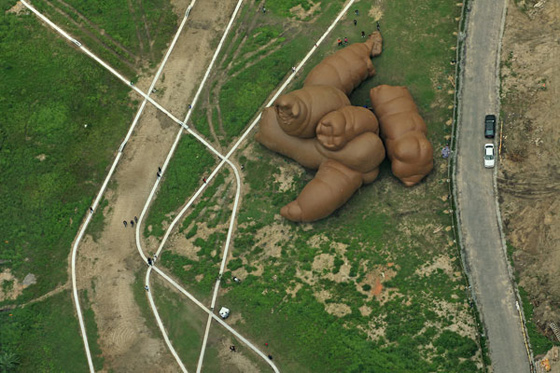 © Artkurio.com Paul McCarthy, Big Luck, 2013
Modern critics are condescending to the use of poop. The conclusion of Gillian Steinhuer regarding the “River of the Apkata”: “Barney is one of the few artists who still believe in the possibility of shocking the audience.” Her skepticism can be understood: on the Internet for a long time there is already everything. Donald Kuspit in the essay “Triumph of the shit” (2008) claims that bodily excrement (which he equates to garbage) has long become ordinary, assimilated, even decent in the context of avant -garde practice: they lost all transgressive or revolutionary potential. I would noted in brackets that the art world is still not so loyal: the Brener is an outcast, the person is non-grata for many galleries in Europe due to fear of his dirty protest. But in general, the bites are rights. Shit is already too aesthetized by artists: it has become a product of symbolic economy. Here you can refer to Mantzoni banks, to the sculptures of Paul McCarthy, to the decorative paintings of Chris Outili, drawn by elephant feces, and, perhaps, on the “River of the Apotive Pass” of Barney and on no.660 Creed. Creed has a young woman, pleasant herself and is also clearly shy about her occupation. The video is shot in profile, we do not contemplate the bowel movements mechanics. In short, everything here comes down to Soft Porn techniques, and thus, no.660 Creed turns out to be a typical salon art.
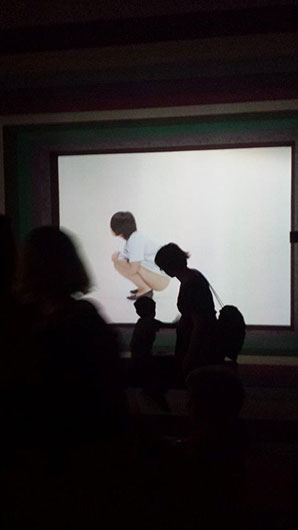 © Matthew Baun Martin Creed, No.660, 2007 At the Hayward Gallery
Alexander Melamid told me that he saw in India the beach - a spacious and beautiful one, which the local population uses not for sunbathing, not for walking and not for picnics, but exclusively for bowel movements. And in the West, civilization in the form of hegemony of sewage conquered life. An ordinary person who wants to contemplate the process of human bowel movements has a choice: to go to third world countries, but this time and money (besides it is not known how long it will be possible to exist such special places as the beach of Melamida, indicating local traditions); To immerse yourself in porn films suffering, alas, from the one -sidedness of the director's concept; Or the easiest way is to go to the State Art Museum or to a commercial gallery - the most convenient places for reflection on cultural vectors and the spiritual potential of our excretory processes.