
Translated material
City in intensive care
Ekaterina Sergaskova
In Odessa in a wretched empty. Usually, there are no May in the cafe in a cafe on Deribasov’s free places, and now employed tables are one or two. Rare passers -by are talking:
- Odessa was always peaceful, after all, no one wanted this.
- People have become very aggressive, yes. Very aggressive.
On the corner from Zhukovsky, the sign "Grezky Maidan" is installed. Until May’s second, the space around the Athena shopping center was called an area, now only the Maidan, and Greek Street Street Grushevsky. Some renamed May in February - Odessa events are too similar to what happened on February 18-20 in Kyiv. When the Maidan’s self -defense decided to break through to the Verkhovna Rada, it was the same sunny and warm day as the second in Odessa. On such days, it seems that nothing cruel can happen. The first grenade exploded in this spring air brought me into a numb. I remember how it was.
It all started suddenly and quickly. Supporters of Ukrainian Odessa met on Cathedral Square. It sounds ridiculous, as if in St. Petersburg - and Odessa is often compared quite justified with Peter - a rally gathered in support of Russian citizenship. Between people who tied their yellow-blue ribbons, young guys stood in fan scarves. They did not particularly want to talk with outsiders, they were serious and focused, as if they had already known something.
Somewhere nearby there was a scream in Megaphone-a tall guy in ordinary city clothing, without any ammunition, said that pro-Russian activists from Kulikovo Paul, where anti-Maidan stood for two months, attacked pro-Ukrainian self-defense. This whole yellow-blue crowd shuddered, fused into a single lump and rolled into the sound. A few moments, and Greek Street, coming from the Cathedral, turned into a gray mess. Unstable stone urns are touched, paving stones are divided into pieces, grenades release caustic smoke, and it seems to be real bullets above their heads. The understanding that all this is actually happening only when the crowd ran to me, falling through the fence of the cafe, and a small stone flew into the leg.
Here is still the one, from the fourth floor, covered with someone else's jacket.
- Who has an extra helmet? - I asked in the air and saw that almost everyone around me, without helmets, and several guys have already been wrapped in bloody bandages.
Those people who stood quietly in the square, singing the Ukrainian anthem, turned into fighters who were ready to fight without any protection. Even a young girl in a T-shirt, from under which a pink bra was looking awkwardly, picked up an ax and chopped tiles under her feet, and her friend handed her to the guys on the front line.
No one could have thought that in Odessa, in this bright, resort, even some kind of country town, his own Maidan would unfold, and immediately in the acute stage. For some thirty minutes-and people with yellow-blue bandages were thrown by the mantle cocktails of people with orange-black ribbons (they are called “colorandum”). Meanwhiles, police officers in helmets, silent and powerless, like cerebrals, from whom they pulled out fangs, stood calmly and slurred. A few days later, one of the police chiefs, trying to persuade the guy with Megafon to redirect the crowd to the stadium instead of Greek, told me that there was no opportunity to stop the clash.
Before my eyes, several anti -Maidans were beaten who failed to hide. They were beaten with their feet and demanded to confess to separatism and pronounce “Glory to Ukraine”. Holding the tablet in my hands, I screamed and asked not to kill, but the scream seemed deaf and not my own, exactly like in a dream, when you try to run, but you can’t. When a shot man gave the spirit in front of me - as it turned out later, the pro -Ukrainian peaceful rally - could not look away for a long time. It pulsed in my head: "It cannot be."
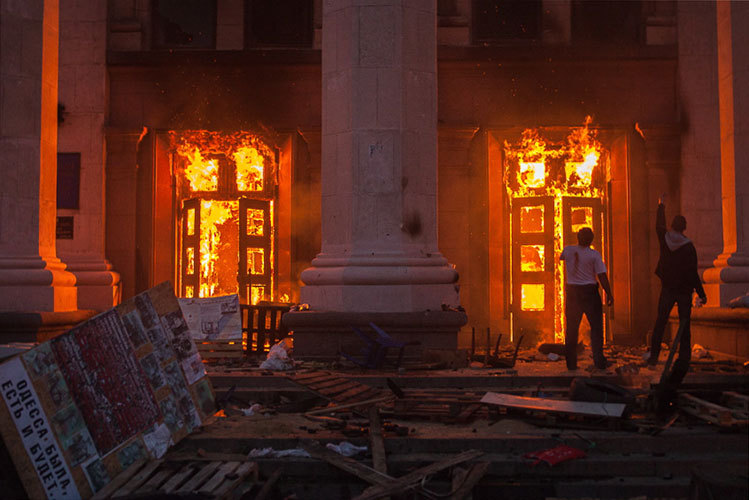
When the inveled crowd went to the Kulikovo field, where supporters of the federalization of Ukraine spoke from the stage yesterday, who promised that on the second of May there would be no provocations on their part, I hoped that there was no one there. And for some reason, supporters of federalization climbed into the house of trade unions, and from there they began to fly to Molotov cocktails and bullets. Only ten minutes, and the camp disappeared in the fire, and soon the building flashed. A man fell out of the window of the fourth floor, the crowd cried out. It seems that only at this moment people began to realize that something was wrong. Not that they went to the Cathedral Square at three in the afternoon.
Now in Odessa quietly and empty, as if the city was seriously wounded and sent to intensive care.
The first fire engine arrived soon. Activists began to remove people from the upper floors themselves and help to get off those who were clamped in smoke on the first. There are no thoughts in my head - only a fixation of the sequence of actions. Here two were removed, they serve a rope there several more, and here it still lies from the fourth, covered with someone else's jacket.
Late in the evening, when the fire was extinguished, and people with yellow-blue ribbons diverged home, a man came up to me in a body armor, asked to turn on the camera and began to pronounce a screaming about Putin, but stopped short. He took me by the elbow and led me to the house of the trade unions, which has already been cordoned off by the ineffable Cerberries. Black slurry squayed under my feet and smelled terribly with something burnt.
“Look there,” he said. - I was just there. There is a very, very many bodies there. It's scary, you know? Very scary. You just know.
The next morning, women with flowers came to Kulikovo. They sobbed with grief and rushed to those who tried to argue about what had happened. The next day, they stood under the building of the Odessa District Department of Internal Affairs and chanted the slogan, which is now so popular in the east of Ukraine: "Fascism will not pass." And they rejoiced when the guys with orange-black ribbons were knocked out by glasses, broke into the control territory and began to destroy everything that came to hand. When the detained pro -Russian activists began to withdraw from the police department, women cried and hugged them with the words: "You are the heroes of Odessa, you are real, our heroes." They hugged me when I ran out of the yard, because I just almost fell under a hot hand for a man with an orange-black ribbon who attacked my colleague with his fists.
The voltage reached a boiling point on both sides. It seems that the whole aggression that once had already wandered among the police had moved to ordinary citizens. When the Cerberries lost their fangs, the fangs grew up from the people.
Now in Odessa quietly and empty, as if the city was seriously wounded and sent to intensive care. The spring fair, which recently appeared on Deribasovskaya, stands without guests. The Greek Square with traces of bullets mudtles silently. Broken paving stones in heaps are collected in the sidelines. On the Kulikovo field are flowers and lamps, and the house of trade unions still smells of burnt. Walking around this city is now as strange as if that nightmare was replaced by new, viscous, predawn.
Timur Olevsky
I remembered a bright youthful experience. It was at the Taganskaya station. I suddenly wanted all people to become the same as me. The same kind, sensitive, attentive. When a train appeared in the tunnel, I realized that people are not obliged to be like me. And when the doors of the car opened, I experienced almost the horror that all people could actually become the same. And even more so, like me. I later called this experience "get sick of fascism in three minutes." And forgot. And in Odessa he suddenly remembered.
Near the captured police on Preobrazhenskaya Street, two young women and a grayish man in a tie were resting in a cafe under the very collar. Cute, offended, with curly hair, one of them comes up to me and says: "Eighty percent of Odessa residents for Russia, only say this." “You yourself say” - I give her a microphone. “And write my phone,” says the man in a suit. “I came here, I am engaged in spiritual practices, resurrect people.” “Thank you,” I say, took the phone.
A minute before, I left the police yard after 80 Anti -Maidan released activists under the cries: “Heroes of Odessa!” Someone hugged me, taking me either for the liberator, or for the liberated. Sincerely hugged. At the headquarters of Odessa self -defense for United Ukraine, an evacuation was announced that evening. So that the volunteers are not locked in their small extension, everyone went with things to Duke.
"How many Odessans for a single Ukraine?" - I ask there. “Eighty percent,” the man in the helmet tells me, but immediately recovers: “For.” And a little more. Between them, Odessa residents who are not engaged in politics. Odessa is a city of business, not politics. ” "Do you have a family?" “No, I'm lonely, but there are family.” “You did not protect us why you are needed, give a form, go home,” they say to the police colonel nearby.
“I came here, I am engaged in spiritual practices, resurrect people.”
Before that, I went to checkpoint with the coordinators of the Maidan headquarters. Two people with Odessa, but not caricatured, cinematic, but a real dialect explained to me how they protect the city from invaders and separatists. They spoke from the front seat of the car, so they turned into profile. Round, southern Jewish noses, soft consonants and stories about grenades, walkie -talkies and supplies. The car has a Ukrainian flag. “If we, Odessa, have undertook to protect ourselves, we cannot win.” “This is a movie, it is true,” I think. Such an easy adventure film about the Civil War, Dovzhenko studio. Here are half the Jews discuss the defense of the city in Odessa.
On the sidewalks are flowers.
But no one - neither those nor these - believes that they shot their own.
I go with my Odessa acquaintance from the synagogue, where young fighters of the Right Sector pray, to Deribasovskaya and ask when the movement began to join Russia. She replies: “So together with the Crimea it began. As soon as polite people appeared there, they started talking about joining, and then they repeated all the time: see how good they are. After the Maidan, the youth spoke in Ukrainian, after the Crimea, pensioners with other young people went to hang tricolors. ”
I can't collect thoughts all the time. I can’t think about bloodshed in Odessa, under the sun. Nobody seems to be. Odessa tragedy does not fit in my almost religious idea of the city.
Only two days later I realized why I remembered that my experience on Taganka.
A shadow of a large country hung over this city, which wanted everyone to be similar. And the city seems to have experienced the same as me. And just as fast.
Odessa will be protected. From those who will force you to become in service. Each force will have its own eighty percent. But here they will not let Odessa be change here.
I felt a real foreboding of the Civil War in Ukraine here and immediately realized how the city got rid of it. He defined the threat as external and suffered his fears and hatred, everything that divides people in the city beyond the brackets of state borders.
And Odessa will be forgiven with the dead and will remain the same sunny. Only even stronger.