
Translated material
The color of the centaur
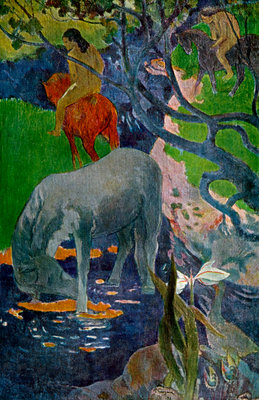
I started an examination of the exhibition with the picture that, no matter how wild it sounds, played a role in my personal life. The fact is that in the very beginning of the 1960s, the father wrote out the only foreign periodic one then available then-wonderfully designed Polish magazines. He did not know the language, but admired the pictures - from Bridget Bardo in a bikini to the reproductions of the Western, then not yet permitted artists. In my misfortune among the latter was Gauguin: naked girls riding horses, including white. Having framed the notch, her father hung her on the wall just when my first teacher, a harsh woman with the pagan name of Iraid, paid us a pedagogical visit. Naked Tahits made a difficult impression on her.
“The apple is not far from the apple tree,” the teacher said, although my sins could not be compared with the Gauguin.
Skillful, as they now speak Russian, “image maker”, Gauguin with all his might supported the image of a romantic genius, which stood over bourgeois morality. Indulging the long -standing fantasy of the West about "noble savages", he, referring to the relationship with the Peruvian Indians, depicted a savage who rebelled against the dilapidated conventions of the tired civilization. At his grave (he died on the Marquis Islands), Gauguin ordered to establish instead of the cross a rough stone statue of a pagan idol.
To evaluate the art of Gauguin on his conditions, you should listen to his complaints.
“Lord,” he wailed, “how hard it is to write paintings when I want to express the thought by means of painting, not literature!”
This important recognition explains the gap of Gauguin with the impressionist tradition, which made its painting possible. Having learned the lesson of the predecessors who freed the picture from the topic, Gauguin sought to again introduce a story, mythology into the art, ultimately the content. He returned the plot power over the picture, but it was already a different plot. After the impressionists who saved painting from narration, not a new narrative, but a symbol came to the fine art.
According to the clear formula of Averintsev, the symbol is the balance of form and content. The secret of this parity is perhaps the most difficult in art. If the meaning prevails, the artist remains with allegory, if the form wins - with an abstraction. Only a balance, difficult, like a pas de de on a log, creates an unequity unity of visible and invisible, beauty and depth, natural and supernatural, reality and truth lying behind it.
In Russian art, in my opinion, Vrubel came to this ideal, in the Western-Gauguin.
Once on Tahiti, he wrote there what he saw, but the way he wanted to see. Responding to their critics, who were no less than my teacher, they were annoyed by implausible colors and the distorted prospect of his paintings, the artist said: "They say that color photography will finally present us the truth. But what is the suit of a centaur?"
Covering the colors of fantasy, Gauguin tried to blind from his images primitive mythology, to create a world full of gods, to show people who did not know the fall, alien to any morality, simply because they still do not need it.
Gauguin turned reality into an idyll and passed it down for utopia. And a century later, we trustingly follow him, repeating the poems of Mallarme, who knocked out the artist for voluntary exile:
The flesh was disgusted and tired of the books.
Run ...