
Translated material
"Wishlist", bluff and propaganda: the May plan of Putin
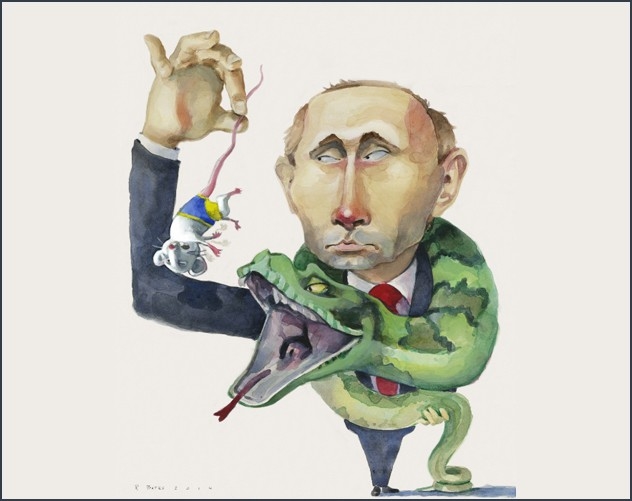
One of the main problems of Vladimir Putin is a third term is his unpredictability. No one (and, probably, he himself) can really formulate the short -term and long -term courses of domestic policy. With foreign policy, everything seemed much easier before the accession of Crimea. After-it is unlikely that you can find someone who will confidently answer such questions as: whether Putin will introduce troops to Ukraine, whether the plan of joining the eastern regions is being prepared, what is the plan of action in case of further tightening sanctions, for what concessions the Kremlin is ready to resolve the Ukrainian crisis and so on. In other words, no one knows that Putin will throw it tomorrow. However, in fact, there is already a plan, and it is even published. Reading the pro -Kremlin press sometimes a very necessary lesson. It is there that you can find answers to many questions that today raise experts, journalists and diplomats to a dead end. For example, Peter Akopov in the newspaper "Gazyu" quite frankly draws a picture of the future of Ukraine, and at the same time reveals the "plans" of Russia's actions. And they, admittedly, are more than detailed. So, let's try from a propaganda column to make a schematic plan of Russia's action on May in relation to Ukraine (in the form in which the Kremlin would like this “plan” to be perceived). Step one is the recognition of the legitimacy of referenda scheduled for May 11 in the Lugansk and Donetsk regions. Step two is the recognition of the independence of these regions that will receive the name of Novorossia on Russian television. Step Three - Gas Disabling to Ukraine. Step fourth is the non -recognition of the legitimacy of the presidential election of Ukraine. The fifth step is the political, moral, technical support of “supporters of federalization” in other eastern regions in order to prepare referendums about self -determination there. The sixth step is the unification of the broken regions into the Republic of Novorossiya. The seventh step is the conclusion with the “state” of the agreement on strategic partnership, the placement of the Russian military contingent on its territory. The step of the eighth is negotiations with Kiev on the Confederation (this, apparently, is what Kyiv in his position will be allowed to dream). Voila. As Putin would say, everything succeeded without a single shot. At the same time, even Peter Akopov, who speaks of himself as a person who adheres to the right, conservative-nationalist views, convinces that Russia will not fight, as well as to join almost no recognized territories to itself. In fact, this “plan” is nothing more than an ultimatum to Kyiv and one of the brightest “horror stories” that Moscow is trying to scare the Ukrainian authorities: if the presidential election is not canceled in the near future and the constitution with our triad of strategic “Witness” (federalization, neutral status, Russian) will pretend to contribute to the described above scenario of events. And, no matter how scary, probably, such a plan is in the heads of the inhabitants of the Kremlin cabinets, only with some critical amendments. The first - it is unlikely that the Kremlin will actually decide on the recognition of the independence of the Lugansk and Donetsk regions, at least in the short term. It must be borne in mind that the referendums themselves will be very doubtful: they are carried out in a situation of either dual power, or a vacuum of power, and it is almost impossible to organize a full -fledged process of will, not to mention the legitimacy of the decision itself to conduct a referendum and legitimacy of those who made this decision. But to play on the probability of such a recognition is possible, and the Kremlin will do it. The second follows from the first - the scenario of concluding agreements with new territorial formations and even more so the placement of the military contingent there is almost incredible. This will only mean one thing - war. Moreover, the war is not only with the “damned junta” and the supporters of the Maidan in the East (and there are a lot of people as we saw in Odessa), but also with those oriental Ukrainians who were opposed to Kyiv, but friendly in relation to Russia (for many of them, this friendliness does not mean the willingness to move under the direct patron of Moscow). The third - the entire step -by -step scenario inevitably guarantees critically destructive for Russia the tightening of the position of the West and the introduction of sector sanctions, as well as sanctions against state -owned companies and cannot be excluded, personally against the president. This is the path of the unambiguous isolation of Russia and the “Lukashenization” of its leader. Apparently, Putin is not ready for this today, counting on only one thing: as the situation in Ukraine (not without our help) is raised, as the violence and risks of new revolutionary impulses are increasing there, the West adjusts its position and attitude to what is happening and agrees to the scenario of the crisis of the crisis promoted by Russia. Moscow is also ready to make concessions: for example, to abandon the word “federalization”, but subject to the electoral authorities. In other words, the published “plan” is a mixture of really existing and discussed “wisdom”, bluff and propaganda. This is a hard ultimatum, which is presented to Kyiv, but not at all with the aim of making it fulfill the requirements. This is an ultimatum with the aim of radicalizing the unofficial position of Moscow, increasing the fears of the Ukrainian authorities to lose control of the territory of its country. And then, as is often the case with Putin, as the card will fall. And if the West does not reconsider its attitude to what is happening, the Kremlin will find “hot heads”, ready to implement the described “horror stories” into life. And the war will become inevitable.