
Translated material
For non -block status
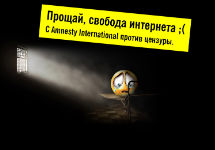
The international human rights organization Amnesty International began the campaign in support of the "faces". The human rights activists consider the blocking of our site on the law of the meadow the act of political censorship and the “undoubted violation of the right to freedom of expression of opinions”. They urge to send letters of protest to the Russian authorities . "Express concern in that in the territory of the Russian Federation access to sites is blocked due to the publication of materials about peaceful protests," says Amnesty International. Users are invited to demand from the Prosecutor General’s Office the cancellation of the decision on blocking, and from the State Duma - the cancellation of the Luvus Law. This law "contradicts Russia's obligations in the framework of international law in the field of human rights, the Constitution of the Russian Federation and the norms of Russian law," notes Amnesty International.
"The indefinite and unlimited blocking of the whole site, and not individual pages with allegedly illegal information means the suspension of the entire media. Even if you have never heard of" faces ", the fate of this site can become the fate of any Russian Internet resource," the Russian department of Amnesty International writes on his Facebook page.
The Lugovoi Law, which entered into force in February, allows you to block the sites without warning the prosecutor for calls for participation in inconsistent shares. On March 13, according to this law, the “facets”, Ej.ru, Kasparov.ru and the blog of Alexei Navalny were blocked. The "facets" immediately appealed the lock.
On May 6, the Tagan court recognized the blocking of the "faces" of the legal . In court, representatives of the Prosecutor General and Roskomnadzor refused to name specific publications that caused the blocking. Meanwhile, article 15.3 of the Law "On Information, Information Technologies and Information Protection" directly states that the requirement to block the resource must contain a "website of the site on the Internet" Internet, network address, signs of the site on the Internet, which allow identifying such information " (identified by us. - Ed.).
According to representatives of the supervisory authorities, the decision on blocking was made on the basis of a prosecutor’s conclusion that “a significant part of the site” contains calls for inconsistent public actions. As an example, the prosecutor’s office presented the screenshot of the Grani page with a note on the March Strategy-6 campaign in defense of swamp prisoners. According to the representative of the department, Major Gavrilova, the publication does not contain direct calls to participate in the shares, but in the context of all publications of the "faces" the note can be perceived precisely as such a call. Her colleague from Roskomnadzor Maria Smelyanskaya, in turn, said that "to question the conclusion of employees of the Prosecutor General’s Office is unacceptable."
The obligation to prove that unlawful information on the site is absent, lies with the owner of the information resource, said the representative of the Prosecutor General’s Office. At the same time, an employee of the RKN noted that the mechanism of unlocking sites has not been fully worked out.
The “facets” indicated that the blocking of the entire resource violates the media law, which provides for the termination of the publication only by decision of the founder or court. Representatives of the defendant objected that the “facets” were not deprived of registration as the media.
The “facets” intend to appeal the decision of the Tagan court, and later file a complaint with the European Court of Human Rights.
Simple ways to restore access to illegally blocked content: http://grani.ru/wiki/blocked/