
Translated material
The moon is in the window
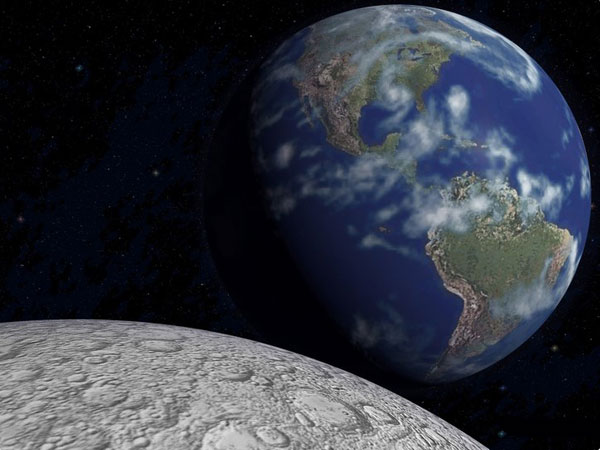
The plans of the Deputy Prime Minister Dmitry Rogozin on the colonization of the moon were not his personal initiative, but by a brief presentation of the draft concept of the Russian lunar program, the text of which was at the disposal of Izvestia.
The project of the lunar program was developed with the participation of various enterprises of Roscosmos, the Russian Academy of Sciences and Moscow State University. The authors of the concept are sure that in the event of its implementation by the middle of the 21st century, a inhabited base will appear on the Earth's satellite, whose inhabitants will be able to extract lunar minerals. The first adjustment of Russian astronauts is expected already in 2030.
The developers are sure that in the coming decades between the governments of the earthly states, “geopolitical competition” for the moon and its natural resources may begin, and therefore, Russia should be ready for this, including creating its outposts on the satellite.
The authors of the program believe that the leading space powers in the next 20-30 years will "explore and consolidate the lunar bridgeheads to ensure the future possibilities of practical use." It is assumed that there are not so many convenient points for placing lunar bases - the most profitable places are located near the lunar poles, where the sun's rays are directed almost along the tangent to the surface and thanks to this the sun is constantly shining on the lunar mountains, and in the lowlands a constant night.
The project recognizes that it will be easier to master the moon with the involvement of foreign investments, including private ones, however, it is emphasized that "the independence of the national lunar program from the conditions and scope of the participation of foreign partners in it should be ensured." In other words, the developers believe that the lunar program can have a national character, and the colonization of the natural space object closest to the Earth can occur for the forces of one country.
To maintain the correct pace of mastering the moon every 3-4 years, the next stage of the lunar program should be implemented, so no one in the world will have doubts about the technical power of the Russian state.
So far, there is no technical and economic substantiation of the integrity of mining on the moon-to write this document, it is necessary to conduct geological exploration of the proper level, which will show the degree of content in the lunar breed of certain elements of the Mendeleev table. But after studying the moon and obtaining accurate data on deposits of various fossils, it will be possible to attract private investments.
All work on the colonization of the moon is divided in the concept of the concept into three stages. From 2016 to 2025, it is supposed to send only four automatic stations to the Earth's satellite. These devices will have to determine the composition and physico-chemical properties of the polar regolithic (lunar soil), identify the presence of water ice and volatile compounds, as well as help choose the most promising areas in the field of the south pole of the moon for the future deployment of the Russian lunar base.
The second stage, which will last until 2030, will consist in organizing manned expeditions into lunar orbit - however, landing is not supposed to be.
The third stage will last another decade, it is then that the astronauts will visit the potential area of the lunar base for the first time, and the first elements of the infrastructure - the first observatories, as well as objects for monitoring of the Earth, will also be deployed.
The cost of the described lunar program is still unknown. The estimate of the first, the cheapest, stage is estimated at 28.5 billion rubles at current prices.
Meanwhile, how meaningful the colonization of the moon is, while disputes are underway. It is known that the moon has quite large reserves of metals - iron, aluminum, titanium. However, all these fossils are on Earth, and their production does not represent any particular complexity.
It is also known that in the surface layer of the regolith there are huge reserves of Helia-3 isotope, which in theory can be used in thermonuclear reactors. Today, one liter of helium-3 costs more than $ 1,000. Scientists believe that on the moon it is from 500 thousand to 10 million tons. According to some calculations, approximately 30 tons of helium-3 are enough to provide energy to all the Earth throughout the year.
Currently, there are no industrial methods for obtaining metals and helium-3 from the moon breed, but nothing prevents you from starting their development.
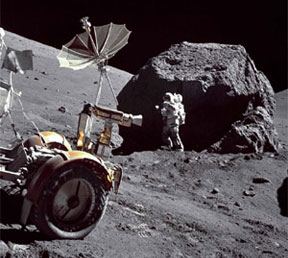
Oddly enough, the moon may turn out to be an ideal place for the placement of many industrial facilities. And the point is not even in dirty industries, but in the fact that on the Earth’s satellite nature created almost ideal conditions for electronics and metallurgy. A deep vacuum and the potential presence of cheap electricity obtained from helium-3 create ideal conditions for processing metals and creating microelectronics-on Earth the conditions are objectively worse due to a large amount of free oxygen in the atmosphere, which worsens the quality of casting and welding, and also makes it impossible to obtain ultra-water alloys and substrates of microcircuits in large volumes.
The moon can also be an ideal place for the placement of space observatories. Modern telescopes on Earth and its orbit can see what is happening over millions of light years, but they still interfere with the abundance of radio waves and excess light, which are companions of human civilization. Many astronomers have long dreamed of placing a telescope on the back of the moon, to which radio waves do not reach the ground.
However, not everything is as rosy with the moon as it might seem. Not for nothing, not a single state has begun in the colonization of the natural satellite of the Earth - so far it seems simply an unprofitable project.
In order to use helium-3 in the energy sector, technologies are needed that humanity has not yet disposed. In order to launch a thermonuclear reactor, it is necessary to reach a temperature of a billion degrees and solve the problem of holding the heated plasma. Today, scientists manage to keep plasma, heated only to several hundred million degrees.
In addition to everything, helium-3 is quite difficult to get. It is not assembled in the deposits, but quite evenly distributed in the regolithic. 100 tons of lunar soil contains approximately a gram of helium-3, thus, at least 100 thousand tons of soil must be treated for the extraction of a kilogram of helium-3.
Due to the absence of atmosphere on the moon, due to which some plan to establish on the satellite plants for the production of microcircuits, the surface of the Earth’s satellite is covered with sharp particles (they are not smoothed out due to erosion), which, in addition, have an electrostatic charge. As a result, dust has an abrasive property and can significantly reduce the life of the mechanisms, each of which will cost orders of magnitude more earthly analogues due to the cost of delivery.
And the geopolitical significance of the moon is called into question by many: of course, the state, which will win the next “lunar race”, will receive its share of glory, but how to convert it into something useful is still incomprehensible.