
Translated material
Between the first and second
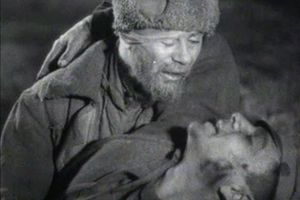
How did we see the war? Another, imperialist. The one that seems much closer today than the domestic. Maxim Semenov - On the representation of the First World War in our cinema.
A few days ago, director Nikita Mikhalkov, who is responsible for the sovereign in Russian cinema, said that the first world was slandered at school. In a hasty manner, the monument to the heroes of this war is built on Poklonnaya Gora (it seems that the monument designed in the best traditions of late Soviet architecture, only with icons and kings, should open in August). The bookstores are full of biographies of Kuzma Kryuchkov and Nesterov, the ubiquitous activists of the Rocks are removing the memorial fraternal cemetery, and state television channels show the cycles of documentary programs that inspire us with the idea of the greatness and sorrows of those old years.
The war, which destroyed the "yesterday's world" and turned the private time of millions of people during the historical one, again becomes relevant. They write about her, they remove about her, they talk about her. And almost every story about the First World War is inspired by one thought: this war was silent, the general betrayal did not allow us to capture Tsargrad and the Straits, and the Bolsheviks, the apogee of universal betrayal, tried to erase the memory of the heroic war, while sinking it as much as possible. The idea is logical, but, like most logical ideas, it is very far from the truth.
Indeed, the First World War did not give rise to a state cult around itself. However, it would be wrong to call her forgotten. Her events were actively reflected and interpreted in art. For example, in the literature in the 20s and 30s there were many works directly related to the war. The First World War plays a significant role in the “Transfigured Russia” by Sergei Sergeyev-Tonsky, “Rus” by Panteleimon Romanov, “The Great Division” by Alexander Lebedenko and many others. Finally, the events of the war were reflected on the pages of the two most important Russian novels of the 20th century - “Quiet Don” and “Dr. Zhivago”.
But this note is not about the war at all and not about literature, it is about cinema.
A high pre -revolutionary cinema rarely and reluctantly turned to the events of the day of the day. If the sensationality beckoned easier for people, then the audience that was seen went to the symptographer for sensations of a different kind. They preferred to read about the war in newspapers, while they waited for the wringing of hands and ethereal beauty.
The situation began to change after the February Revolution. And not anyone changed it, but Evgeny Bauer himself is the largest master of early Russian cinema. Already in the spring of 1917, he shot the art drama “Revolutionary”, which indirectly touched on the topic “Second Patriotic War”.
The main character - a fighter for the people's business, sent to the tsarist authorities to Siberia, returns to Moscow in early 1917 and with horror finds out that his son became a Bolshevik. Among other things, the son tells the hero that the proletarians have no homeland, and therefore he decisively does not intend to support the war.
In several pathetic scenes, the elder, which was killed by gray hair, indicates the offspring of marching soldiers - real heroes fighting for free Russia, after which the father and son decide to go to the front together. All this is accompanied by endless kisses, wringing hands and hugs, which look naively, if not wild, almost a hundred years later.
However, the “revolutionary” only outlines the topic. The film ends at the very moment how the heroes sit on the train that should take them to the front, and we do not see the hostilities themselves, and we cannot see. Time to comprehend what was happening has not yet come, and Bauer honestly removes a beautiful appeal, which should touched and move his viewer. No more.
Soon the October Revolution occurred, the civilian - the image and comprehension of the First World War began to lose its relevance. Everything was mixed in the country, and now yesterday’s enemies, Germans, they remove the “horrors of the Kyiv Extraordinary” (with executions and torture of officers), and the suppliers of salon dramas are “the atrocities of the Denikin bands” (murders and rape of civilians in a random order).
The First World War returns to the screens only with the end of the civilian one. Life on the territory of Soviet Russia was slowly restored, people began to look back, trying to understand the reasons for the changes that occurred with the world around them. And to circumvent the war with in silence with which it all began was simply impossible.
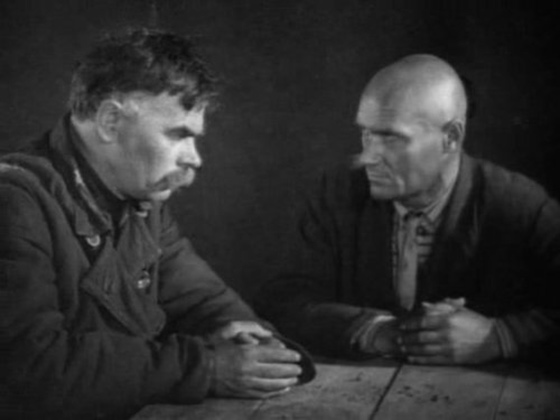 Frame from the film "End of St. Petersburg"
In 1927, the "end of St. Petersburg" Vsevolod Pudovkin was released. The war in this picture is devoted to perhaps the brightest episodes. Suddenly, headless people appear on the screen - industrialists and royal ministers who share military orders. At the same time, crowds of patriots with tricolors and posters are poured onto the streets of St. Petersburg. Filed in the ironic manner, they cry with happiness, sing hymns, refuse German production products and make countless speeches, demanding to protect the civilian population of Serbia. Feeling the strongest unity of society, passers -by enthusiastically kiss the police. General agitation reaches such a high point that the monument to Alexander III, the king, who was friends only with the army and the fleet, begins to sob from tenderness.
Almost immediately, Pudovkin shows the front line. Soldiers are preparing for the offensive, which he mounts with bidding on the exchange in order to demonstrate the connection between the war and the growth of the shares of military enterprises. The solar hall of the exchange is opposed to the trenches wet from rain, in which soldiers sit. Pudovkin creates a feeling of a slow course of time at the front with several shots, after which he moves to the story of the February Revolution. At the “end of St. Petersburg” you can find several important motives that will be repeated from the film to the film: the unexpected beginning of the war, the ura-patriotic carbon car of 1914, when everyone is confident in the imminent and decisive victory over the enemy, the painful life of the front, when the soldiers are forced to wage a long and meaningless, in their opinion, the invisible border, which separates the soldiers from death to death to death to death to death to death to death to death to death to death to death bosses.
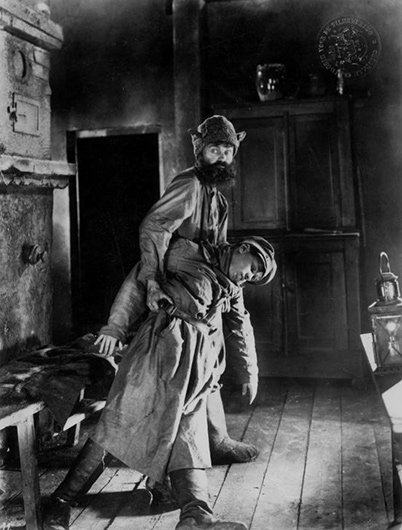 Frame from the film "Empire's Club"
The horrors of the war, as well as the deep abyss between the authorities and the ordinary, we can find in the “fragment of the empire” Ermler and the “Arsenal” Dovzhenko (both films were released in 1929). In both films, horrors are specified: in the military scenes “The wreckage of the Empire” we see how the hero stumbles at a frightening crucifix at night-someone pulled a gas mask on the head of Christ.
The image of the abyss separating the soldiers and authorities is not only continued, but also deepened: Fedor Nikitin plays both the Russian and German soldiers in the military stage, while the roles of officers are entrusted to other actors. The meeting of the Russian and the German, thus, becomes recognizing themselves in another, both soldiers are afraid to die and do not want to kill each other, the soldiers find a common language. However, the order of the officers to shoot to shoot an end to sudden unity.
In Arsenal, Dovzhenko Macabr was brought to almost extreme. In one of the most memorable scenes of the film, we see a person dying of gas poisoning. The soldier's face is skewed in a sardonic smile, he laughs and cannot stop. At the same time, Dovzhenko shows the bodies of already dead soldiers. Dovzhenko also mounts the paintings of human frenzy in the rear and at the front with the scenes in which Nicholas II keeps a diary, reporting that almost nothing had happened during the day. Scenes with a diary turn into a strong symbol of powerlessness of power, unable to help people who suffered in her unleashed war.
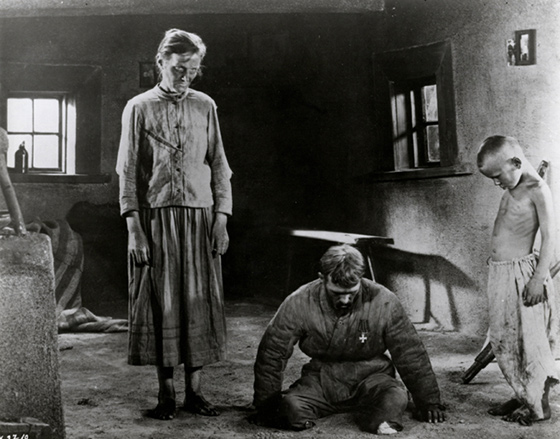 Frame from the film "Arsenal"
The indifference of the authorities can also be found in the first film adaptation of the “Pacific Don”, which Preobrazhenskaya and Rights were carried out back in 1930. There, the conditional Grand Duke, surrounded by a numerous retinue, mechanically distributes the icons to the wounded in the hospital. The prince’s face is impassive and most like a mask, and the distribution of the icon seems to be a meaningless ritual.
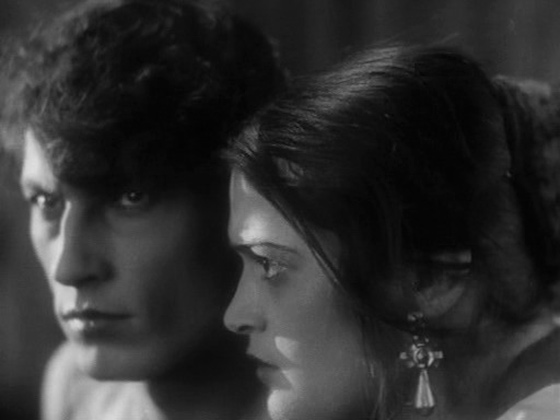 Frame from the movie "Quiet Don"
Over time, in the Soviet interpretation of the First World War, the idea of the unity of ordinary people who are forced to fight each other in the name of other people's interests is more clearly formulated. Soldiers fighting on opposite sides of the front line, random victims of xenophobia - all of them are, first of all, people, and this is enough so that they do not kill each other. At the same time, the faces of officers, princes and inhabitants in a wandering crowd often turn out to be masks, these are not persons, but bright types, devoid of subjectivity. Their actions are deprived of emotions or, conversely, are greatly exaggerated (delight, anger, tenderness - everything is brought to extreme).
Finally, the most significant statement on the theme of the First World War is the famous Barnet “outskirts”, which in 1934 took one of the prizes at the Venice Film Festival. Speaking about the arrival of the war in a small provincial city, Barnet not only brings to the logical end everything related to the First World topic, but also gives them a personal, human sound.
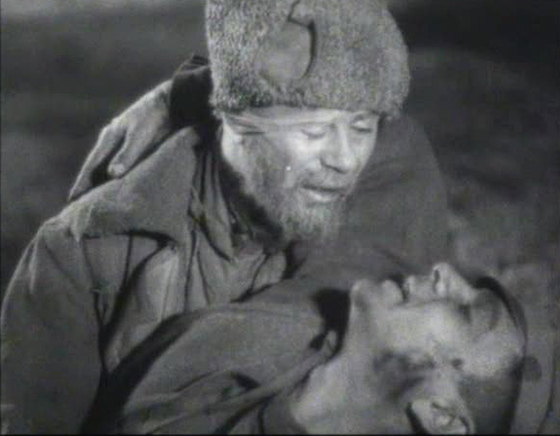 Frame from the movie "Outskirts"
So, the beginning of the war was decided through the quarrel of two bosom friends: Russian and German. Each of them is confident that the army of his country will nods the enemy with caps, and everyone is ready to abandon many years of friendship from “high patriotic considerations”. Barnet pays a lot of attention to the hardships of front -line life with a boring seat in the trench and a sudden enemy bullet. What is characteristic, his heroes, having hit the front, do not kill the Germans (the only clash with the German ends with his captivity), death always on the conscience of officers. The captured German, like almost all other heroes of the film, turns out to be a shoemaker and is not dangerous, while the enjoying of the enemy is a deemagogue, more and more reminiscent of Kerensky, and the owner of the shoe factory.
In the course of the film, Barnet makes his heroes cope with xenophobia and see in his alien. Ordinary people have no reasons for enmity, and patriotic rhetoric is a cover for meanness and crimes. All this leads not just to unity - in the finale, with the advent of the October Revolution and the end of the old one, the really new one, fundamentally different from the former world, begins. Heroes, alive and dead, cancel time and history and get up to go further, forgetting about the last war of mankind.
All this could be considered the features of communist ideology, if it were not for the “great illusion” of Jean Renoir, shot in 1937 and each of his scenes protesting against the war. His heroes overcome prejudices and learn to see their own reflection in the enemy.
Alas, in the late 30s it was already difficult to talk about the end of the story and the arrival of universal unity. People were alarming in anticipation of new shocks. Simultaneously with the film by Renoir, the film Kozintsev and Traubberg “The Return of Maxim” was released on the Soviet screen. The theme of the First World War appears in this film only at the very end, in one short and terrible scene. After the intercon, telling about Russia's entry into the war, a “patriotic” crowd appears in the frame. But there is no more irony in her interpretation. We see silent and serious people with torches and portraits of the king. They silently walk along the street. Sometimes their silence is interrupted by the simultaneous cry of "Hurray!" But in this cry there is no joy, only a gloomy threat. This is not a patriotic rally of 1914, this is a real fascist procession that is clearly familiar to the audience of the 30s.
The first war, the war, which could be discussed honestly, without unnecessary pathetics, a war, not erected into a cult, but recognized by madness, disaster, became more and more the property of history. The pacifist search for himself in another and the dreams of building a new world came something completely different. And in 1941, before the start of the second war, Mikhail Romm will hastily finish the “Dream” - a film in which only Soviet troops included in Lviv will bring happiness to the heroes.