Date
Author
Шекспировский сезон Алексея Бартошевича
Source

Preserved copy
Translated material
How do you like it
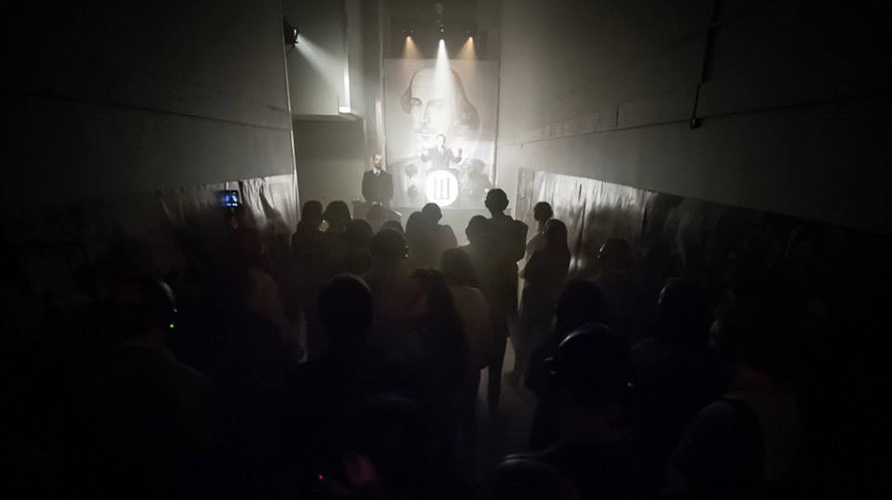
Have you ever tried to drink poison? And not just poison, but the very one that Claudius poured into the ear of the resting Hamlet-father? Do you know how the plays of Willyam of our Shakespeare, as well as their author, smell like? But did they try to taste the pies with humanity - those who serve on the table in the tragedy of Titus Andronik? But did not want to look at Shakespeare at the desk, something scribbled there? And look at the sheep grazing at Avon? And get into the head of the bard and swing there on a swing?
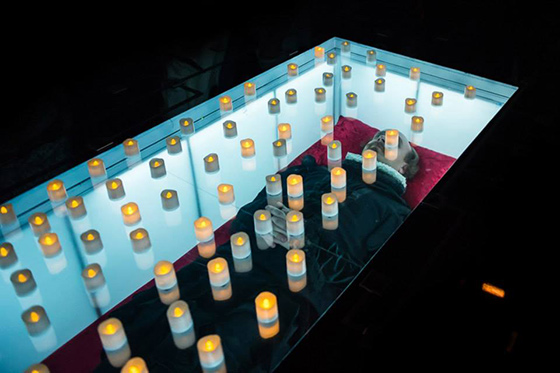 © Theater of nations Shakespeare is awakened
At the end of April, in the days of the Shakespearean anniversary, all these and many other rare pleasures gave us the theater of nations, showing a view called “Shakespeare. Labyrinth ”(director - Philip Grigoryan , playwright - Olga Fedyanina, artist - Galya Solodovnikova).
That it’s good to sit in the theater as sewn to one place (such and such a number, such a chair). It is much more fun when the audience is driven in the crowd of all the nooks (labyrinths) of the theater of nations - from stairs and wardrobe to the buffet and the auditorium; Entrusts and small performances on Shakespearean themes are prepared everywhere - almost all entertaining and funny and, of course, completely deprived of even a hint of anniversary fir trees. With Shakespeare, they do without unnecessary ceremonies, as with a comrade and a colleague, who is not a sin to sometimes make fun of. So that the anniversary is not very confused. Well, what is that he is an Avon swan and a genius in general! To kneel, or something, stand in front of him? Cover it with state gloss?
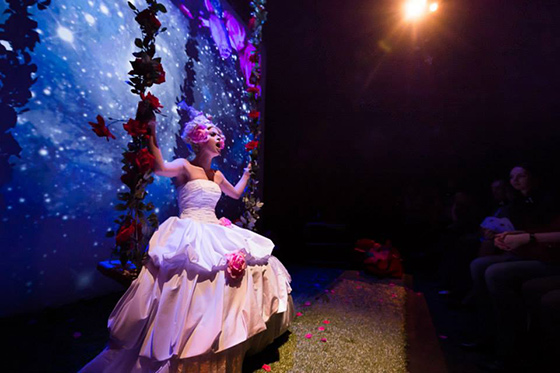 © Theater of Nations Opera Ophelia Philip Grigoryan
I hasten jealousrs of the purity of classic ries to inform that in the play (who wants to, can call him a performance, who wants to - a burlesque and who wants - a cabbage) parody not so much a bard as ritual sighing about him. It is not difficult to assume that Shakespeare himself would have grinned greatly from the memorized shakespeareous enthusiasm. And, on the contrary, he would probably like a slightly frivolous and slightly impudent youth stem through the theatrical.
The one who knows about the Ambrouase of Tom Hamlet only firsthand can shock the muffled-parody interpretation of the Ophelia aria, performed surrounded by clumsily bright flower flowers, ribbons and, moreover, with cats in baskets: a touched public is allowed to stroke cute animals (director-Philip Grigoryan). But the music of Tom’s music to the great tragedy, written in the spirit of a glossy salon kitsch or a belated Bidermaer, in my unenlightened look (I don’t know what musicologists will say), is unlikely to deserve a different approach.
The spirit of parody dared to touch even our native literature. Jubilee (1864) Speech by I.S. Turgenev about Shakespeare seemed to the authors of Liquid Theatre too much more and noisy-patriotic (not the French, not the British, but only the Russians are able to understand all the depths and heights of the world genius, etc.) and immediately became the target of unexpressive irony. Turgenev’s speech, accompanied by the enthusiastic cries of the invisible crowd, sounds on the stage as if it was a verb by the majestic Alexander Prokhanov.
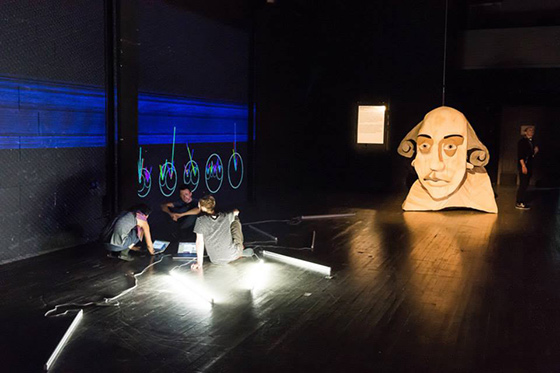 © Театр Наций Малая сцена была полностью перестроена под инсталляцию Московского Музея Современного Искусства
Probably, Turgenev’s speech would have liked our Minister of Culture very much, and he would not have looked at one slightly embarrassing circumstance: Turgenev composed this Panegyr in honor of the Russian spirit, being, as usual, in Paris. It seems that the ardor of his patriotic feelings, as it happened more than once with our classics, only increased as it was removed from the dear Fatherland.
As for the British classic, he confidently withstands a serious test of parody: by the way, there was a great master in this part (see “Summer Night Dream”, “Famulish Efforts of Love”, “Henry IV”, etc.). From which he is dragged from the labyrinth, according to which he is dragged along with a slightly stunned audience, he is selected without difficulty. And, significantly, without any loss for reputation.
While we are moving from one place of action to another, we are carefully informed about the life of the Stratford native - partly reliable, partly mythical: they say that in his youth he sinned with poaching, served as a school teacher, married three children, did not study in Oxbridges, moved to London, held horses at the theater, rewritten other people's plays, then rewritten alien plays, then He began to write his own and so on until returning to a small homeland and death on his birthday. Listing the numerous classes that the young Shakespeare was indulged in, they especially remind us that he, according to rumors, at one time served as an assistant to the butcher and, cutting the next bloodied carcass, recited tragic monologues. The alleged career guidance of the future author of bloody tragedies in the context of this representation turns out to be important.
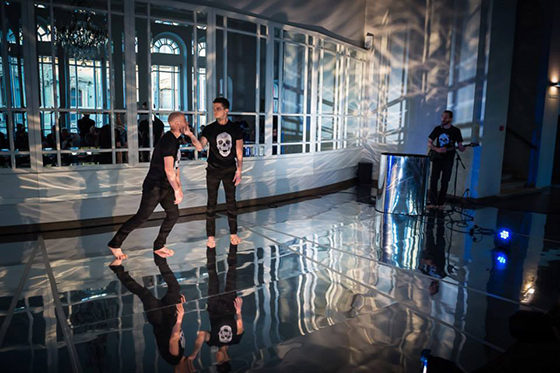 © Theater of Nations "Hamlet" from Dialogueedance
Few of the Shakespeare-labyrinth who worshiped will now doubt that the main work of the British genius is not “Hamlet”, as it was accepted in the previous, pre-dramatic times, but previously considered only the student experience of the novice playwright “Titus Andronik” with his savage set of corpses, severed hands and other parts of the body. Moreover, from the very beginning, the audience is introduced to the eerie, but, alas, a completely reliable catalog of Shakespearean cruelty - we are given an impressive list of people killed in his plays, also recalling more than sixty geese, from a bard to the feathers that written his works. (It would be nice to calculate the number of chopped calves, whose skin went on the covers of Shakespeare's primords: the defenders of the living nature will simply shudder.) As a result, the grotesque figure of the master of bloody horror stories appears before our gaze, in front of which Polansky and Tarantino are real babies.
This is not to say that Shakespeare did not at all deserve such a renom, and therefore, and a series of parodies, Burleskov and travesty played before us. By the way, in the philosophical "Hamlet" - as many as eight murders, not counting the death of the unfortunate drowned man, and five of them occur on the stage. But Titus Andronik is out of competition. And therefore, more other plays are open for a parody, which we are immediately readily and brightly demonstrated by us.
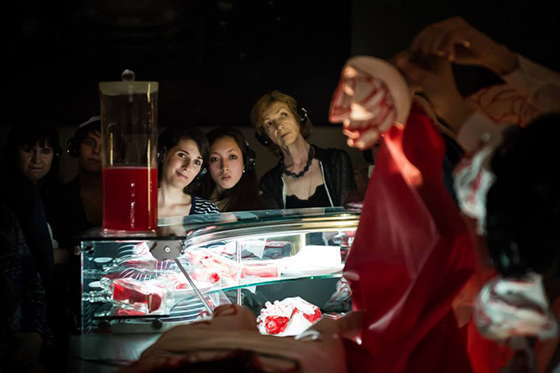 © Theater of Nations "Tit Andronik" Vyacheslav Ignatov
On the stairs, on the way to the buffet, a cleaning lady with a rag and a bucket hastily washes a puddle of blood from the floor, thereby reminding us of the content of the Shakespearean cannibalistic horror, called the Titus of Andronika (production is the Trickster Theater and director Vyacheslav Ignatov). The buffet is the most suitable place for the play, where mothers are served on a feast with a pie with a secretly baked meat of her children-in addition to other nightmares, which are packed with a tragedy of the “honey-hungry Shakespeare” (we will forgive him, firstly, we repeat, this is his first experience in the tragic genre, and secondly, still a person has anniversary).
The characters of the Titus of Andronika in outlandish pink masks (however, maybe these are witches from McBet) in the taste of postmodern horror films prepare a dish from a freshened and cut corpse for us (see a similar scene from the Greenee, thief, his wives and her lover ”), filling it with spices and seasonings, then to offer the most honorable The public pies with appropriate contents. The audience willingly grab them, obviously, in the justified hope that in pies there is an ordinary beef, and not the fruit of a cannibalist rampant.
 © Theater of Nations "Tit Andronik" Vyacheslav Ignatov
The tragedy version of the famous scene of Brad, Lady Macbeth, who was so impressing the directing of Titus of Andronika, who was played in the wardrobe.
Judging by the two chopped hands thrown on the floor (we will not forget about Shakespeare's butcher's youth), Lady Macbeth - at the same time by an avalanche from the Titus of Andronika, the very innocent girl who raped her lover on the corpse of her, and then chopped off her hands and cut off his tongue. The unfortunate Scottish queen, she is also the miserable daughter of the ancient Roman patricia, are tied behind her back (a sign that her own hinges are lying on the ground), and to transfer them from the floor to the washstand standing nearby (probably, in order to wash off blood from them), she has to be wielded first, and then, when it is not very good, resort to the help of her teeth. The text that she pronounces at the same time is a free imagination on the theme of the Shakespearean monologue.
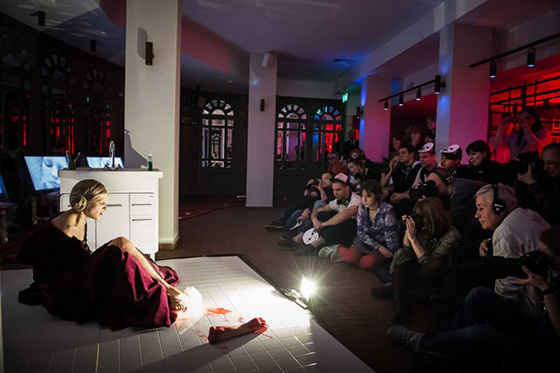 © Theater of Nations "Macbeth" Timofey Kulyabin
I’m afraid that in my presentation all this is like a cool absurdity or, rather, to a black comedy. However, the talented Elena Morozova somehow manages to play everything described so strongly that you involuntarily forget about the grotesque oddities of Misiangscen. And it inevitably comes to mind that the actress was simply born to play the heroine of McBet - of course, in a more adequate option, and not only with the help of teeth and legs (no matter how good they are). Why not take up the arrangement of the original text of the tragedy to the gifted by Timofei Kulyabin, the director of the version described. Moreover, Lady Macbeth is. In the end, Shakespeare's year is only halfway. And what does the anniversary have to do with it - as if this author was put only on his round dates. We had just seen a map of cities on the stairs, all strewn with luminous points, denoting the cities where Macbeth was walking and going on (the map hangs next to the evacuation plan on the occasion of the fire, which is very appropriate when it comes to Shakespeare's “Scottish tragedy” with her gloomy glory).
The final scene of Shakespeare. Labyrinth ”(director - Yuri Kvyatkovsky), addressed to the farewell drama of the Bard, was deployed in the auditorium of the Theater of Nations, the former theater of Korsh . We hear the monologue of the old theater chandelier, who saw the whole long history of these stage. The chandelier with the voice of Liya Akhedzhakova recalls how in 1901 the famous Nikolai Nikolaevich Sinelnikov set the “storm” with the whole set of theatrical miracles, accessible to the then technology: the ship on the stage fell apart and drowned, the sea waves rolled into the scrushes, Ariel flew in the air, the spirits were playing their ghostly performance, and so on, so on, and so on. The then taste, general for Moscow and London, in which Herbert Birbus reigned then (the fact that the Korshevskaya chandelier is also known about this - either one of the miracles of Sinelnikov, or evidence of the theatrical education of the antique lamp).
The postmodern irony is given to us without the slightest effort, it is proportionate to us much more than the depth and seriousness for which courage needs.
The irony in the finale is unexpectedly stained with sad, almost nostalgic lyrics. A wise chandelier is not about old -fashioned theatrical effects: what is Sinelnikov’s tricks next to the computer magic of Hamlet | Collage ". She is sad about the lost naivety, about the patriarchal innocence of the old theater, forever lost and contemptuously ridiculed by the skeptical spirit of future generations.
You can, with a shrugging, have plenty of sagging about the old sentiments and archaic tastes of the chandelier, which, probably, it is high time for a landfill.
You can, but for some reason I don’t want to. Not only to me (because of the reverence of age), but, as it seems, the authors of the performance, the meaning of which is to an endless ironic stem and postmodern (or already post -dramatic?) The amusement of an unrequited classic, perhaps, is not reduced. Which confirms the episode “Fortinbra”, which was set in the middle of the composition and the completely unexpected in open drama, in which director Dmitry Volkostrelov used the famous poem by Varlam Shalamov. At first, this fragment of Shakespeare. Labyrinth ”seems strangely alien to the general tone of the performance, but in the end it turns out to be a support and core of the entire composition.
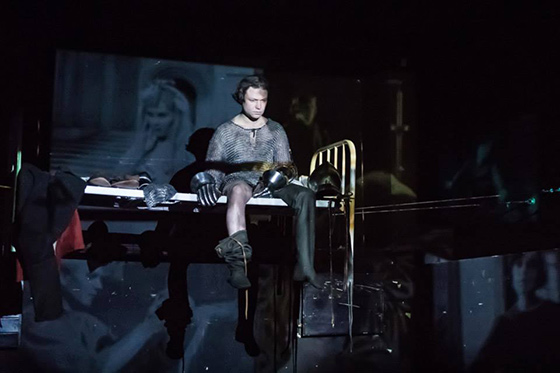 © Theater of Nations "Foretin" Dmitry Volkostralov
In the Shalamovsky epilogue to the Hamlet to the triumph of Fortinbras is the shadow of the author of the play to discover that a real victory and power belongs to the not triumphant warrior, but to him, the artist, to give the Norwegian commander the word of the role or throw him out of the play and from history, choosing another version of the final. Maybe in our days Shalamov’s thought sounds a little naive with all her nobility, but it is beautiful - and fearless - naivety, which we, always inclined to the skepticism, lacks mental strength. The postmodern irony is given to us without the slightest effort, it is proportionate to us much more than the depth and seriousness for which courage needs.
The episode, where there is nothing on the stage, except the light on the wall named after the Norwegian prince, in this void and darkness, we hear the voice of Valery Galendeev, reading the Shalamov text, - becomes (at least for my taste) the climax of the whole performance.
The full of human depth and seriousness, this scene serves not only a counterweight, but also an excuse (not only structural, but, one might say, ethical) general ironic intonation of the performance: you can not live too long to live with one parody. No matter how witty and groove is, she has a short breath by nature. This was clearly understood by the writers of the performance.
In conclusion, I will allow myself to give two historical parallels, which, I hope, have some relation to the subject of conversation.
When in December 1911 the art theater played the premiere of Hamlet in directing Gordon Craig, the actors of the same theater showed a parody of the Craig performan in the famous Bat Kabar. The parody compiled a certain unity with its subject, in which one did not destroy, but as if ironically corrected the other, lowering it to the ground and not giving the symbolic revelations of the British visionary to be entered into the fatal distractions.
And here is another parallel, taken from Shakespearean times.
At the English court of the XVII century, they loved to play “masks”, solemn spectacles to mythological plots. The famous master of the court genre, the friend and opponent of our hero of the day Ben Johnson came up with supplementing the main plots with grotesque “anti-Masks”, which did not at all undermine the sublime-serious essence of the performance, but only did not allow him to be too stolen by their pathetic exalue.
So, we can say with some confidence that the anniversary “Shakespeare. Labyrinth ”played the role of“ anti -Masque ”in relation to “ Hamlet | The collage ” , the main Shakespearean creation of the Theater of Nations and, possibly, the central event of Shakespeare in Moscow.
Maybe two contrasting views on the bard only complement each other, and, in essence, “Hamlet. Labyrinth ”and“ Shakespeare | Collage ”, taken together, make up one whole, one performance in two parts.
Oh! Didn't I mix the names of the performances?