
Translated material
The horned god
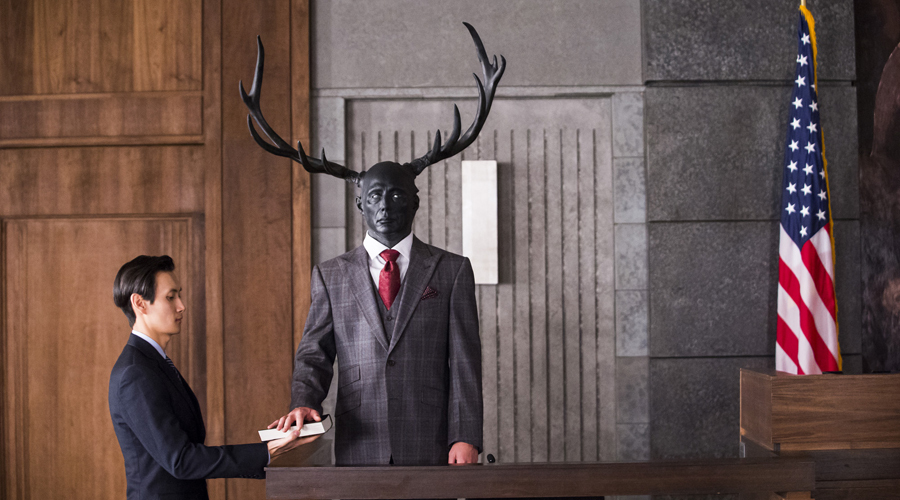
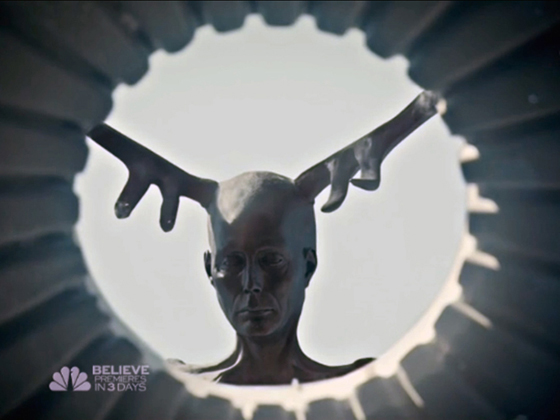
The black silhouette of an anthropomorphic creature, a monstrously thin, tall and bony, crown a pair of branched deer horns. A man-man, man-stag , goes from a nightmare to a nightmare, from a dream to a dream, firmly settling in the subconscious of the former FBI agent Will Graham. His face is cold and lifeless, devoid of any emotions. Only when a bullet from the speed of Will wounds a strange creature, a frozen mask is replaced by a grimace of rage, but this is a rare case. Usually, a person is even more impassive than his prototype in the daily world-Dr. Hannibal Lecter. Like the real Lecter, his horned alter ego calmly looks through the hole in the roof like a human eye, folded from human bodies, calmly sits in the courtroom, serene observes his possible killer and his degeneration.
Where in the NBC series about the psychiatrist-carnibal, very voluntarily based on Thomas Harris’s novels, this horned figure, as if cast from dark metal? Perhaps, from the walls of the Celtic boiler from the Gundestrup, which depicts the god Cernunn (Kernun) sitting among the beasts-the person-man is if not a twin, then a close relative. And certainly it was not without the myths of the Algoncins Indians, which the creators of the Hannibal series themselves do not hide. “Meet our Wendigo,” wrote the screenwriter and producer of Hannibala Brian Fuller in the appropriate tweet .
 © NBC
© NBCThe image of a man-man created in the series of Fuller is very close to the description of the human spirit, which is given by the writer and ethnologist from the people of Ozhibwe Basil Johnson: “Wendigo was emaciated to complete exhaustion, with dry skin tight. Due to the drunk bones, the skin, which was reminiscent of the ashes of death, and the deeply planted hollow eyes of Wendigo looked like a bony skeleton, freshly opened from the grave. ” Add branchy horns to this-and get an olive person from Will's visions. Johnson also noted that Wendigo exudes a strange aroma of decomposition and death. The theme of decomposition and wilting often accompanies Lecter (performed by Mads Mikkelsen) - both in the dreams of his patient and the victim of Will Graham (Hugh Dance) and in reality. In one of the scenes, Will sits opposite Hannibala-Vendigo at the end of a long table breaking from all kinds of dishes. But all luxurious dishes are touched by the seal of death and decomposition, through bright colors of plants, skulls are visible.
Hannibala Lecter unites a lot with myths about Wendigo. First of all, cannibalism as the main feature of the demonic half-man-half-war and the reason for the transformation of man into Wendigo. Hence, even a controversial term “vendigo-psychosis” means a type of mental disorder, in which the patient seeks to taste human flesh and at the same time afraid of his own transformation into cannibal (such cases were allegedly recorded among the Indians speaking the language of algoncins). In any case, the legend of Wendigo served as a symbol of an important taboo on cannibalism, which Lecter violated, thereby turning into Wendigo. True, according to Harris’s books, Hannibal’s path to turn into a serial killer began with an act of cannibalism, committed by himself - he was only a witness, but what he saw in childhood was forever injured by his consciousness.
The images of “Hannibal” can hardly be taken seriously - they are full of such baroque excesses, they can be so absurd in their grotesque cruelty.
Wil Graham also has an animal essence. This is a heart-to-face with brown feathers, Will's subconscious itself-when Wille's brain covers the fire of the disease, he sees the flame devouring a deer. This image connects Will with the world of Maniac Hobbes, a passionate deer hunter. He was close to nature in his own way-like an Indian-hunter, he “checked” the remains of his victims and used them completely, even using his hair to fill the pillows in the living room. Hannibal-Vodigo behaves differently. Being a kind of love-like demon, he perceives victims as a lower order, “like pigs”, according to Will. For the most part, people can amuse him, but nothing more. Hannibal is real interest to Will Graham because he is able to become the same Wendigo. In one of the nightmares, Will sees this transformation of a deer into a half-man-half-war, which is watched by the impassive Hannibal-Vodigo.
A deer figurine, similar to the spirit from Will's visions, stands in the office of Hannibal Lecter and regularly appears in the frame. But this living, unbridled and free part of Hannibal’s subconscious has long been separated from the Wendigo monster. She froze in bronze, stained with cold metal. Before us is no longer a spirit-nest, as in the case of Will, but a lifeless instrument of murder-they become a figurine and becomes in one of the episodes.
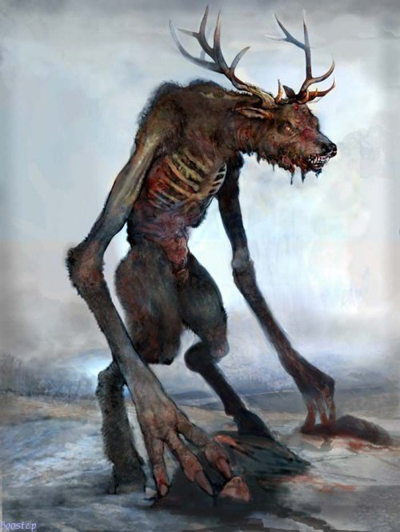 Vendigo in the view of the contemporary artist
The interior of the residence of Hannibal Lecter deserves special attention. According to the creators of the series , Hannibal "creates for himself an inner purgatory, where nature is recreated." Wendigo, no matter what destructive forces he embodied, is inextricably linked with nature and surrounds himself with the corresponding situation. The walls of the lecturer dining room are trimmed with a tree of the night sky, one of the walls is covered with shelves with living plants and mosses, huge buffalon horns flaunt over the fireplace. But this nature is dead and lifeless, like the owner of the dwelling, a sophisticated sadist and epicurean. Therefore, the cold steel of the operating room (or cattle -beams) is adjacent to the tree. Unlike Lecturer, Will Graham feels the need for constant contact with the real, living nature and lives a hermit with a flock of dogs in a secluded house among forests, far from other people.
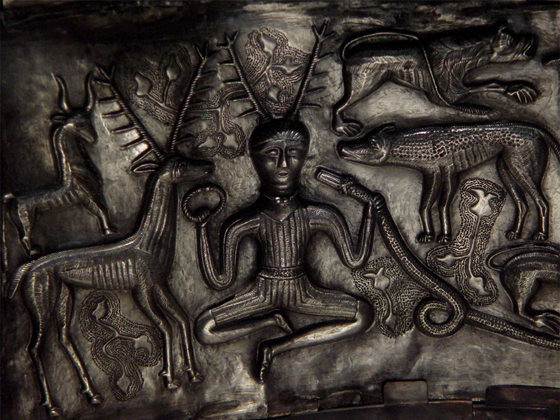 The horned deity from the boiler from Gundestrup, around the 1st century. BC. e. Denmark National Museum in Copenhagen
Even the connection of Lecture-Vodigo with nature is dual. On the one hand, he can kill a person who threatened the extinction of a rare species of birds, and place the nest of these birds on his head. On the other hand, to prepare such a delicacy as a garden oatmeal, recessed in a cognac, frying entirely and entirely consumed. Will mentions that hunting for these birds is prohibited, but Hannibal does not bother. But this does not contradict the image of Gannibala-Vodigo. Luda-eaters, among other things, were perceived by the Algoncins as the embodiment of gluttony, excesses and insatitude. All these features are inherent in Hannibal, constantly looking for new victims - both from the point of view of their sophisticated psychological games, and to satisfy their constantly growing appetite. The horned deity from the boiler from Gundestrup also may not have a random similarity with Hannibal Vodigo. Almost nothing is known about the Celtic god Cernunne, except for his alleged connection with the world of fertility and the world of the dead, which does not interfere with modern neopagowers, especially the Vickans, to identify him with the horned god - the partner of the triune, male deity, supposedly considered the devil in the Middle Ages.
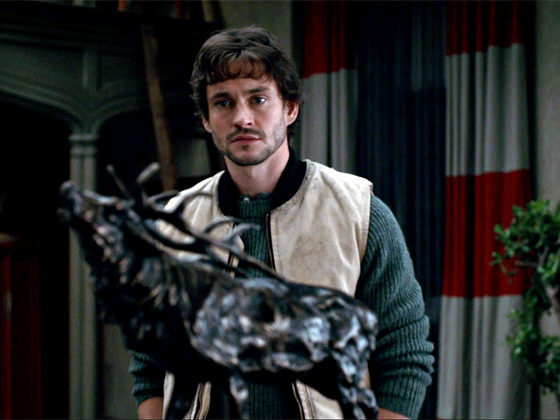 © NBC
© NBCThe myths and demonology in the world of "Hannibal" generally devoted much more space than religion. The sacred role of animals is said repeatedly: from the phrase of Hannibal that the pagans revered a horse, to the image of a werewolf, not just striving to imitate the beast, but wanting to merge with him together. In its own way, the ancient Greek myth of King Licaone, punished for trying to treat Zeus by humanity, is beaten up and thereby experiencing his omniscience. Hannibal not only secretly feeds anything that unsuspecting guests with human flesh, turning them into involuntary cannibals, but is also quite capable of feeding a person of his own body, thereby violating all possible taboos. But Christianity as such is practically there is practically no, except for the obsession with the angels inherent in one of the maniacs in the first season of the series, and the actual image of the Gannibal, about which maniac Abel Gideon (Eddie Izard) says: "He is the devil, Mr. Graham, he smoke ..." elongating from any evidence and accusations, vitually tormenting them and turning them into pawns A complex gambit, Lecter really looks in the series a kind of “prince of this world”, a demon-excellent demon. Brian Fuller emphasizes that Mads Mikkelsen, whose game is largely held by the entire series, seeks to create a fundamentally new Lecturer image, not like the roles of Brian Cox and Anthony Hopkins. His hero is not so much cannibal psychiatrist as Satan, in his own way attached to humanity, but certainly not belonging to the number of ordinary mortals.
He now takes his life, then saves it; In one case, the issue of life and death is solved simply by lot.
The lack of traditional religion in the series is replenished with the almost religious significance of psychiatry and art - including the sophisticated culinary skill of Hannibal as one of its forms (a wonderful culinary blog of the series is a good confirmation). Almost a third of the significant characters of the Hannibal are psychiatrists: Dr. Lecter, his personal psychotherapist poor Du Morya (Gillian Anderson), Alan Bloom (Caroline Davern), Fredrick Chilton (Raul Socialist Revolutionary). Maniacs are represented as artists, obsessed with a certain idea, creators using human bodies as a material for creating their works. The images of “Hannibal” can hardly be taken seriously - they are full of such baroque excesses, they can be so absurd in their grotesque cruelty. It is enough to recall a direct reference to modern art: a frozen body divided into thin layers in glass windows, copying the installation of Damien Hurst “Some Comfort Gained from the Acceptance of the Inherte Lies in EVERITHING” . At the same time, in most cases, it is difficult to understand where the authors of monstrous installations have technical means and time for their installation in the right place. But for the creators of this gloomy, emphasized theatrical fairy tale, complete allegories, symbols and conventions, such details clearly do not matter.
The structure of "Hannibal" is somewhat reminiscent of the series "Secret Materials". There is also the main storyline and a series of “monsters of the day”, heroes of the same series. At the center of the narrative are the relationship of Hannibal and Will, including several other important characters in their complex interweaving. Their confrontation is revealed against the background of the gallery of crazy freaks, which do not so much have their own detailed stories as they serve as allegories and symbolic hints of what is happening with Will. And in this gallery, the topic of communication with nature arises repeatedly: here you have a person - living honeycombs for honey, and a person is a base for a colony of mushrooms, and a person is part of a flowering tree, and a person sewn in the belly of mares.
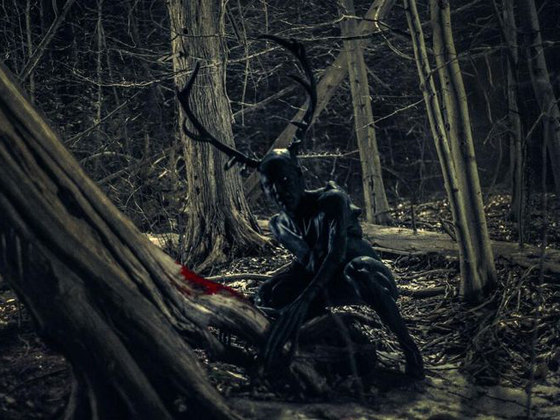 © NBC
© NBCOne of the many maniac artists who appear in the series tries to look at heaven and the god there through the creation of his hands. But instead, Hannibal Lecter sees his installation. Eating a fried bird, Lecter mentions the French tradition, which prescribes to cover his head and food with a napkin to hide what is happening from God's eyes, but he himself is not hidden from anyone's eyes. He tells Will that he does not worship any definite deity and does not even think about him, but recognizes his achievements insignificant in comparison with the power of God. As Lecture's behavior shows, in the world of Hannibal he is, if not a deity, then a powerful and evil spirit. At the same time, Hannibal speaks of the Hindu deity Shiva as simultaneously destroying and creating and periodically acts in the same way. He now takes his life, then saves it; In one case, the issue of life and death is solved simply by lot.
Will Graham with his fantastic empathy, allowing him to experience the experience of killers, acts as a shaman, traveling into the world of spirits. By negligence, he turns out to be too close to the powerful Wendigo. An attempt to open confrontation threatens a deliberate defeat, and Will in the best mythological traditions realizes that the only way to defeat the powerful spirit is to deceive him, having lured his vigilance and entering his confidence, get the genie to get into the bottle on his own. Another thing is that in the process, Will risks losing his own human essence and reborn, becoming the same Wendigo.