
Translated material
Sergey Guryev: "I am listening to motes"

Sergey Guryev is one of the founders of Russian musical journalism, a person who taught this profession to smile and joke mockingly, exploding the brain. Guryev is known in different images, several times on the network the topic was discussed that he was a fictional character in general. But his images do not contradict each other. Fame came to Sergei initially as a journalist, an ideologist of the Samizdat era, editor, author of the iconic musical fenzines “Urlinite”, “counter -culture” and Pinoller. He established himself as a writer, releasing the biography of the group “Sounds of Mu”. There are people who are firmly confident that Sergey is a producer and musician.
The reason for the interview is the exit on the Label “Geometry” of the Box-Set “PSS” (“Complete Works”) of the Rock Group “Pure Love”, in which Sergey is frontman. This underground team went from the experiment of students-intellectuals through the title of “Legends NOT for everyone” to a lifetime monument-a complete discography published at the present time incredibly luxuriously and in the best traditions of postmodern. Once the “chl” was a meme for experts, now it suddenly turned out to be a reflection of ideas and complexes of the recently ended era.
- There is a feeling that underground as a movement or as a creative reserve is not. Those who call themselves so have enough money and connections to buy expensive tools and trips abroad. Or they are forced to work on the corporation. Can a new musical phenomenon from the boiler rooms and watchmen (homeless people) now?
-It seems to me that now the concepts of “underground” are most consonant people who began in the 90s, when there were many poverty, freedom and illusions of some creative novelty. For example, such leaders of the genre as Julia Teunikova or Vladimir Belkanov have much more money has become much more. And the phenomena of a later time - say, Lemonday or Jack Wood is no longer an underground for me, but rather certain miasms of indie culture. All this is such a subjective-terminological issue. I understand the underground as something spiritual: they say, somewhere “upstairs” people are forced to try to match the trends and “bend under the changeable world”, and in the half-mythical underground they continue to reign non-possessiveness, spontaneous impulses and languor of the spirit-this is all “underground”. And the “Indian, or“ Indie ”, is something else related to the search for a concept and style, so that the found somehow“ shoots ”in an alternative environment. It seems to me that in this regard, the young generation is now more likely to be in the Indie field, and people searching for a spiritual point somehow transferred over time.
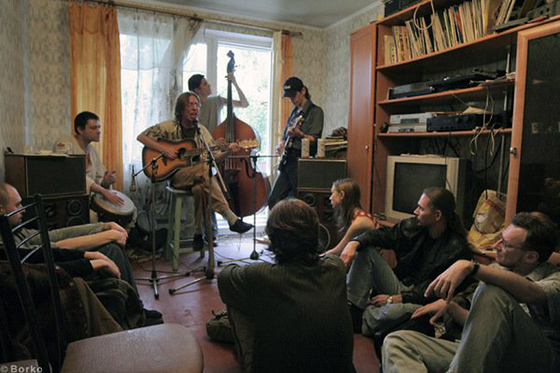 © Dmitry Borko Sergey Guryev (in the lower right corner) is listening
-It seems that the term with which your work was associated,-"gonzo-journalism"-recall less and less. Or is this psychology, this technology, falling into “real”, “effective” brains, mutated in PR cyvization and in this form it now commands us from all the “buttons”-the Internet, television, radio? Can it grow efficiently - in positive?
-We did not call ourselves “gonzo-journalism” in the era of “counter-culture”, but, probably, we could really. This is due to the eccentric, game beginning. In the late 80s, I believed that rock journalism should not be expressed in the description of rock music with traditional means: it should carry the same serving, the same message as the rock itself. For example, in rock music there are “fuzz”, “drive”, “Rubilovo”, “Kryshnos”-and all this must be achieved in rock-journalism. Search for paradoxical phrases, mix - sometimes even within the framework of one sentence - science philosophizing and criminal slang, for example. Causing the reader, as they began to call later, cognitive dissonance. Then, then, as it seems to me, even the “Moscow Komsomolets” learned a lot and even the “echo of Moscow”. But now the very concept of “cognitive dissonance” has turned into such a stamp that on some portals, as I heard, it is forbidden to use it. “Gonzo-journalism” was an relevant “fresh” at the turn of the 80-90s, when people are tired of academicism and longing for scoop. And after the journalistic Bacchanalia of the 1990s, with all these “megalopolis expresses” now, perhaps, the fundamental analytics has become a sip of fresh air. Another thing is that she, like the heroes of the “yellow years”, also mutated in PR cyvization-and in all sorts of show / round tables on federal channels, intertwining of those and others, arrange a kind of surreal circus. In the time of “counter -culture” it was clear where to go: expressing himself as a football language, there was a bunch of free zones. And now the information space is total and distorted - and, no matter how and wherever you spit, you will find yourself part of it, you will dissolve in it. Therefore, I don’t want to do anything.
I am selflessly loved by the lack of practical meaning.
- The mythics of journalistic objectivity are a thing that I can not perceive mass consciousness, I suppose. How do you feel about modern journalism?
- For me in journalism, the most valuable language continues to be the language in terms of form and orientation towards spiritual values in terms of approach. As for the language, the last one in musical journalism was probably Max Semelik. Now, from the reviewers of music, I can probably be the most cute Andrei Smirnov (“Tomorrow”) - because he is not worried about relevant commercial trends, but the same spiritual component. Leva Gankin on the "Radio Culture" really liked it, but there, alas, he has not been there for a long time.
-The output of the PSS Box section of the group “Pure Love”, where you sing and salt on the incident-a game that has grown into something more? For such a thought, for example, your maximalism and perfectionism, long refinements of the material are imposed on such an idea. As if the publication was prepared for centuries or into space. Why is it so serious?
- The content of the collection of “pure love” is an artistic thrash, and in contrast with this I wanted to make the publication pathologically representative. Such a sparkling shit in gold. In general, “pure love” was originally a dream of an ideal, nonexistent and impossible rock band in nature. Connecting inconsistent: high intellect and empty-headed and laughing texts about love, imaginary musical primitivism and the search for new faces of the expressiveness of rock music. As Rosvit Trexler said, “a musicologist who will once examine their songs in detail will be amazed” ... We dreamed about this with the artistic brain of “pure love” by Max Volkov at the older courses of the art history department of the Moscow State University in the mid-80s. It seemed to us that there was no living rock music around us in the USSR, but there are either pathos-revolutionary antimusics, or the Autograph group. And I wanted to create the middle between Slade , the Stranglers and VIA "Veras". So that there was something thunder-like-like-good-and sexually aggressive. At the same time, there were no funds at hand at all. In this regard, “Pure Love” has always been a utopia, a beautiful drawing of a mythical rock-twin advice, crowned with a heart with crossed bones instead of Lenin. Not a group as such, but its perfect image. But we nevertheless tried to create a real group, contrary to logic and opportunities. And the exotic fruits of these titanic, but obviously impracticable efforts now make up the notorious content of the collection. Listen to all this now, it seems to me, at least funny and, so to speak, culturally instructively. In some places, inhuman breakthroughs in the unattainable.
People search for a spiritual point transferred over time.
- Expand, please, the secret of the separation of glory and labor in your duet.
-The fact is that I am more widely known in some circles thanks to Rock-Samizdat, Indie-producing, a book about the “sounds of mu” and all that. Therefore, there is such a stamp of perception: “Pure love” is a group where Sergey Guryev sings. ” At the same time, Max, which is the main creative core of the project, is undeservedly lost in my dubious shadow ... In fact, this is an absolutely self -valuable personality: an orientalist, the son of a naval officer, a very thin and deep man. Although much in the group is built on the unnatural joint of our seemingly unprofitable creative principles. Almost the same words, by the way, can be said about my journalistic Koitus with another Volkov, Alexander Sergeyevich, with whom we made “counterulture” and Pinoller . I live, so to speak, in the elements and under the canopy of thin and deep wolves, forming long -term creative tandems with them.
“Pure love. Muvia " - a film that included in" PSS "
- Describe the project “Pure Love” - musically, aesthetically. In the late stage, there are many musicians in the group-almost an orchestra, a noticeable female backing vocal. Do you spit on market trends? The group is not interested in the future? Or do you see him like that?
-Initially, in the mid-80s, “pure love” in terms of its intellectual reflection on everything-punk and VIA, actually intelligence and everyday “stupidity”-could probably be assigned to New Wave . But it was such a special new Wave -not overcoming, but, on the contrary, fundamentally not wanting to abandon such basic values of the rock of the 70s as “slaughter” and “cargo”. And the “orchestra” and the female back-vocal trio that appeared later are all the same symbols of the epic and monumentalism, contrasting with the “thrashness” of the conceptual nucleus. If you bring this discourse to the point of absurdity, it would have been a kind of concert for a casket with an orchestra, where the casket plays the melody “And everything is calm in the cemetery”, and all this is arranged in the grandiose symphony of Malera with elements of Slade . On the trends of the market - of course, do not care! “Pure Love” and the market are like a comet above the anthill, pointlessly and almost imperceptibly every hundred years flying.
- You talked about a warm attitude to Slade and The Stranglers . Okay, and now there is someone on the world stage who causes you a feeling of spiritual kinship?
- In general, there is almost no such thing. In the era of the active phase, dead sympathy caused Weather - unlike other Jack White incarnations. Unfortunately, such frank rock music is usually shy now. Queenadreena caused even more acute love on the verge of maniae, but now the soloist of Katie Jam, it seems, did not have physical strength left for this project. In the same way as I personally have with purely physical forces to “pure love” there are big problems. I don’t feel the eternal jagger and close.
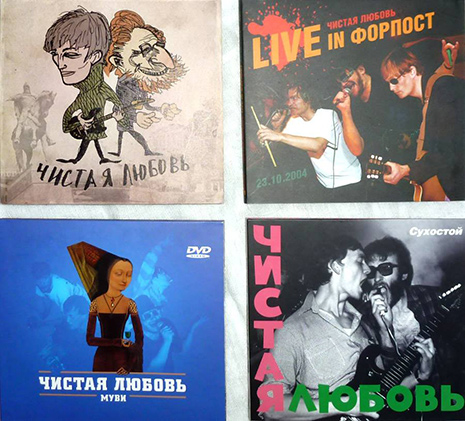 Cover of albums "Pure Love"
- “Pure love” - a generational relic, an expression of development, the genesis of the latter so far a generation that tried to formulate itself and suffered from the impossibility of this?
- “Pure love”, it seems to me, is a deeply individual phenomenon. If we talk about some archetypal influences, then this is probably the Beatles and DK. Accordingly, Max and I are such a tandem where, contrary to the logic, not McCartney, but Makkarte, is trying to sing with a conditional linon duet, but Zhenya Morozov (Vocalist "DK". - Ed. ). Everything turned out very musically, but with elements of the atonal bear Reva. Our generation is a generation of postmodernism. Creativity is the convulsions of postmodernism, which, destroying styles about each other, creates primitive chaos and at the same time through its own self -destruction comes to minted classical chitic forms. And all this in one bottle. In the description, it seems that this is impossible - but nevertheless ...
In rock music there is “fuzz”, “drive”, “Rubilovo”, “Kryshnos”-all this must be achieved in rock-journalism.
-At the presentation of “Pure Love”, the musicians who you produced-who showed the “daughter of Monroe and Kennedy” and playing an excellent “Best” Rock Bard Vladimir Belkanov performed a lot of new things. On the rise with the “UKOK” program, psychedelic “Rada & Ternik”, but almost nothing is heard about the delicate and deep project “Third World Spring”. Why did these, so different, artists turned out to be your wards at different times?
-One producer girl once brought out the “formula for failure” of the musical project. Like if you want to know whether a certain young musical project will shoot or shoot, you must let him listen to Guryev. And if he likes it, then he will definitely not shoot! I think this is a good formula. I have a rejection of almost any musical project, where you feel in a certain deep nerve of youth masses of the current moment. For example, when Kushnir in the mid-90s gave everyone to listen to the Mumiy Troll demo cassette and almost everyone told him that it was “shit without a chance”, I said that “with a competent promotion, this can be promoted to the level of“ agata Christie ”.” And "Agatha Christie" was then in the "Zenith-Osenit" itself. But the very music of the “trolls” at the same time caused me an extremely aggressive rejection! And if I really like someone, it means that he is absolutely clean from this “entering the youth nerve of the era”-and he has practically no chances to achieve wide success. I always loved to help such projects to help, literally leaving with bones.
- Tell me then - for a fig?! What is the meaning of this activity? No one has become rich and even tele -known, although, for my taste, these are sharp -aged, the musicians needed by the country. What is missing our world? Why do you need an artist who is stupidly does not know the majority of genre lovers?
- I selflessly love the lack of practical meaning. It seems to me that when I fight for a certain pure, free idea from any pragmatism, I, as it were, score glasses in the parallel higher world of like Platonic Aidos, which is much more valuable before eternity. Accordingly, these projects, which I help, it seems to me, have much more value in the absolute sense than those that achieve formal success in the world of shameful apparents.
The theme of the deep and very ambiguous influence of the special services on the underground rock movement remains almost unexplored.
- Who are you listening now, who are you helping?
- Right now I am listening mainly Grand Funk Railroad is the popular in the 70s of a straightforward and quite classic hard rock with good religious potential. And I help-Marina Bareshenkova, a girl-algraiter who accompanies her keyboards. This is for me - such sacred, temple art. She sings in a high, pure voice, selflessly sincere, and in her songs there are practically no distortions coming from the Earth’s fuss - this is like a retranding of higher spiritual energies. She loves medieval music and, when she sings under her Kurzweil, she often uses organ registers, harpsichord. Recently, I read the epic of Pisigigin about the British folk surveillance-I think that Anne Briggs sung by him, the vote of his sung by him, made the same impression on his contemporaries.
- Your choice, as before, is clearly outside the trends announced in the media with “fashionable”, or the tastes of the Internet and the television auditor. But even in some retro-mail, this music is also unlikely to fit. What do you expect from the musicians you help?
- I just wait for them to give a concert at the limit of their capabilities and make a strong impression on those who came to them. This has nothing to do with commerce. People now often complain that living is becoming bad. And here the task is simple: to create a wonderful zone in which everyone will be fine one fine evening.
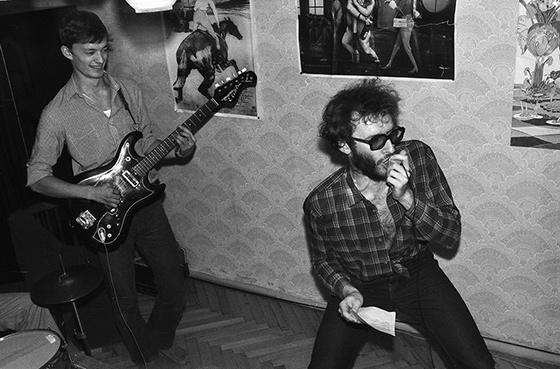 © Alexey Shulgin "Pure Love." Apartment
- How do you feel about the recent scandal with the “discovery” that the later songs of Tsoi were allegedly written in Hollywood? The topic sounded anecdotally - the people were not concerned about the problem of authorship and stylistic correspondences, but a purely political aspect. But the participation of our special services in these processes has long been loudly declared. It would be strange if the CIA and their colleagues from different countries did not pay attention to these processes like this.
- The theme of “special services and art” is generally large, interesting and relevant. Now they say more and more about the fact that our notorious perestroika is rooted at the International Institute for Applied System Analysis, which existed in Austria in the 70s, over which the owl wings of both Andropov and Western special services extended. Then his Soviet branch appeared: the All-Union Research Institute of System Research-VNIISI, within which Gaidar worked. There, using system analysis methods, all sorts of long -term programs for the development of the USSR were developed. And all the special services that were hanging around these institutions tried either to fool each other, or to start some joint projects in order to get their governments and make money. And then everything began to move in a certain direction, in St. Petersburg, on the initiative of the KGB, a rock club was created in the early 80s, in Moscow in the 85th in the same way-a rock laboratory. I, with all this in the 80s, being a rock and suicide, was a little in contact, and there was a complete feeling of a strange civil war in an underground rock movement, where the warring parties were underlined by various KGB clans, which were opposed to each other. Some wanted to arrange perestroika and warm up on this claws, others-on the contrary, maintain the status quo. Many rock offenders, of course, were used “in the dark”, others worked as a kind of “double agents”, trying, in turn, to use the interests of the KGB for revolutionary purposes. There was even the term "new Zubatovshchina." Сейчас это, наверное, многим покажется конспирологическим бредом, а тогда весь воздух был этим пропитан. «Поздние песни Цоя в Голливуде» — надо полагать, перебор, но широкая тема глубокого и очень неоднозначного влияния спецслужб на подпольное рок-движение остается пока практически неисследованной. Что, может быть, и хорошо, потому что вскрытие новых фактов могло бы привести к целому конгломерату разочарований и краху идеалов.
 © Алексей Морозов
— После твоего с Александром С. Волковым журнала Pinoller , кажется, альтернативной прессы как массового явления не стало вообще. What happened? With whom? Почему в сети нет популярного издания, посвященного альтернативе?
— Я думаю, ответ прост: в связи с развитием интернета. Точно так же как пластинки перестали продаваться: все есть в сети. Диски покупают теперь не человеческие массы, а коллекционеры, чей круг узок. Можно и сейчас, конечно, сделать альтернативный журнал для коллекционеров, но это будет скорее не социокультурный феномен, а полиграфический. Кроме того, в 80—90-е в народе, еще озверевшем от тоски совка, жил запрос на эксцентрично-эпатажно-революционный дискурс. Сейчас эта ниша выглядит, как мне кажется, далеко не так заманчиво.
— Нынешние политические изменения воспринимаются нередко как сползание к реакции. Будет ли все это стимулом для создания новой альтернативной прессы, музыки, вообще искусства? What will it be?
— Тут видны два понятных пути: нащупывание новых и новых болевых точек архетипов сознания, что все видели на хрестоматийном примере Pussy Riot , — и поиск утраченных вневременных форм духовности в рамках этих архетипов. Мне, как человеку стареющему, ближе второй путь. Слушаю мотеты… Как говорил великий Черчилль, «кто в молодости не был революционером — у того нет сердца; кто в старости не стал консерватором — у того нет мозгов».