
Translated material
Venetian incident of Medinsky
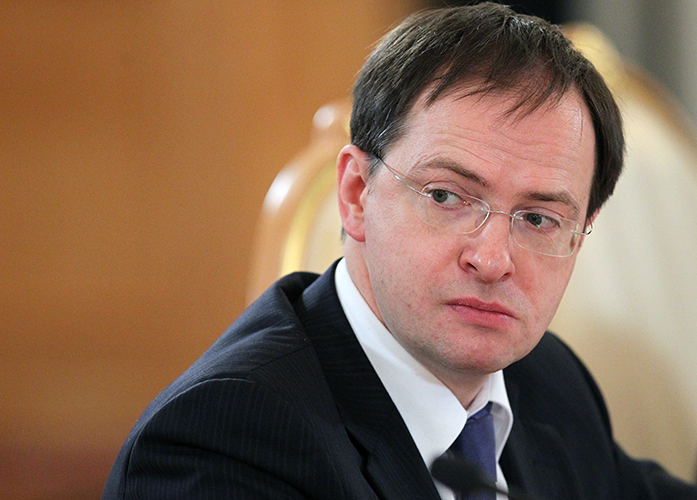
On Monday, May 12, at 9:30 a.m., a special event was supposed to take place at the University of Venice University. The event is simultaneously academic and international, about which, however, the university did not notify anyone until the last moment. When only five days remained and the invitations were finally sent, and a press release was published on the university’s website, it became clear that the scandal could not be avoided.
Academic news about the award of the degree of Honorary Doctor ( Honoris Causa ) University of Venice, Russian Minister of Culture Vladimir Medinsky, unexpectedly a wide resonance. Voices against the decision of the Academic Council ( Senato Accademico ) , which was on March 24 and held a secret until the last, began to be distributed from the moment the news was published.
The first to protest on the blog of the rector of Carraro on the university’s website was the classic philologist, a specialist in Greek poetry prof. Pontani . He published a statement in which he quoted the statements of Medinsky in the press on various issues - from the fact that Russia, fortunately, is not Europe and is the last stronghold of true culture and Christian values in the decomposed West with its multipluturalism, and ending with prostalin statements, as well as the apology of the Molotov -Ribbentrop Pact, not Leaving aside the homophobic views of the Russian minister. Professor Pontani suggested that if any ordinary teacher of the University of KA Foscari allowed himself such statements, this would lead to at least investigation and additional checks, if not to dismiss, and, in any case, certainly not to the award of honorary academic degrees. Following Pontani, another associate professor of Ka Foskari, the famous theater, Paolo Pupp, who then wrote a separate letter, spoke with protest. In his commentary, he emphasizes that the simultaneous award of the same honorary degree to the well -known philosopher, the student of Foucault Arnold Davidzon and the dubious Russian political figure compromise the very concept of Honoris Causa . Pupp ironically compares such a decision with the history of Caligula, who appointed the senator of his horse, or with a recent attempt to nominate the Berlusconi to the Nobel Prize of the world. The professor of Russian literature, Donatella, also condemned the decision of the Academic Council and emphasized her solidarity with colleagues who expressed their indignation, and at the same time the hope that this would be a turning point in a change in university policy.
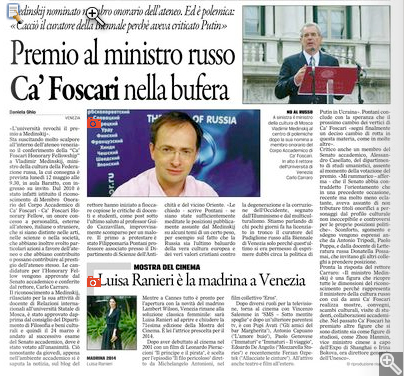
Not only humanities expressed their position. Professor of Chemistry Stefano Antoniutti bitterly noted that such decisions drop the prestige of the university and once again demonstrate to students ignorance of the story of those who are called to be their mentors, and that “in relation to Signor Medinsky, we must feel what Bruno Schulz or Primo Levy in the face of the pursuers, with the only happy difference, which, fortunately, we are still free still free People". Students, as well as ordinary workers of the university joined the votes of teachers. Thus, one of the administration employees asked to pay special attention to plagiarism issues in the dissertation of Medinsky and recalled the recent case of non -consuming the university and accusing the applicant in plagiarism with a significantly lower percentage of coincidences with the published texts of other authors. In connection with the upcoming architectural Biennale, the fact of the dismissal of the Medinsky commissar of the Russian pavilion Grigory Revzin for criticism of Ukrainian politics Putin was also recalled. The replicas of the protest multiplied every hour, and then resulted in a general letter, which signed more than 100 teachers and employees of KA Foscari. Such a massive and operational protest Professors Venetian University hardly knew.
The awarding of an honorary degree of the current Russian Minister of Culture, perhaps, had far-reaching goals, not least connected with the financing of the university exhibition center for the study of Russian art with the eloquent-abbreviation "Tsar" -CSAR ( Centro Studi Sulle Arti Della Russia ) , the discovery of which three years ago Svetlana Medvedeva was already accompanied by a polemic - however, then not so sharp. The first official exhibition of the Academy Sergei Andriyaki, then presented by the center, somewhat puzzled the local public, but it was soon forgotten, probably rightly considering the political and aesthetic curtsy and compromise. Indeed, over the next years, many high -quality projects of unofficial and contemporary art were presented in the center, including a monumental exhibition dedicated to the memory of Dmitry Prigov, in the last Biennale. And although various rumors continued to walk about the sources of financing the center, until today it remained purely intranius.
Officially, the degree of Honorary Doctor Medinsky was nominated at the request of the Faculty of Philosophy and Cultural Heritage ( Dipartimento di Filosofia E. Beni Culturali ) . Only guesses are expressed about specific initiators, but whoever stood behind this decision, no one clearly expected such a mass reaction. As the protests increased, the rector Carlo Carraro tried to make excuses, giving examples of the already held precedents of awarding such degrees to politicians. The director of the center, the vice -rector of the university, a specialist in Russian art prof. Sylvia Burini, the curator of the event, abstained from the comments.
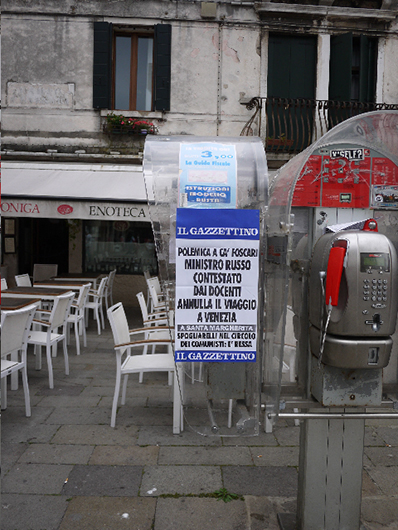
The news quickly spilled over the university, and on Saturday, May 10, the main Venice newspaper Gazzettino was released with the heading “Storm in Ka 'Foscari: Professors of the University of Ka Moskari dispute the awarding the degree of Honorary Doctor to the Russian Minister.” On the same day, by the evening, an official notification was sent about the abolition of the ceremony "in connection with the great employment of the minister." The representative of the university told the press that the ceremony and the announced open lecture of the Minister, dedicated to the history of Italo-Russian relations, would simply be postponed the next day due to disagreement in the schedule, but some sources say that there are serious reasons to believe that the decision will be revoked and the degree will not be awarded.
Everything that happened was a surprise not only for the leadership of the university, but also for me personally. Honestly, having received an invitation to the ceremony, I decided that I would have to go and arrange a single protest. Russians in Venice can be counted on the fingers of one hand, and there was no need to expect such a deep penetration into the Russian reality from the Venetian friends of the academic circle, and at the same time to allow such a profanity of traditional European academic awards to be a shame for the University of Venice and for those who are not alien to Russian culture and its current fate. It would be sad to think that such an export version of one of the most infamous and ignorant current Russian politicians from culture will be meekly adopted by European intellectuals. After spending some time to re -read the chosen passages and quotes from the minister, I already set to transfer them to Italian and preparation of leaflets for distribution at the university and in the city, when news about protests began to come. It remains only to express gratitude to the professors, students and employees of KA Foscari for solidarity in defending human and academic values and such fundamental concepts as honor and honesty, without which no culture is unthinkable.