
Translated material
Between Karlsruhe and Krasnoyarsk
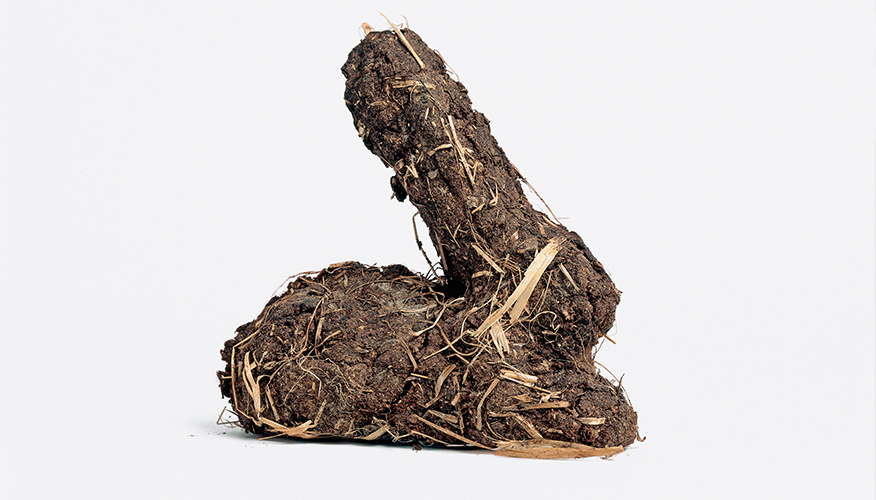
The exhibition “ Ways of German Art from 1949 to the present ” , which started in October 2013 at the Center for Arts and Media Technologies (Karlsruhe) and from the end of April to the end of autumn, demonstrated in Moscow, will then go to Krasnoyarsk. “Only about 400 works and almost 100 artists” - how and why all this is collected together?
Deep Storage , which can mean “Deep burial” is the name of the 1998 exhibition, organized by the curator Matthias Vincen in Munich and the New York Museum of Modern Art ( Moma ). Today he is one of the sorceresses of the exhibition-panorama of post-war German art in the Moscow Museum of Modern Art. In that project, Winzen focused his attention on strategies related to the representative of memory, today's exhibition in MMSI is the result of working with a rich collection of the Institute of Relations with foreign countries ( IFA ), located in Stuttgart, with the help of which curators show the history of German art of the last sixty years. The institute’s support is provided by E.O.'s energy company, the shareholder of Gazprom, which finances the restoration of the Amber Chamber of the Yekaterininsky Palace, as well as the exhibition “Russians and Germans. 1000 years of art, history and culture. " The scale is striking: there are so many persons, names and works that at first it is difficult to understand what to go to the exhibition and what exactly is most valuable in it. On the one hand, Western artists and photographers have long been crowned with Laurus, on the other hand, the number of not so widely known, but important names is striking.
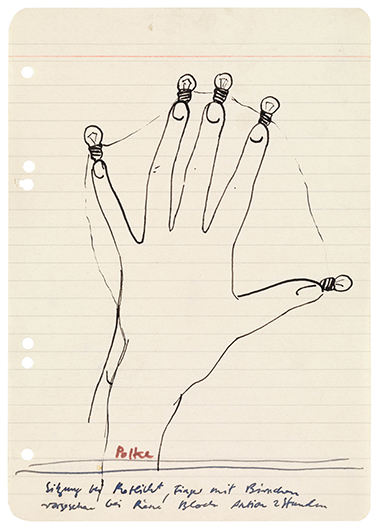 © Bernd Borhardt Sigmar Polke. Without a name, without a year. © The Estate of Sigmar Polke /Vg Bild-Kunst, Bonn 2013
Avoiding cliches, the curators “reconstructed” neoExpressionism mainly through the painting of the GDR, diluting it with only three small works of the Luperz Marcus, the large exhibition of which was recently discovered in St. Petersburg , where there were always much more practitioners and fans of eighties painting. The artist Joseph Boys, which is very revered in our country, although he occupies one of the premises entirely, loses the halo of the mentor here (although it can be called a dozen of his students also here) and appears more like a lonely visionary with a cross, a volume of Immanuel Kant and rows of elegant drawings. But the tribute to Sigmaru Polka is symbolically, who also occupies one of the halls neighboring with the boy and which was once considered the main successor to the latter. At the exhibition there are no attention to the attention of collectors and the media of Neo Raukh, Daniel Richter, Jonathan Mezie, there is no Hans Haak, who moved to the United States, there is no famous representative of conceptualism Hannah Darbivus and, alas, there was no early Palemo Brillimo. Not yet The cult master of the Werner Buke Werner, without whom at least one exhibition of the GDR art is almost a chauvinist George Baselitz, the renegade of Jorg Immanorf, the scandalist Martin Kippenberger, the noisy Christoph Schlingenzif, and Anselm Kififer is also missing. Thanks to this set of missing names, both the plan of the exhibition, and partly, the collection that dictates it is, perhaps, more clearly than thanks to those who are here. Although among the participants of the exhibition there are more artists from the western part of the country divided in the past, it is difficult not to pay attention to the mathematically verified harmonic proportions of the composition: one sixth-authors-women, a little more than one fifth-authors from the GDR, a third-photographers. The more the rhetorical neutrality of the exhibition coincides with its role - a dictionary or an encyclopedia.
Over the past two years, namely in the second half of 2012, two exhibitions of German art have already opened in Moscow - “The Reality of Painting: a Picture in the Arts of Germany. 1950-2010 ” From the collection of the Bonn Art Museum in the GCS and the collection of works by Joseph Boyce under the heading “ Call to the Alternative ” in MMSI. How the logical continuation of this series of projects seems to look like The current exhibition in the Museum of Modern Art at the same time (or perhaps simply did not arrive for the year of Germany in Russia). At first, the absence of any question or problem in the title of the project is resolved in the walls of the museum. “The post -war” is not a clarification, but a clear indication. Attention to its own, national, history and the very situation divided by the Cold War of the country for decades have been the main theme of all German art.
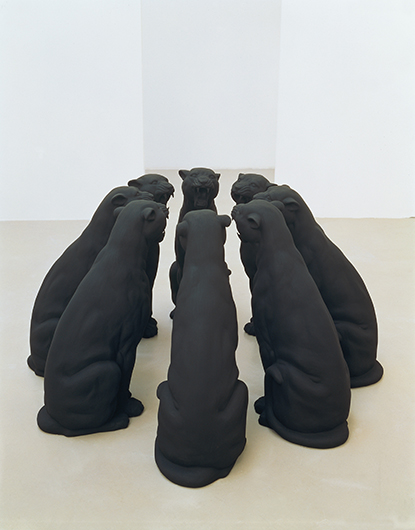 © VG Bild-KUNST, BONN, 2013 Katarina Frich. Panthers, 1992-1994
The second curator of the exhibition Matthias Flyugge in an interview entitled “Exhibition of Exhibitions”, which he gave to the Krasnoyarsk publication, explains that it is not too smart to build an exhibition on the principle of political confrontation between Germany and the GDR - on the contrary, it is more appropriate to draw parallels between Western and Eastern artists. The parallels, as we are shown, at every step. Whether it’s the factory workers and highlighting envoys in the photographs of Helgi Paris and Herlinda Kelbl or the divided West and East of Germany in the sculptures of Franz Erhard Walter and Rainer Rutenbek, and so on, semantic or methodological parallelism makes the impossibility of any meeting very conditional. Plastic graphics and sculpture of Boysov harsh critic Norbert Crick (Germany), along with the urbanist models of Thomas Shutta and Iza Gentzken (Germany), come in an unexpectedly clear dialogue with the abstractions of the Carlfredrich Claus (GDR) and Gerharda of Altenburg (GDR). The auto -reflexive things of Jurgen Klack (Germany) and Klaus Rinke (Germany) are responsible for the work of Diter Appelt and Michael Morgner (GDR). Blurred photomonta of Otto Steins (GDR) correspond to the abstract things K.O. Gettsa (Germany), whose retrospective recently held in the new National Gallery in Berlin. A very successful example of the exposition solution is the hall of his student Gerhard Richter, where the multiple television veneer television is included in the exposition, the installation of Diter Kissling (GDR), which refers to the mirror installations of the first. The whole exhibition, close to perfection rhythmically, looks like almost the obvious intricacies of all two or ninety -five “ways”. The cycle of the “path to world wisdom” of the kifer pops up in the memory - metaphorically, it also happens in the forest here.
It may seem that the curators, starting from one of the latest Ukbar II works here, Corinne Vasmut, create their own mythical, full of doppelgengeers, in which, according to Jorge Luis Borgesus, there are no nouns, but "the primary cage is not a verb, but a monosyllabic adjective." The specifics of the differences between the artists of the East and the West are erased in favor of a certain consolidating humanitarian line in the interpretation of their interaction or autonomous synchronism. This Samaritan magical poetry of the rich in shades of being looks strange if you imagine that suddenly today and tomorrow everyone is de-energized by the virus of a new Cold War. But if you do not imagine, then you can leave a photograph of Moby musician, hiding his eyes from bright rays of the sun as a final image.
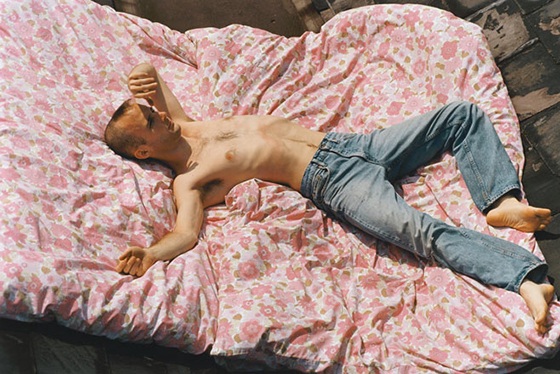 © Wolfang Tillmans Wolfgang Tilmans. Moby (Lying), 1993