
Translated material
Rogozin's answer
Deputy Prime Minister Dmitry Rogozin spoke about how Russia will answer Western sanctions. So far, the response affects only the space industry, but in other areas, Russia does not have such a noticeable influence.
Rogozin, speaking together with the head of Roscosmos Oleg Ostapenko, recalled: “We have repeatedly told our colleagues both at the political and at the level of specialists of Roscosmos that sanctions are always a boomerang, they always return back.” He promised that the Russian policy "will be built on the principle of application in response to an application and action in response to action."
Dmitry Rogozin decided to start with GPS. The American navigation system, although satellite, has a ground infrastructure, which is located, including in Russia.
Part of the ground infrastructure is called the system of differential correction-it was its work that Deputy Prime Minister promised to suspend from June 1. Moreover, Dmitry Rogozin promised to continue sending the necessary information from the sensors to the United States in the event that the US government allows you to place similar equipment to correct the GLONASS signal on its territory.
Dmitry Rogozin said that at the beginning of the year Roscosmos sent all the necessary papers to Washington to coordinate the deployment of equipment, but he never received an answer. After June 1, the US government will have three months to negotiate with Russia, if they are unsuccessful, then from September 1, the American navigation system will cease to receive information from the territory of Russia. So far, the GLONASS differential correction stations are located on the territory of Russia, Brazilia and Antarctica, the United States denied Roscosmos to issue building permits at several Russian measuring stations due to fears that GLONASS systems can be used for military purposes.
Russia really can simply stop transmitting signals from differential correction stations in the United States. Now these stations are under the jurisdiction of the geophysical service of the Russian Academy of Sciences, information from them is transferred not only to the US seismological service, but also to the Ministry of Internal Security.
The essence of the work of differential correction stations is quite simple. Their exact coordinates are known, respectively, comparing these data with the location of navigation satellites, you can much more accurately find out their place in space and, moreover, predict the route for the coming hours and days. Due to the fact that the exact coordinates of navigation satellites are known, more accurate coordinates can be calculated, for example, a GPS navigator in a car.
The more differential correction stations are on Earth, the more accurately the orbit of satellites are known. But the disconnection of Russian stations will not affect the household navigation devices at all - they do not require great accuracy. In order to turn to the desired street, it is not necessary to know the location of the car with an accuracy of a centimeter. Experts cannot yet say how much the GPS work will deteriorate, but most likely, the accuracy will decrease by no more than 2%-nevertheless, differential correction stations are, of course, not only in Russia.
Interestingly, the Minister of Industry and Trade Denis Mansurov did not know about the disconnection of the GPS ground infrastructure. In a conversation with reporters, he suggested that Dmitry Rogozin did not make an official statement, but expressed his personal position. However, almost immediately, the press secretary of Dmitry Medvedev Natalya Timakova assured that Rogozin agreed on his performance with the prime ministers, unlike Mansurov, who just made his personal position.
In addition to the “blow” on the navigation system, Russia decided to limit the supply of missile engines to the United States with some conditions. Now American users are available to NK-33 engines produced by Kuznetsov OJSC and RD-180, which are made at Energomash. The former are used on Antares launch vehicles, which deliver goods to the international space station, the latter are installed on the ATLAS V missiles, which are used, among other things, for the withdrawal of military satellites into near-Earth orbit.
It was the use of Russian missiles in the interests of the American army that Dmitry Rogozin did not like. He stated that now Russia will supply missile engines to the United States only if there are legally binding guarantees of using them exclusively for civilian purposes.
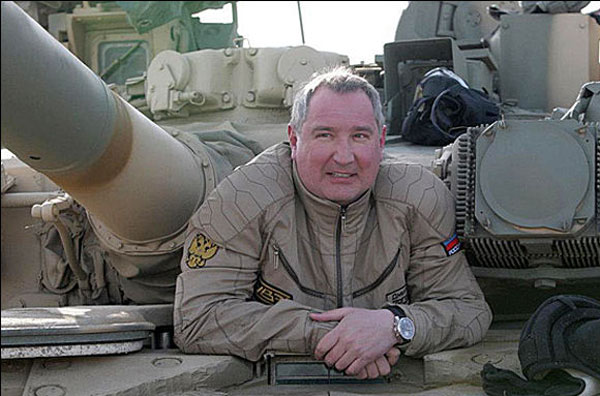 Photo: facebook.com/dmitry.rogozin
Earlier, the Minister of Defense of the United States has already demanded to abandon the use of Russian engines - however, this is the most profitable offer in the market. However, Russian engines are not indispensable, the termination of their supplies to the United States will hit both Russian enterprises and the American budget, but is unlikely to affect the American space program.
Another statement by Dmitry Rogozin can hardly be called sanctions, although it is unpleasant for the American government. Russia, according to Deputy Prime Minister, is not going to extend the service life of the International Space Station after 2020. A little earlier NASA proposed to use the ISS at least until 2024.
Dmitry Rogozin said that finances will be aimed at “other promising space projects”. It is possible that Rogozin speaks of a new lunar program , which can be occupied by Russian cosmonautics for the next 30 years. According to preliminary estimates, only 30 billion rubles will be needed for the first stage of this program - given that the total budget of Roscosmos is approximately 168 billion.
The Deputy Prime Minister emphasized that the Russian segment of the ISS can exist separately from the American, and the American separately from the Russian one. In addition, the United States currently does not have their own means of delivery of a person into orbit, and Rosksosus spends a third of its budget on manned astronautics - so in this matter the United States is extremely interested in cooperation with Russia.