
Translated material
Sanctions: look for who benefits
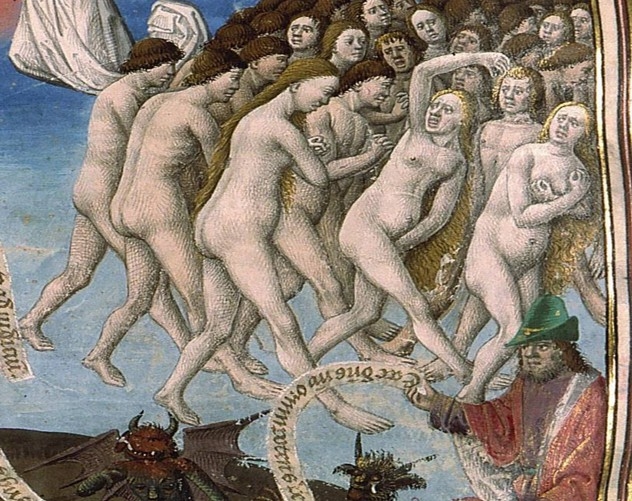
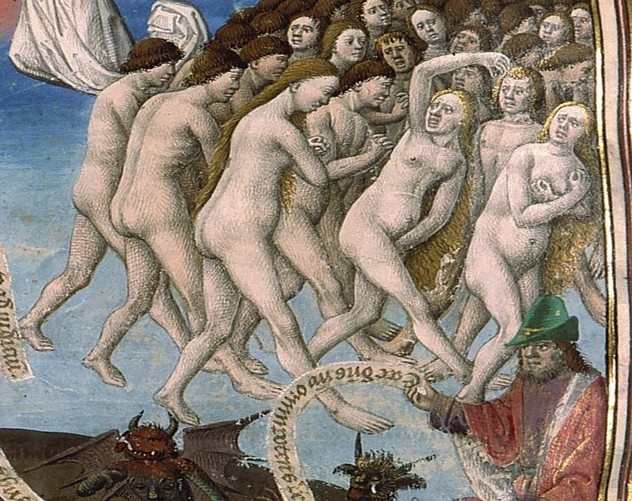
The Last Judgment. Illuminated French manuscript of the 15th century
Sanctions are a fashionable topic for today's conversations. Few people saw them (I’m not even sure that the gentlemen from the lists have already felt on themselves), no one knows if they will be, and what they will be, but “foreboding” is worn in the air. Meanwhile "which?" With regard to sanctions, in my opinion, not the most interesting question. In the Roman tradition, I would ask the question “Cui Prodest?”, And not even outside, but within Russia. The sanctions, whatever they may be, are least terrible of the power elite. Visiting the United States and the EU is not the main value to them in life. They can hide their assets not only in the system of trusts, but also (as is already done) through informal, not related to power and therefore not falling under the sanctions of Trustees, which are owners for the whole world, but in fact they only “look after the property of a narrow circle of people close to the throne. The opportunities to be enriched in them in a closed, which is under sanctions, and therefore, in principle of opaque and not accountable to international law, the country will only become larger, even if the export of oil and gas is blocked (what is believed in the coming years with difficulty). Their authorities, as a result of sanctions and natural, while “rallying the nation and strengthening of the vertical of power”, will only be more, there are much less risks. The state business is an amorphous conglomerate from companies that are wallets of power, systems that control one or another domestic market, feeders for specific close associates, ineffective property accidentally inherited and so on. It is impossible to talk about the benefits or harm for state business as a whole, and, in particular, because within its framework the main tasks of normal business companies-profit and benefit to customers-are hardly even in twentieth place. The only thing that is obvious today is that the authorities in Russia itself are ready to “deploy” the State Business with his back to the USA and the EU, inside the Russian market and east (the latter is somewhat ephemeral, but in the heads of power sits as a real idea). Why? Again, because it is not margin, not markets, not the benefit for customers, but Agency Cost, control and the ability to “take a lot from the inside” are the main interests. And these are the most stable areas of operating. With losses, you can live for a long time, and catastrophic losses (if there are) can be closed from the budget. For the security forces, as far as one can talk about such a heterogeneous, wide, from the point of view of positioning and mentality, the sanctions are extremely profitable, and the more the better. The ideologem of the security forces (consciously simplifies this concept) is a primacy of redistribution over creation (in particular, it is redistributing in their favor the assets of other people's strata and control over the redistribution of their own budgets between the members of their and the collective state contractor and ensuring the loyalty of the mass: the conflict of mass with the very stratum of the security forces and the power of the power and power It is masked by forming an image of an external and internal enemy and redirecting negative energy to them. The necessary conditions for success are “force majeure” circumstances in the country and economic problems against the background of a hostile environment. This is an ideal option, directly allowing not only to “legitimize” its position redistributing, but also to significantly weaken the opponents, since any opposition will inevitably be associated with weakness in the face of an external enemy and even with betrayal. Widely mentioned as a small, but significant part of the Russian Oligarchs Society, in practice, has long fit into one of the four of the above groups - if Trustees is considered a separate group, of course. The people who did not inscribe either were kicked out to the west, or put to the east (and some were then kicked to the west). The oligarchic business in Russia, within the framework of and outside the framework of the “trust”, is built almost exclusively in the state delegation of the right to do anything and, accordingly, to protect the state of this niche. The sanctions can neither change the niches, nor change their distribution (although the fact of sanctions will certainly be used in the subcover struggle for the niche, and, perhaps, we will see several niches from hand to hand). Perhaps the profit will be reduced, and the market value of the assets of the oligarchs will fall somewhat. But the oligarchs themselves do not have illusions about who ultimately owns the right to decide how much their business costs. The state will say - and in the framework of “compensation for the unfair decision of the foreign court” or simply, within the framework of the state program, will buy for two prices. He will say - and in the framework of the fight against tax evasion or simply for stealing from itself its own oil, the business will choose for free. What is the market value here, and what difference does it make how much it is. Maybe for some of the oligarchs the sanctions will be a good reason (for themselves and for the authorities) in order to “bounce”-to leave domestic business, to leave only that which is already reliably placed outside, and to start living in Europe or (scary to say) in the United States. But this is not about the economy, but about psychology. “Simple people” should even win from sanctions in the short term: a decrease in imports should give an impetus to an increase in internal production, that is, to an increase in effective employment; The low incomes of the population will remain low (we will exclude the upper 25% of the population of Moscow and the upper 5% of the population of other cities, the rest of the sanctions, even very harsh, will affect little), but the response measures of the authorities in the form of, for example, closing the border for capital, redirecting the tourist stream inside the country and returning to the progressive taxation system can even slightly increase the income of lower groups by the time of lower groups. Moreover, finally the society will gain real enemies, the real goal is to win economically, and the real dream is to defeat physically, weapons. I am sure that the "happiness" index of the population should grow. It seems that we have not only affected the "liberals and intellectuals." It is worth noting that the consolidated "liberal stratum", or the "fifth column" does not exist. Conditionally, but also intrusively, liberals in Russia are called everyone who consistently advocates a primacy of civil freedoms, a single, complete, effective and prevailing legislative field and the private sector as the basis of the economy. Within this framework, there are many irreconcilable views, ranging from religious and ethical and ending with purely economic. There is almost no liberal layer in Russia - this is the result of both hundreds of years of genocide and the directed work of the last 15 years to squeeze out active liberal members of Russian society into external or internal emigration, as well as to replace them with “system liberals” - functionaries of the authorities prescribed to depict superficially liberal views for neutralization of the moderate electorate and isolation of really liberalized liberal Person. This process was facilitated by a number of inalienable properties of the liberals themselves - due to their beliefs that could not offer public opinion neither bright and empty slogans, nor simple decisions, nor promises of happiness on the furnace. Worse-liberals cannot express their position without the use of comparative-analytical argument, which requires a constant reference to the history of developed democratic countries that have rich experience of practical implementation of liberal ideas. This intellectual connection is actively used by anti -liberals to accuse the first in “connection with the West”, its idealization and even “betrayal of the interests of Russia”. Unfortunately, thanks to both massive and supported by power, propaganda, as well as the extremely weak level of mass ideological work by the liberals of the presentation, if not about betrayal, then at least about the arrogant attitude of liberals to Russia and their idolatry to the West are very popular in society. The mentioned “system liberals”, which are easily caught by society on completely coherent with power of manners and deeds (corruption, parasitization on power, inefficiency of activity, etc.), successfully fulfill the role of the “window”, even more discrediting the liberal idea in society. Any hostile actions in relation to Russia from the West, thus, are directly associated with the liberal circles and the most liberal idea and significantly worsen the positions of liberals as political and intellectual power in Russian society. Serious sanctions can cause a situation in which liberals in Russia will be destroyed institutionally and even partially physically within the framework (or under cover) of popular anger. At the same time, as a result of the application of sanctions, the Russian economy is already forced (since the existing power simply does not have another arsenal of techniques and methods) will migrate even further from the liberal market and free competition, thereby destroying the only basis of the liberal electorate - entrepreneurs and free specialists. Inevitable nationalization and mobilization will lead to the completion of processes that have been going on since 2003, but have actively unfolded only by 2012. Russia, instead of “taking into account sanctions” or “frightening of sanctions” to change the foreign policy course, in practice will irrevocably change the domestic political course to one in which a change in foreign policy will be impossible. Do countries understand this that actively introduce and prepare new sanctions? Of course, yes. According to their further actions, it will be possible to judge what they really want - to return slowly and stumbling, but going in the direction of the liberal development of Russia to the circle of friendly countries, or the isolation and conservation of Russia, which in this position internal forces will deplete and eventually tear into pieces. The inner feeling tells me that the latter for the USA and the EU is very seductive, but risky. And liberal countries do not like to take risks. Here, in fact, is my answer to the question why there will be no serious sanctions.