
Translated material
Jody's approach
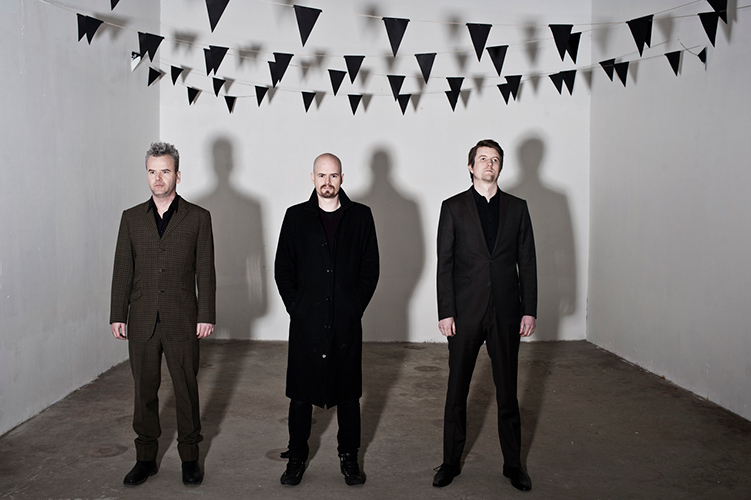
In Norway, in fact, there are no problems with teaching music, but behind higher education saxophonist Peter Frost Fades and the drummer of the Bircland table, independently of each other, went to England independently-partly because both were inspired by the British improvisation school of the 60-70s, partly because both wanted to change the situation, play with new people and see in new ranges Free music. There, in the musical college of Lids, they met with the guitarist Chris Sharki-in fact, “Jody”, that is, a native of that part of the north-west of England, which is called the Tinside. Passing the rehearsal phase and concerts, the musicians almost immediately went to the studio, where the first album of the Why Eye trio was recorded-improvisational music, much more reminiscent of this Heat , King Crimson in the mid-70s or customers of the label of Chris Catler Records , than about free improvisation in her now Paradoxically canonical form.
“Of course, British improvisational music influenced us,” says Fadnes. “Evan Parker, Derek Bailey, all these guys.” They at one time showed that there is another way to improvise, other ways to work with form and structure. But our music has a great difference from what they did - we like to use the genre, style, melody and rhythm, in this sense our music is probably much more conventional. We ourselves listen to the pop, and the underground rock, and electronics, and modern academic music and-consciously or not-we rely on this listener experience when we improvise. The British school of Free Improv tried to break out of the Convention and sought, one might say, to abstract music: without a melody, without rhythm, without a style. But in the end, they still developed their style and their own convention. Today, the language of free improvisation is almost as strictly defined as Bibop. You know, in Britain there are so-called free music clubs, in Lids, for example, there is such that opened back in the 70s. So in such clubs you just cannot afford a melodic line or bit - they will tell you that this is not an improvisation. That is, the idea of freedom seemed to have turned against herself. After all, if you must remain inside the prevailing convention of free music, then spontaneity, game moment is lost. So for us it was very important for us to turn to our listener experience without restrictions and use it in the context of an open form. We have to pay our price for this: once we played in Berlin-we didn’t agree on anything, we just went on stage and started playing; So when we finished, someone from the hall began to shout that this, they say, is not an improvisation, that we have a bit and in general we play pop music. In general, “free music” becomes almost as conservative as the jazz mainstream, which, of course, is funny. But now a whole new generation has come to the music, which, on the one hand, is inspired by the conquests of pioneers of free improvisation, and on the other, it feels the need to draw something from the music surrounding us today. All this leads to eclecticism, but this is quite consonant with the time in which we live, with its absolute accessibility of information. ”
"Yes, this is an improvisation of the IPOD -shuffle !" - laughs next to Fades Bircland.
“I must also say that in this tour we want to try a slightly different approach,” the saxophonist continues. - Chris will come to us, and the next week we will rehearse - we want to introduce a fixed material, some structures into our improvisations. Of course, we do not want to lose the freedom that we have now, but we need to try to discover new directions for ourselves. The fact is that if you play absolutely open, free music with the same people for a long time - and we have already played several hundred concerts, then the group itself becomes a fixed structure, sound, idiom. And at a certain moment it is very difficult to step beyond this comfortable zone. So now we are trying to approach improvisation from the new side: to introduce very specific sounds into it and play around them-I hope so we will go to something new, but we will preserve the spontaneity of our music. ”
After returning to Norway, Fadnes began to work at the University of Stavanger, where he was responsible for research work at the faculty of music and dance. In his profile, Peter writes that he sees his task "demi -improvisation."
“When I began to make music as a teacher, I drew attention to how many myths exists around improvisation,” Fades explains. - It's just amazing! There are a lot of points of view on improvisation, many different opinions, but almost no one talks about its mechanisms, about how the musicians think. But we can talk about this, this process can be analyzed. Improvisation is a special way of musical thinking, and it does not have to be mystical, even on the contrary - it can be very pragmatic. Of course, approaches can be very individual. I remember, once asked Fila Minton after his stunning solo performance: “How do you do this?” And he said: “You know, I don’t think about it.” Such an approach may well be, because it works for him. But this does not give a researcher and teacher. Most musicians have their own specific improvisation method, someone may not think at all, while others, on the contrary, specially develop their own, special language and know exactly what notes, or textures, or some other elements they want to use. About every musician interesting to me, I try to understand how he thinks how he builds his music. And if you do this with a sufficient number of improvisers, then, probably, you can identify certain techniques and methods with which you can work as a teacher. ”
The Geordie Approach is generally actively involved in educational projects. Sharks, for example, led experimental student orchestras several times. And together the musicians have already given more than 130 concerts for children - as part of a state program, according to which professional musical and theatrical performances should be held several times a year in each Norwegian school.
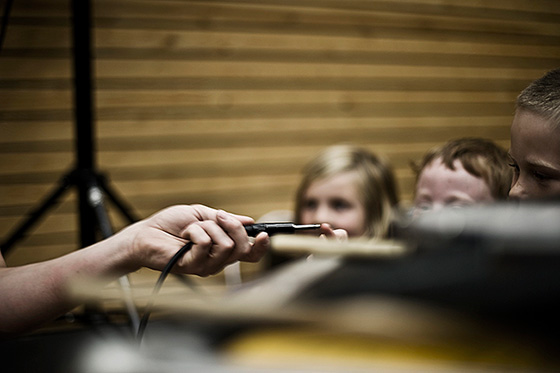
“We decided that children in schools are constantly saying something, so we can do without words, just play,” Peter continues. - Our performances are called “BroughbØtta” , that is, “bucket of noise” - in Norway they are called small children if they are too loud. We distribute a lot of small percussion tools to children, so they can play with us: put their sounds in context and hear what is happening, how the music responds and what can be done about it. They hear that music can be a noise, or maybe a melody, or rhythm, or something abstract, or just a texture, or any combination of all these things. There is some kind of magic in this, and I think that this sense of game and joy can wake up musicality in many of these children. This is a great way to start making music, it is much better when a child needs to reproduce some structure or play “mi” correctly. Of course, it is also necessary to master the tools, but it is important to maintain this feeling of the game from the very beginning - then then, when you may perform Bach, you will do it interesting. ”
“And the children are also very open,” the table adds. - They still have no prejudices about what is right and what is wrong in music. The strangest things that an adult public may not have accepted, they perceive with interest. They have not yet been influenced by radio, television and all this-I mean the smallest, they, in my opinion, are surprisingly susceptible. ”
This is an improvisation of the iPod-Shuffle era!
“But keeping the attention of six -year -olds is a difficult task,” Peter laughs. -You cannot play something for a long time unfolding, introvert-they just stop listening. You have to be very economical in what and how you do. Therefore, for us it was a very, very useful school - we transferred this experience to our “adult” performances. This is what we worked on and working on: to learn how to develop spontaneously coming ideas, focus on them, find different ways of transition from one idea to another. It's not about any specific techniques, but rather about strategy. This is generally one of the most difficult things in improvisational music - to keep the attention of the public, to make the music interesting not only for you, but also for listeners. ”
It is clear that all these, in general, are universal things and there is no special “Jody approach” in this: the name The Geordie Approach is just a joke, the same as the tracklist of the first album of the trio, consisting of surnames like Kigan, Schirer and Robson.
“When you engage in improvisation, the names of the tracks are always a problem,” the table explains. “In the sense, these are not songs, there are no words in them, so it doesn’t happen that we think:“ Oh, this line is ideal for the name. ” When we recorded the first album, we decided that since the group is called The Geordie Approach , we will call the tracks in honor of the football players and the Newcasl trainers - because, in the end, it is not as important as they are called. ”
“Yes, and the name of the album, “ Who Eye, ” is also Jody Sleng,” says Peter. - What does it mean? Oh, it’s a pity that we say without Chris, here it is necessary to explain. But in general, they use this expression in a variety of contexts. It can mean something like “Ah, yes, okay ...” ”
“By the way, with the last album, it turned out a little differently, that is, the name turned out to be more meaningful,” the table notes. “We called this record “ Inatween ” - Jody is so pronounced the word“ between ”. We just felt between different ideas - especially at concerts. This word is very suitable for the state when you are focused, but you don’t know what exactly will happen at the next moment, and as if you are constantly in a new fork, constantly Inatween . ”
The Geordie Approach will perform on May 17 at the SKIF festival in St. Petersburg , and on May 19-in the Moscow club “Chinese pilot Jao Yes”