
Translated material
Life after sanctions
The issue of the effectiveness of sanctions , as well as their legitimacy as a means of international policy, is currently causing strong discussions between experts. Statements in this area are divided mainly into two categories: those that describe the harmfulness and illegality of sanctions and those in which sanctions are represented by one of the necessary tools in a complex approach to regulating international relations. At the same time, the former mainly describe the social and economic damage caused by sanctions, and the latter often affect this topic only indirectly, as inevitable costs in order to achieve the tasks.
Neither those nor the others, however, usually affect the specifics of the restoration of countries after at least partial relief of sanctions. It is clear that in any case it is quite difficult to do, since usually sanctions are imposed on countries in which comprehensive instability or premises for it already take place. In other words, at the recovery stage, it is almost impossible to establish what part of the general damage was caused by sanctions and how it was/can be compensated. However, for the sake of forming a wider context, one can consider individual examples of such restoration processes in countries to which strict international sanctions were applied.
Libya
In Libya, by the time of the 1969 coup, as a result of which a new political system was established in the country and Gaddafi was in power, the economy was lifting (the rapid growth of GDP was observed since the late 1920s). The coup, accompanied by the nationalization of oil industries, caused severe cooling in relations between Libya and Western powers, primarily the United States. It was also accompanied by frictions of a political nature, primarily related to the fact that Gaddafi supported terrorist movements in a number of countries. In 1979, the United States qualified Libya as a state sponsored terrorism. It should be added to this that Libya at the stage of Jamahiria was invested a lot in the development of its weapons and adjoined the countries of the social unit.
The first serious economic sanctions against Libya, which significantly limited the possibilities of exports and imports, as well as financing, began in the 1980s. The first initiators were the United States, then the UN. In combination with the general drop in oil prices in the world (and oil formed the basis of the Libyan economy), the sanctions led to the fact that GDP was almost doubled during this period. The diversification of the Libyan economy began in response to this by the 1990s. Although she did not stop, she slowed down this process. The sanctions were systematically tightened until the 2000s. By that time, they included the embargo for the supply of oil equipment and freezing some foreign accounts.
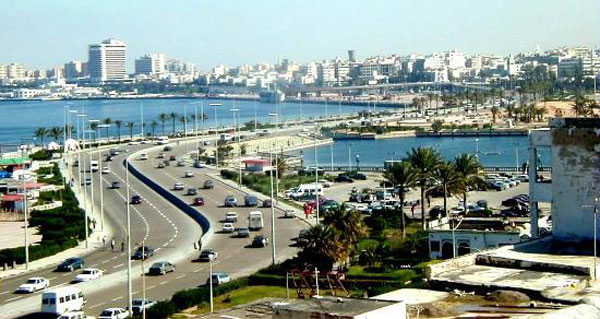 Tripoli
In 2003, Libya changed diplomatic tactics and fulfilled a number of requirements emanating from the UN. In particular, she explicitly refused to support terrorism, officially assumed liability for a number of terrorist attacks and announced her readiness to pay compensation to the families of victims. After that, the UN sanctions from Libya were lifted. At the very end of 2003, Libya also announced his intention to curtail the programs of arms buildings. As a result, in 2004, the United States ceased to spread to Libya in 1996 an act on Iranian and Libyan sanctions. After international restrictions were removed, the Libyan economy began to grow rapidly, primarily due to oil trade, which continued until 2011, when folk excitement began in the wake of the Arab spring, which were crowned with the revolution.
These events hit the Libyan economy, as a result of which the GDP that year has been reduced more than doubled compared to the previous year. However, in the next year he grew sharply, despite the strong political instability in the country. The period of folk protests against Gaddafi was accompanied by a new wave of sanctions against Libya initiated by the UN and the USA. Many of these sanctions were targeted, that is, they consisted in freezing foreign assets of the Gaddafi family and other representatives of the authorities. However, due to the fact that the key sectors of the Libyan economy were controlled by the state, that is, the regime could use their income in their interests, these possibilities were also blocked (first of all, it extended to large banks and oil trade). After overthrowing the regime, these restrictions were removed.
The rapid restoration of the Libyan economy was in its kind of sensation of 2012. It should be borne in mind that its main driving force remained oil trade, and according to the results of the events of 2011, the oil producing infrastructure was damaged. Nevertheless, already at the end of 2011, analysts began to predict the GDP jump in at least 50% next year (as a result, it amounted to more than 100%). This was partly due to the fact that during the civil war and the opposition forces, and the Gaddafi regime diligently and purposefully avoided destroying the infrastructure, and random damage that took place was relatively easily eliminated. Although at the time of the change in the oil production, the level of oil production was only 40% of the previous one, this was already a good basis.
Nevertheless, later the talk that economic growth in Libya met significant socio-political obstacles: the new government has no distinct strategy, and meanwhile, in the country with the original Tribalism, a continuous struggle for owning resources is underway in the circumstances. Moreover, in mid -2013, the seizures of oil storages began by rebels, requiring the government of greater autonomy. Following the results of these perturbations, GDP already in 2013 decreased by 10%.
According to Neut Mason , a former trade attache at the US Embassy in Libya, it is urgent to restructure oil production and increase the transparency of the distribution of resources. Next, he believes, it is necessary to send more funds received from foreign trade, the local authorities, so that they, at their discretion, invest them where necessary. The alternative to this may be an attempt to centralize the distribution function, which, according to Mason, will lead to an increase in corruption and social injustice.
Also, part of the income from foreign trade should be directed to financing public needs (assistance to poor families, social funds, civil servants, etc.). As for the infrastructure itself, it is necessary to make a thorough revision of its functioning in order to avoid leakage of funds at different stages. Finally, Mason believes that it is necessary to legalize the private sector, since despite the change of regime, the government still refers to such innovation with great caution.
Iran
The United States imposed sanctions on Iran in 1979, shortly after the Islamic Revolution. They became a reaction to the capture of hostages at the American embassy in protest that the United States adopted an expelled Iranian Shah. Then large amounts were frozen in foreign Iranian accounts. In 1984, after the invasion of Iraqi forces in Iran, a ban on the sale of Iran of weapons, as well as to provide the United States of any assistance to Iran, was banned. In 1996, an act of sanctions against Iran and Libya, which was renamed in 2006, was signed, when the sanctions were lifted from Libya. In 2005, when Mahmoud Ahmadinejad became president, on the initiative of Bush, the accounts of those who were related to the Iranian nuclear program were frozen. In 2010, Obama signed an act of additional sanctions against Iran. In 2013, after the moderate Hassan Rukhani came to power, the sanctions were somewhat softened due to the fact that negotiations on the nuclear program moved out of the dead point.
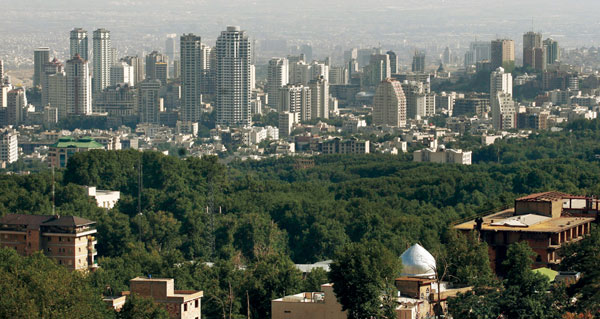 Tehran
Since the 1950s. And before the 1979 revolution, the Iran’s economy developed rapidly, mainly due to agriculture. However, by 1978, the growth rate slowed down in connection with the rapid leakage of capital abroad. Soon after the revolution, as a result of which 80% of the country's economy was nationalized, the war with Iraq erupted, which cost $ 500 billion in total. The subsequent tightening of sanctions also did not contribute to its rapid growth.
Now, according to the forecasts of the IHS analytical center made in April 2014, the growth of the Iranian economy for 2014-2015 The financial year can be from 1-2% with a bad scenario and 6-8% with good. In case of maintaining the status-QV, analysts predict an increase of 2-3%. The worst scenario takes into account the potential deterioration of relations between Iran and the West, economic complications and the destruction of the oil and gas industry in the country. The development scenario while maintaining the current conditions involves a large share of uncertainty and instability, the presence of moderate financial and economic sanctions, a certain influx of foreign investors and the increased development of oil and gas production.
Finally, the most optimistic scenario implies the complete abolition of sanctions. “The EU suspended the ban on the insurance of Iranian petroleums, the funds received as a result of oil trade in the amount of $ 4.2 billion were unlocked, and the current restrictions on the import of raw materials will remain for six countries that still buy oil from Iran. Nevertheless, despite some softening of sanctions, the country will probably have to solve problems with financial debts, strong inflation and economics, which has declined to $ 270 since 2011. ”
The IMF makes similar forecasts: with probable economic growth by 1.5% in 2014 and 2.3% in 2015, inflation reduced to 23% (compared with 35.4% in 2013). At the same time, an increase in unemployment level is likely to 14% (from 12.9% in 2013).
At the same time, in the country, according to the France-Presse agency, after the initial emotional upsurge following the election of the moderate president Hassan Rukhani, discontent begins to grow. Indeed, in accordance with the expectations, Rukhani achieved from the West the softening of the sanctions, but this was not easier for citizens. “He began to slow down the increase in inflation that he inherited from his predecessor’s programs, which, although they were called upon to support the Iranian economy as it is isolated from the outside world, ultimately only aggravated its problems.” Most Iranians still believe that Rukhani’s policy in the future can provide a positive increase in the economy, but the lack of direct improvement, high prices and strong property stratification among the population do not add Rukhani popularity.
“We live in very difficult time and are in the conditions of economic stagnation in combination with inflation. In such a situation, it is difficult to pursue a policy, since any actions to stimulate growth lead to inflation, ”explained Ramin Rabia, a representative of the Tehran Stock Exchange. As unemployment grows, the population is even more poorer, which, in turn, is concerned with foreign companies in Iran. The reason for the anxiety is not only that purchasing power falls, but also that in a situation of social tension, conservatives and supporters of a tough course may have more pressure tools on Rukhani and, accordingly, influence in decision -making.
To be continued