
Translated material
"It was euphoric freedom"
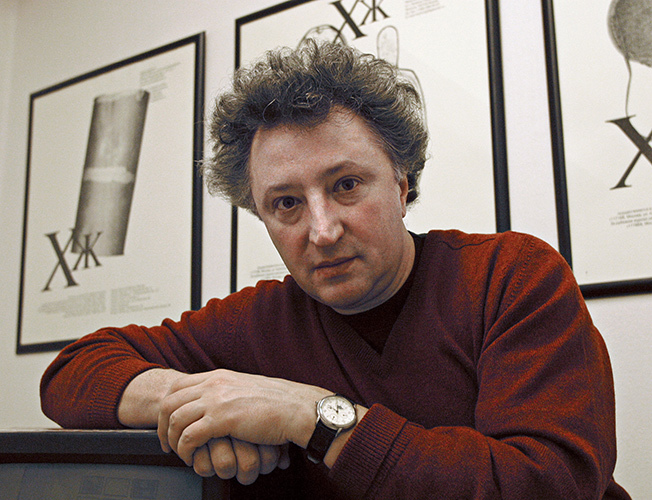
Art critic Victor Misiano, who founded the famous publication about actual art-“art magazine”, who made many resonant exhibitions and was in the center of events, told us that for him it was the most important in the activities of Moscow artists in the 90s.
-In the artistic life of Russia of the 90s there were many events. How much is possible to select the most significant?
- I have to immediately fend your thesis about a large number of artistic events. The artistic and cultural infrastructure in that era was paralyzed, while the economy of art is primitive. There was more enthusiasm than objective resources to create large -scale and professional events. At the same time, of course, there were bright phenomena, but in comparison with the normal routine of artistic life, even today there were very few. Statements, affected gestures, declarations - this was enough, but if we talk about the event in the institutional sense of the word - an exhibition, a book, an artistic project, an important text, a conference, a discussion, a public controversy (what is usually a artistic life), then here we must be aware that all this was the property of a relatively small circle of people, several topographic points on the map of Moscow - according to the mostly small ones - mostly small Private galleries that appeared at this time, primarily in the gallery quarter on Bolshaya Yakimanka. This is Marat Gelman Gallery, the first gallery created by Aidan Salahova with Alexander Yakut and Zhenya Mitta, the gallery of Irina Piganova (Meglinskaya) “School”, the Gallery L , and then XL . But, of course, already against the backdrop of modern art factories (“garage”, the Museum Empire Tsereteli, GCSI) - which, in my opinion, are extremely vulnerable to criticism - these small, several dozens of square meters, institutions may seem indistinguishable. Only now a curious thing: in terms of quality of art, what was created in these fragile places was so high that it seems almost inaccessible today ...
This experience of rampant freedom was quite painful. He was not only relaxing-soldering, but he turned out to be fraught and unbearable ease of being.
-Is it possible to say that in the 91st in the artistic environment, freedom played a special role and a sharp difference occurred in the direction of emancipation and openness?
- It was an euphoric freedom. But in the strictly liberal sense of the word, this was not freedom. Because liberal freedom implies not only rights, but also obligations, and with them during this period the case was quite bad. That is, there was no conscious, articulated, internal understanding of his rights, and instead there was a feeling of some kind of ringing void in which you found yourself, without any pre-installed value guidelines. They had to be invented on the go. These values and landmarks were then an individual choice of everyone. Moreover, I would even say this: this experience of rampant freedom was quite painful. He was not only relaxing-soldering, but he turned out to be fraught and unbearable ease of being. And therefore, it is natural that, on the one hand, this experience was experienced incredibly intensively, and on the other, he always passed into his opposite. That is, it was an euphoria, turning into depression in the failures ...
-Can you designate some common features in the art of the 90s?
- First of all, this is a media acceptance. It was exceptional in those years. Basically, art events in the media were covered by people recruited from the art world. And if we take into account that the artistic and cultural life was then extremely not rich in events, any escapa of figures of Moscow radical art or even any small exhibition that took place on small venues, attracted priority attention. Partly, the fact that the real scene of the artistic event was not the artistic world, but primarily media, condemned such different artists as a Brener and Kulik, to work in the framework of a certain general poetics, which received the name “Moscow Investigation” that I did not like. The addressee, by and large, turned out to be media.
The paradigm that was involved in the 90s suggested that the place of art was with money and in power. Just then there was neither one nor the other.
Another curious feature-intellectuals in the art world of the 90s played an important role, because they turned out to be intermediaries between artists and media, as well as intermediaries between artists and the West. In the subsequent era (in the 2000s), the main reference figure for the artist becomes a new Russian market: dealers, gallerists, collectors, oligarchs, their wives, friends, etc. And intellectuals were no longer needed in the interval. In a situation where the figures of the commodity market become priority, the poetics of actionism has lost its relevance, it was necessary to issue goods from expensive materials. But these are already post-deprived, which help through a counterpoint to describe the specifics of the 90s.
It should be noted another characteristic component of the 90s-contrary to the fact that the artistic world was a poor (many painful memories of this were left, for example, Dubosarsky and Vinogradov, describing the poverty of the artist of the 90s with great irony), the artists took an active part in the so-called primary accumulation of capital. Only if during this period the oligarchs bought resources at the mortgage auctions of the real market, then artists and gallerymen functioned in the symbolic market - they created an individual reputation, promoting a brand with a slightly ridiculous name “Actual Art”. Why not modern, but relevant? Because all reforms (political and social) said that behind our back is a void, 70 years of a black hole in history, and we are now creating something completely new for our country. Actual-as something more radical than modern. So it was a very real struggle for the market, for the resource. And the 2000s showed that the art of the 90s calculated everything correctly. The bridgehead was created.
- What moments were nodal in the creation of new paradigms in art?
-In fact, the revolutionary period, the period of accomplishments, the laying of some basics, was very short. I would divide it into two stages. The first is the late Soviet period, still perestroika. If we can talk about some European perspective of the development of Russia, then, without even invading the sphere of political science speculation, but simply looking at the nature of the events that took place in those years, these were large, professionally made, serious exhibitions of large Western masters (Kunellis, Gilbert and George, Raushenberg), accompanied by conferences, and the arrival of serious specialists. So what was loomed into the Gorbachev perestroika was the character of a modern European social-democratic paradigm. And she showed herself de facto. And the second stage is the 90s and the birth of small institutions, a radical-analysis of Moscow actionism, a system of radical gestures. This bet on the market, on promotional strategies, on individualism and war of everyone against all there is a somewhat grotesque expression of neoliberal ideology and an analogue of the primary accumulation in the field of economics.
The most powerful, intensively experienced events have been things for me related to the transgressive activity of a state -owned, provocative nature.
Of course, we can say that the experience of Moscow Investigation will learn in a fairly large number of phenomena of the international scene, that it was a kind of radical branch of what is customary to call “communication aesthetics”, but for Russia it was a serious change in the paradigm, a completely different model of art was declared with which the artists waved to society. And recently, we were again convinced of this - our Fatherland and at this time lives through the system of medial transgressive gestures.
- Can this be called continuity?
- I think yes. I do not fully agree with such an interpretation scheme, according to which the 90s are opposed to 2000s. Despite the fact that the 90s and 2000s are completely different eras, the 2000s and 2010s are still rooted in the experience of the 90s.
The paradigm that was involved in the 90s suggested that the place of art was with money and in power. Just then there was neither one nor the other. But all the tactics of the same kulik, all its radical gestures to a large extent served as a means of scandalous promotion. There was very little another backlash, the main task was to create a new system of art, its legitimization and an attempt to seize team positions in media and other resources. This is exactly what happened in the 2000s. What is now impressive with its institutional resource is a system of continuity in its purest form.
There were few paradigmatic events, and all of them happened between 1991 and 1994. It was during this period that the Center for Contemporary Art was created, both public and state; Private galleries appeared; My "Art Journal" appeared, Olga Sviblova appeared with the idea of taking something in the field of photography. And then the routine began. And it was a painful transition. Because people who have survived the initial courage, then they can hardly fit into the routine. I remember Marat Gelman dropped such a phrase: “There is nothing wrong with the routine. The routine is normal. ” A phrase that is very consonant with our then experiences. Everything was not so bright, it was devoid of a utopian horizon.
Because all reforms (political and social) said that behind our back is a void, 70 years of a black hole in history, and we are now creating something completely new for our country.
There is a text that I wrote in hot pursuit, the “cultural contradictions of the party”, where I just say that all the activities of the art world of the 90s were performive. I still theorize that the contemporary artist creates not objects, but forms of life. And, perhaps, this is a bruise of the 90s.
-Can I suffer you and ask you to name the most significant, in your opinion, events in the art of the 90s, which, for example, will remain in history?
-This is a very interesting question, but I, like a person of the 90s, maybe not completely ready. The optics with which I have been following the process all these years is not very suitable for answering your question. Because personally, I always looked for social symptoms-I was interested in artistic phenomena as an incentive for some speculation and generalizations, for describing artistic phenomena as symptoms of processes. I thought little that it would remain, and what is not, what is most significant and what is not. Although now, of course, is very curious: they lived at such a time, and what will remain of this, what was significant, what turned out to be superficial and superficial? I do not take an accurate answer, but I will try to find a compromise form of an answer to your question.
There is no doubt that if I have to look at the era retrospectively, then my individual biography has developed so that I experienced the events associated with Moscow actionism with radical gestures, promotions, scandals that they created with particular intensity. The most powerful, intensively experienced events have been things for me related to the transgressive activity of a state -owned, provocative nature, such as:
- Oleg Kulik’s action in front of the center of contemporary art, where Kulik was a dog, and the Brener drove him on a leash and he bit all;
- The action of Anatoly Osmolovsky on Mayakovsky Square, when he climbed onto the shoulder of the monument to Mayakovsky;
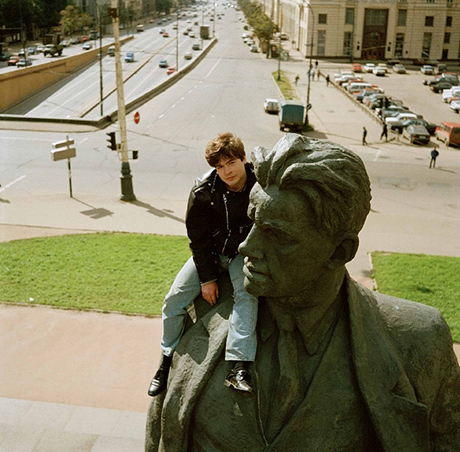 © Osmopolis.ru Osmolovsky on the Monument of Mayakovsky
- All shares of Alexander Brener.
Among significant things - and my own curatorial experience. The exhibition, which I made in 1996 in Stockholm, called Interpol. It caused a huge international scandal: there it was valiantly shown by Kulik and Brener (Brener broke the work of the Chinese artist as his creative contribution, and Kulik bit the audience, including the main sponsors).
I want to say now that, probably, these things were key. But, on the other hand, there is internal resistance. When you begin to think out retrospectively, they immediately come to mind - as very significant, as absolutely providential - completely different things. I recall the one-day action “You are powerless, or in general, everything is not so bad”, created by the amazing artist Gia Rigvawa, now completely forgotten, but then made the work of the work of strikingly subtle, complex, complex, poetic, piercing. Exhibitions of Yuri Leiderman, an artist of a late -niceporalist, who was then unusually authoritative in Moscow and created a series of amazing works. Another strong aesthetic experience is the first exhibition of Olga Chernysheva in 1992 in the Gallery "1: 0".
As an answer to this question, I would indicate the presence of a fork between the fact that it claims to be symptoms and familiar, created on the wave of promotion of the so-called actual art, and something else that was not, but what is in an artistic and intellectual sense, undoubtedly, more significant.
The action that remained especially internally important for me, I would say, a guide, is Vadim Skishkin’s “lighthouse” when he illuminated the dome of the Viennese secession and he blinked the day and night, like a lighthouse, and blinking was synchronized with a fiction of the heart of Fishkin (1996). Work is not a decade, but centuries. It is like Malevich’s Black Square, such things, of course, will remain due to their piercing, human meaning, content, poetic power.
- Much of your named is united by such a thing as poetic expression. Is that so?
- Yes. Maybe. Because to a large extent it was an era that showed the subject. The era when all kinds of scraps (we use the actual term) broke up. The era, the value of which was precisely in this experience of man alone with himself, when he suddenly realized his subjectivity. The era that put a person to the need for a total existential-ontological choice. Therefore, all these works are to a very large extent about this.