
Translated material
"We saw hell on earth ..."
72 years ago, Crimean Tatars were declared an enemy of Soviet power and were thrown out of their houses, where their ancestors lived for centuries
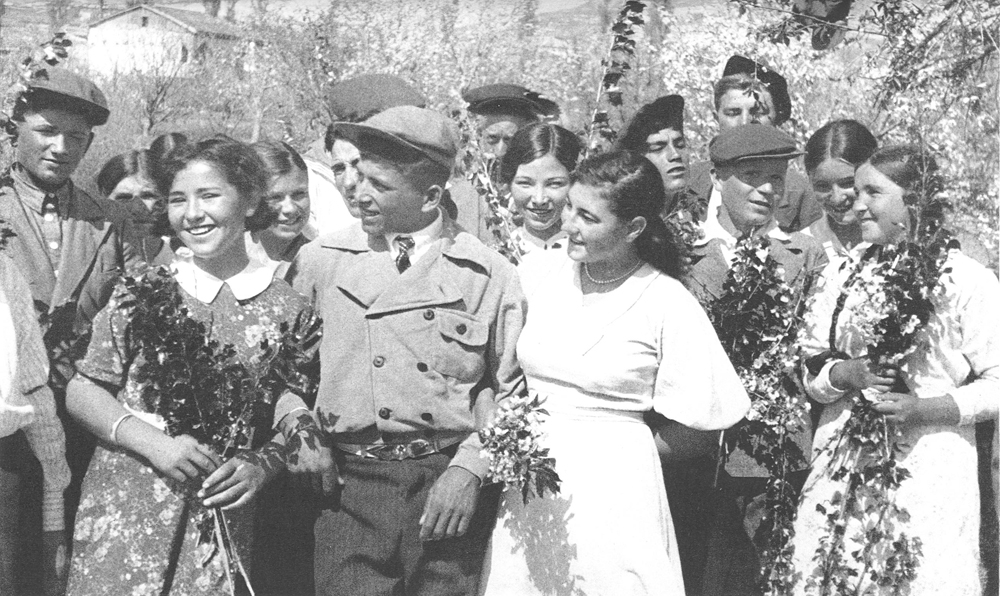
“We do not know another country where a person breathes so freely,” Crimean Tatar youth sang, as their generation sang throughout the country. Until I ended up in camps and links. Photo of 1939–1940 /photo: from the author's archive
... April 1944. The Red Army liberates Crimea from the Nazis. In parallel, there is a stripping of the peninsula from internal enemies - a population who has been in the occupation for more than two years, under great suspicion of the Chekists. The identification of “unreliable” elements in the territory of Crimea, as well as in other liberated territories, was engaged in SMERSH employees, as well as the NKVD and NKGB bodies.
During the “measures to clean the Crimea from anti -Soviet elements” criminals, of course, were found, as evidenced by the reports of the People’s Commissar of Internal Affairs Lavrenty Beria. Thus, according to Beria’s reports of May 1, 1944 in the name of I. Stalin, V. Molotov, G. Malenkov, during the “filtration”, 4206 people of the “anti -Soviet element were arrested, 430 spies were exposed, 5115 people were detained, including 55 agents of German intelligence and counterintelligence agencies, 266 traitors and traitors, 363 of the Militer and the henchman. enemy ".
From the memoirs of Yusuf Gafarov, who ended up in a partisan detachment:
| *So in the text. However, in 1944 there was a People's Commissariat of the Interior, who was renamed the USSR Ministry of Internal Affairs in 1946. |
“We, all the partisans, built us, came some bosses in military uniforms and ordered the weapons, including the cold one. They read the names, built them with accompaniment, and with the same bosses we went around the city along the embankment to the building of the Ministry of Internal Affairs of the USSR*. Each of us once again searched, removed the belts, took out the laces from the boots. We, about 60 people, were pushed into one small room. Only then did we realize that we were in prison. For what?
Interrogations began. Every day endlessly. In early May, we were loaded into trucks and all prisoners from Yalta were sent to their area. I was brought to the Kuibyshevsky district, to the village of Albat. They drove into a large stable converted to prison. There were already many people from all the villages of the Kuibyshevsky district - some of the elder, some policemen, some Imam, who is an accountant. All men of the Crimean Tatars - about 300 people - were prisoners. Everyone had a bad mood, no one knew how it would end. They began to judge those who stayed there. The triples were judged-in two or three minutes they decided the fate of the prisoners, without any issues. They only said the term of imprisonment. The highest term is 20 years, the smallest - 10 years. ”
As it turned out, these were not even flowers - so, flowers. The worst was ahead.
Deportation
On May 10, 1944, Beria introduced a draft of the State Defense Committee for the eviction of all Crimean Tatars from the territory of Crimea - “Given the treacherous actions of the Crimean Tatars against the Soviet people and based on the unwillingness of the further residence of the Crimean Tatars on the border outskirts of the Soviet Union”. The very next day, the “father of the peoples” signed a resolution of GKO No. 5859SS “On Crimean Tatars”: all, all-from infants to 90-year-old old people-should have been deported. Previously, the same fate touched the Balkars, Ingush, Kalmykov, Karachais, Koreans, Germans, Chechens. Therefore, the deportation mechanism at the time of eviction of the Crimean Tatars was tested: the time for fees, the routes-Uzbekistan, Kazakhstan, Siberia, etc., were described in detail, the addresses of the Crimean Tatar families in cities and villages with a mixed population were specified in advance, in all villages inhabited by the Crimean Tatars, troops of the NKVD were located.
The “operation” on the eviction of the Crimean Tatars was instructed to head the deputy commissars of state security and internal affairs B. Kobulov and I. Serov.
On the night of May 17 to 18, more than 32 thousand employees of the NKVD-NKGB began to expel the Crimean Tatars.
From the memoirs of Jafer Emiraliev:
“We lived in the basement of the old house. At dawn, two armed soldiers knocked on us. Aunt went out to them, and they said: “For treason, they send you to the homeland by order of Stalin”, not explaining where and for what time. We were given 15 minutes to fees. No decisions were read out, they did not explain how much and what to take. We were all in a state of shock, managed to grab some of the products and things. Mother with a small child in her arms, my grandmother was weak, took a small knot and a Qur'an. Of the children, I managed to take a boiler, a bucket, poured a little beans. Aunt took some things and blankets. After the specified period, we were kicked out into the street and drove to the place of the At-Akhir (horse courtyard), which was located on the outskirts of the village. All this time we were accompanied by two soldiers with machine guns. By the time of deportation in our village, there were 122 families of Crimean Tatars. When we came to the gathering place, there were already almost all of our village ones. We were all under a machine gun sight, armed soldiers surrounded on all sides. It was possible to even go out of need only accompanied by a soldier. We were kept there before lunch. After lunch on the Studebekkers and Pyatotoks, they began to be taken out of the village. An armed soldier who was sitting in the cab was attached to each car. Everywhere you can hear crying, screams, insults of soldiers. There was chaos and horror, it is scary to recall those watches of grief and tragedy. Our family was taken out the last. Still before his eyes - as our cow, Uncle Vasya from the village of Buyuk Xuren, took away our cow. "
And here is what the author of the author, a teacher of the Yalta university Valentina Ivanovna, who told about those events, told her grandmother: “In the Yalta court, several families - of different nationalities, told. Early in the morning, my grandmother heard a noise, a knock on the door of her neighbors - the Crimean Tatars ... When she went out into the courtyard, there were no more neighbors. The hearth on which breakfast was preparing had not yet cooled down, household utensils stood alone. And for many more days in the city there was a terrible howl of dogs ... "
On all sides of the peninsula, trucks with unfortunate people were drawn to the nodal railway stations, who were driven by force into commodity cars. Where they were taken away, people did not know ... Already on May 20, local party functionaries reported to the Crimean regional committee of the CPSU (b) about the successfully conducted eviction campaign and reported information about the remaining property of the Crimean Tatars.
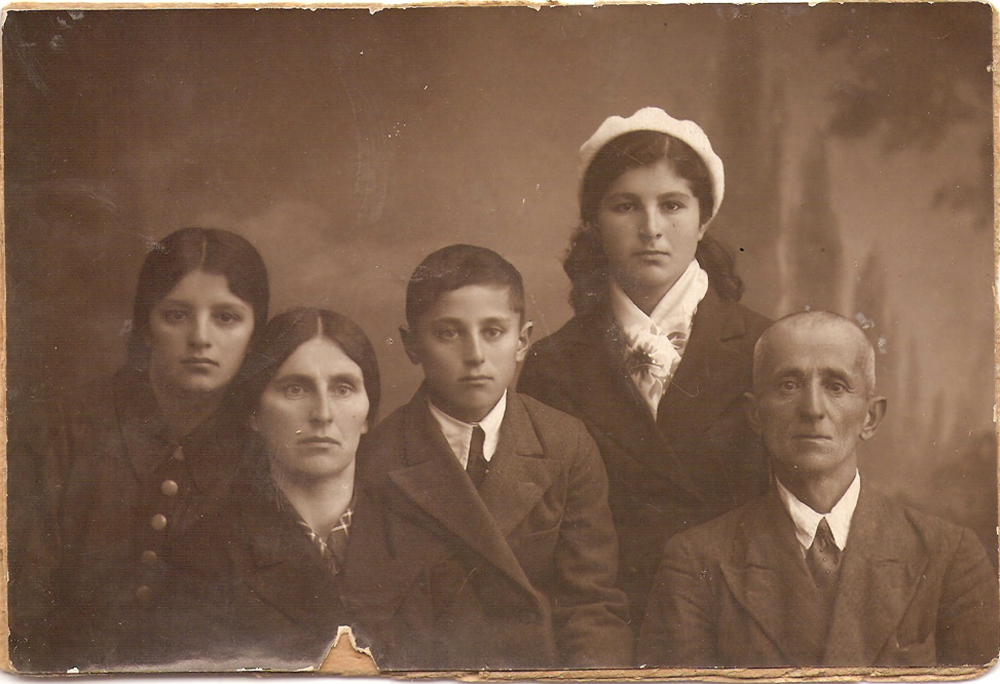
Zylha Lumanova (second on the right) and her family before deportation /photo: from the author’s archive
The path to exile
The main part of the deported Crimean Tatars was women and children: they drove them in commodity cars equipped with bunks.
From the memoirs of Kasida Bekirova:
“There were many families in the carriage. We were driving three families - 18 people. There are ten of us and the family of the father’s sister - 3 people and other sisters - 5 people. They did not have a single man. And we had two men-two of my brothers: Efrasia, born in 1931, and Ozdemir-1940. The remaining 16 people were all female - such a feminist gathering. My mother born in 1899 was among them the oldest. ”
“Without approaching the Bakhchisaray station, we were planted at the railway canvas. They kept there for two hours. By evening, a train with freight wagons was adjusted and began to load us into them. There were 12 families in our car, all the inhabitants of the village of Yukaara Karalez. Those families who took us out before, got into the Kostroma region, some in the Namangan region, and we got to the Samarkand region. There were no conditions in the carriage. The toilet was made by people themselves: in the corner of the carriage pierced the hole in the floor and fenced a piece of rags. They themselves produced water at rare stops, ran, searched for it. At the same stops of several bricks, they quickly built a hearth, where they were prepared from supplies that they could take with them. They did not have time to cook, the boobs of the steam locomotive, and everyone runs into their wagons with half -dried food, jumping into the car on the go. "
They fed poorly on the road, the trains idle for a long time; There were many patients and dead, the bodies of the latest escorts, without any paperwork, simply thrown along the path of the echelon. Before me is a unique document - the diary of Zylkhi Lumanova, a resident of the Crimean village of Tavbodrak. The first record in it was dated May 18, 1944. The 20-year-old Zyilha kept a diary on the way, right in the echelon. The lines written in a simple pencil for these years. There are not many emotions on the five pages of the diary, but in the records made in the Crimean Tatar language, the path was fixed in great detail-people hoped that they would soon return home. So, it was necessary to know the road back. Zylhe was not destined to return: on July 5, 1945, she died of typhus in Urgut of the Samarkand region.
The main part of the Crimean Tatars was sent to Uzbekistan: the last echelon came there on June 8, 1944.
From the recollections of the escorter Idrisov:
“We were unloaded in the steppe. We took them to the collective farm Voroshilov-2-they gave the house, as I remember now, without a roof. Four walls. Kamysh was thrown, Nearby grew Kamysh. Jackals will come, howl nearby. There are four children, there were no father. The brothers were taken to the collective farm. "
From the memoirs of Esvet Barieva:
“After 18 days, the Milyutinskaya surviving directly from the train at the Milyutinskaya station was plunged into cars and brought to the mountains at night. There are only stones around. Neither trees, nor hut ... They themselves huddled something like trenches. Over time, each family was given five horses. So roofs appeared. ”
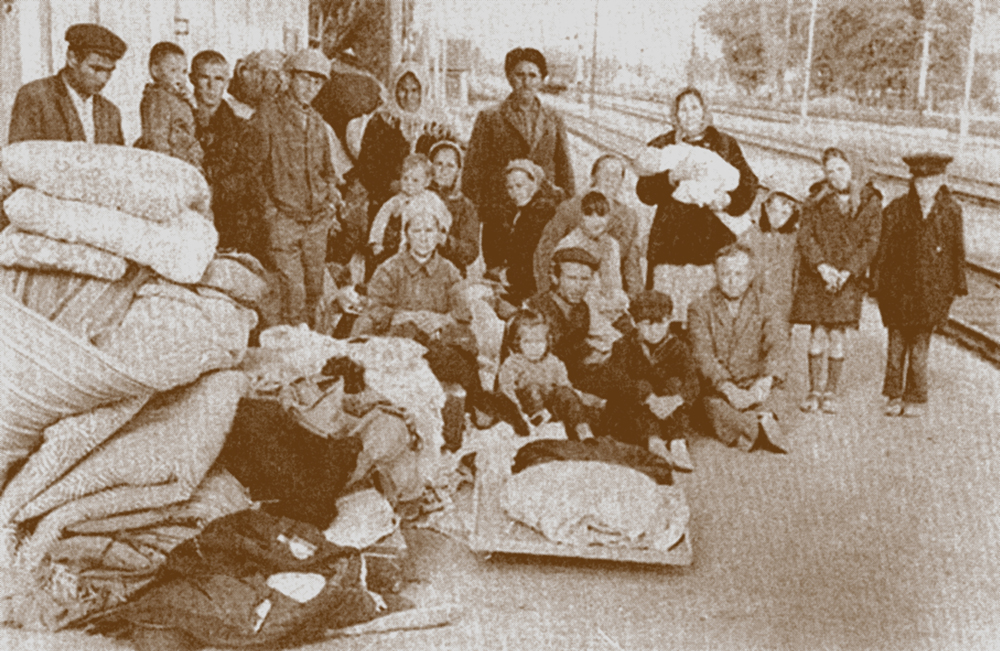
Deportation of Crimean Tatars. Crimea, May 18, 1944 The author of the picture is unknown /photo: fine art images /east news
In a foreign land
The Crimean-Tatar special settlers were determined for the construction of the Farkhad hydroelectric power station in the city of Bekabad, the Koitash and Tashkent-Stalinugol mines in the Samarkand region, to collective farms and state farms of the Tashkent, Andijan, Samarkand regions, the Shakhrizabsky, Kitabsky regions of the Kashkadarya region. As well as to foresters of Siberia and the Urals.
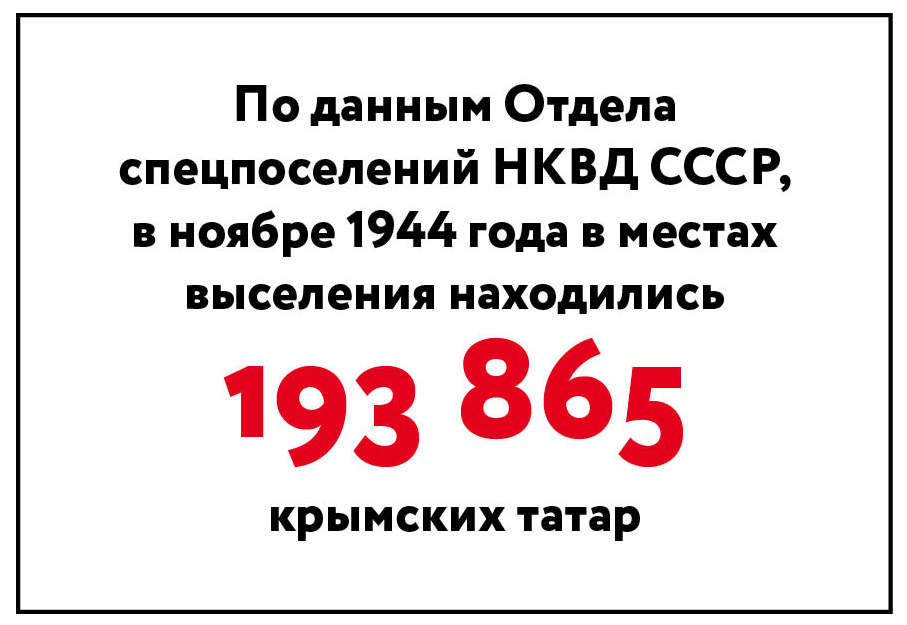
According to the special settlements of the NKVD CCCR, in November 1944, 193 865 Crimean Tatars were at the eviction sites, of which 151 136 were in Uzbekistan, 4286 in the Mari Autonomous Soviet Socialist Republic, the rest were distributed “for use” in Molotovskaya (10,555), Kemerovskaya (6743), Kemerovo (6743), Kemerovo (6743) Gorky (5095), Sverdlovsk (3594), Ivanovo (2800), Yaroslavl (1059) regions of the RSFSR.
Speaking that everything was “taken out”, of course, is only about those who were on that tragic night on May 18, 1944 in the Crimean Peninsula. Most of the male population was at that time in the Red Army. Directives of the NKVD of the USSR No. 1/21826 dated November 16, 1944 and No. 1/1559 dated August 12, 1945 categorically forbidden to “send demobilized from the Red Army-Chechens, Ingush, Karachais, Balkars-in the territory of the former Chechen-Ingush SSR, the former Karachai Autonomous Region and to the territory of the former Kabardino-Balkarsky ASSR; Kalmykov - on the territory of the former Kalmyk Autonomous Soviet Socialist Republic, Rostov and Stalingrad regions; Crimean Tatars, Crimean Bulgarians, Greeks, Armenians - into the territory of the former Crimean Autonomous Soviet Socialist Republic. ”
The defenders of the Motherland found their families - if, of course, they found - already in a foreign land, in the so -called places of special settlements. And they themselves became special migrants. Registered by the NKVD special settlements department only in Uzbekistan in 1952 were 6057 participants in the Great Patriotic War, many of which had high government awards. For them, as well as for their children and wives, the question of whether the son is responsible for his father, has remained immature for many years.
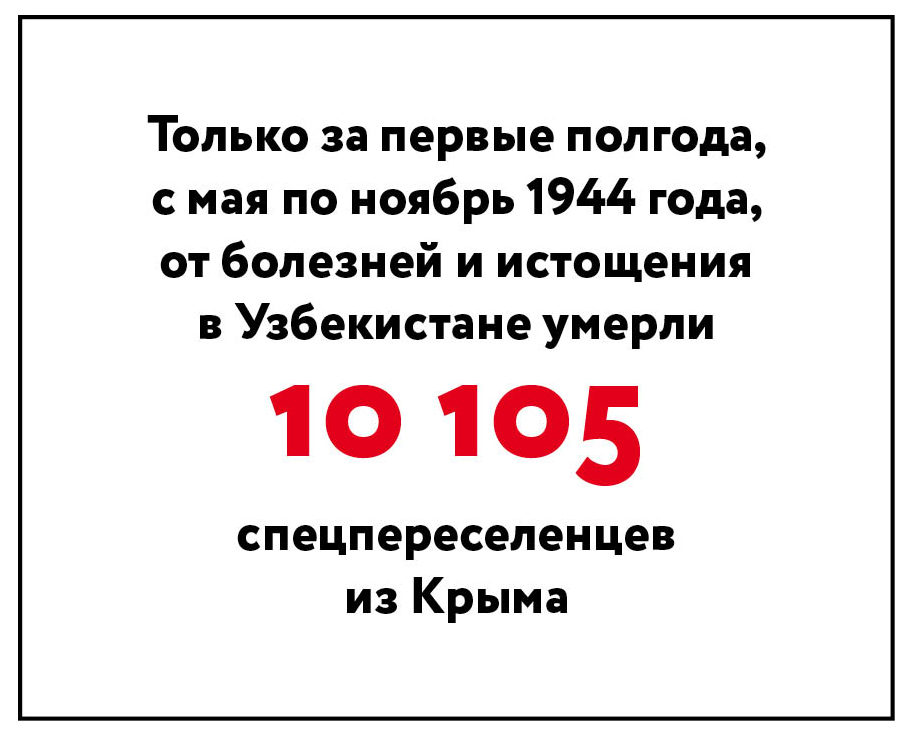
An unusual climate, a constant lack of nutrition, and often roofs above the head, led to the fact that almost immediately among special migrants, epidemics of malaria and gastrointestinal diseases erupted. According to the secret message of the Deputy People's Commissar of Internal Affairs of Uzbekistan Meer addressed to the Deputy People's Commissar of Internal Affairs of the USSR Chernyshev, in July 1944, up to 40% of special migrants were sick in the Namangan region of the Knosyra, and in the Pakhtakorsky district of the Samarkand region there was a “livestock disease of malaria”. According to official statistics, only in the first six months, from May to November 1944, 105 special settlers from Crimea died from diseases and exhaustion in Uzbekistan, that is, about 7% of those who reached the places of settlements. The stories of eyewitnesses of these events are extremely monotonous: constant hunger, illness (malaria, dysentery, typhoid), exhausting labor and the dead - in every family.
From the recollections of the escorter Idrisov:
“... Winter of 1945 turned out to be unusually harsh ... The Uzbeks were angry: you brought it with you. And what about the locals to be offended? They were inspired that the Tatars are nonhumans: they steal children, God knows what they eat, some have tails ... In March 1945, I was the first to get a bloody dysentery in the family. No medicine, no money. The doctors of the local hospital saved ... On March 29, mother and younger brother became seriously ill. There is not a baby in the house. I ran to my artel to the new chairman Peter Spiridonovich Lobanov. I stand, swallow tears and I do not know how to say. Ask for a loan? After all, he was sick - he did not earn. But the chairman understood everything. He hugged his shoulders: "Come on, son!" He led to his home, poured five corn poured kilograms ... Corn saved life, but not everyone. On April 2, my mother died, two more days later - the younger brother. There was no one to call for help. The Tatars were sick and died with dysentery. My brother and I dug up the grave among the stones. ”
From the memoirs of Aisha Seitmuratova:
“To feed the children, the mother was forced to sell things in the bazaar. Once she could not sell anything. Suddenly the old man approached her and suggested in exchange for a bucket of Jugars (millet flour) to give her velvet dress. Without hesitation, my mother took off her dress and stayed in one shirt. We must be grateful to our mothers, who did not eat, but retained their lives to the children. If the Pacific Ocean was an inkwell, then it would not be enough to describe the tragedy of our people. ”
From the memoirs of Adile Emirova:
"Mother! How she fought for our life! Growing up in a peasant family, who worked on Earth since childhood, she started a garden from the very first days of her life in a new place. She learned to cook us porridge of unripe corn grains. From potato cleaning, baked black cakes bitter to taste. At night, I went to water the garden: the water for watering was distributed in turn, often with scandals and fights, and at night it was easier to take water - to spend it from the central canopy to its site. She worked for wear, not sparing herself. And before everyone else passed away. ”
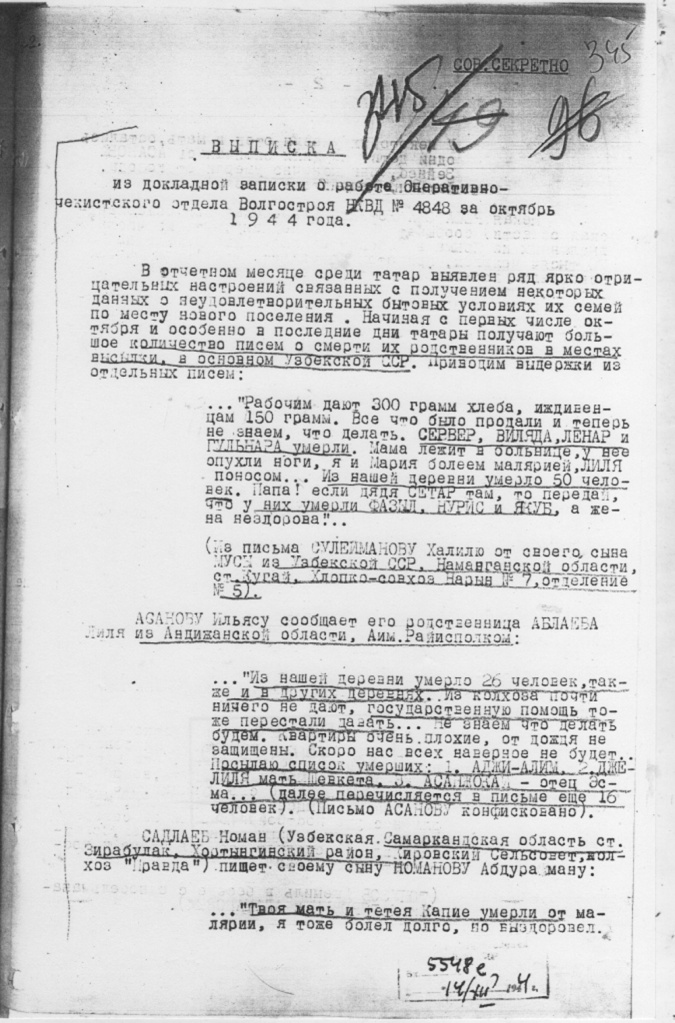
Private document of the era: such top secret reports of the NKVD operatives are often the only evidence of the fate of thousands of people /photo: from the author’s archive
My family
For my father, the deportation began earlier than others-like many young people of his age, in early May 1944, 18-year-old young men, he was called up to the labor of the Guryev: the labor was a militarized working formations that combined elements of a military organization (mobilization through the military registration and enlistment offices, domestic schedule), production sphere (production norms) and camp regime (zone, protection, administrative mode, supply standards).
The main contingent of the labor army during the war was the Soviet Germans, fully deported from their places of residence in 1941. By the end of the war, as other peoples evicted, the number of Trudarians increased. Today, researchers agree that the Institute of Trudarmia was a special form of repression on a national basis, since, as a rule, Soviet citizens of those nationalities that were officially recognized as “hostile Soviet people” got there.
Alas, I did not have time to record the memories of my father about that time.
But my mother recalls that time like this: “In 1942, my sister Khalida was born to me, her father did not see her (was at the front). Khalida died in Central Asia in 1945, just like the other two sisters of Nepis and Aisyv. In 1945, for almost a month we lived without bread, flour, fed only by fruits-apricots and apples ... Mom in the villages changed her things-Turkish shawls, dresses, some of the dishes for milk, sour cream ... So fed us in 1944-1946. And in the forty -seventh almost died of hunger - there are no fruit in winter. Some kind of grass jumped out, we fed for two weeks with that grass (in my opinion, it was a swan). She was only half -eaten, however, they said that she was also poisonous. And in two weeks, this grass was so dangled, I think, if I’ll take it again in my mouth, I will die ... And the little brother Ozdemir was brewing porridge, a manual mother somehow cleaned about 100 grams of flour. People used our mill, but in recent days there are fewer and fewer. And then one day the mother scraped the last half -hearted flour and says: “This is the last flour for the baby, now we will die of hunger, tolerate and eat grass.” And suddenly mom brings flour pea and egg powder. I don’t remember any details how she cooked them. I was already in a state of prostration ... These two weeks were on the verge of starvation ... I only remember the events later, my mother said, if not the Americans, we would have died with hunger. It turns out that pea flour and egg powder were placed along the north path. Thanks to these products for saving me from starvation. ”
Neither father nor mom after 1944 never once visited their native foci. The father’s relatives of the Baidars (now Orlinin) of the Balaklava district entered the closed Sevastopol territory, where the Crimean Tatars were not even missed as spa. And mother’s village of Adzhimenda died, like many Kerch villages after deportation - they were almost mono -ethnic.
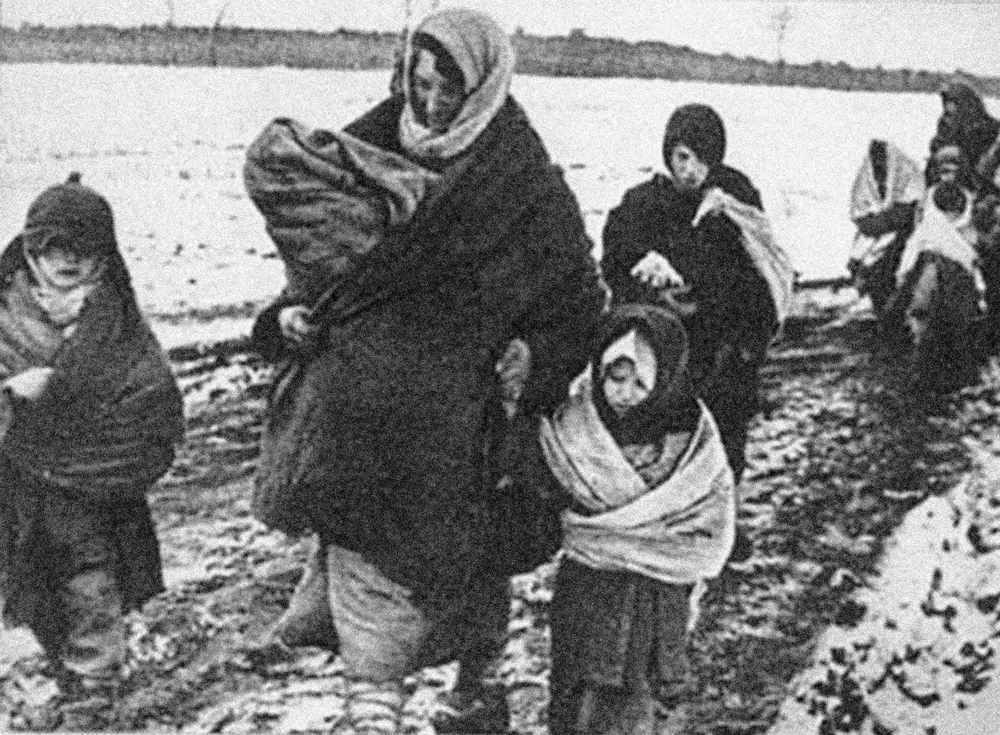
The road to exile. May 1944. The author of the picture is unknown /photo: Fine Art Images /East News
Aliens
The construction of a new life in Crimea - without Crimean Tatars and evicted at the end of June 1944, Greeks, Armenians and Bulgarians - required new labor resources. On August 12, 1944, the State Committee of Defense (GKO), in order to “quickly master fertile lands, gardens and vineyards”, recognized as necessary to resettle to Crimea from various regions of the RSFSR and Ukrainian SSR “conscientious and hardworking collective farmers” - only 51,000 people who were to settle and work on 17,000 Crimean collective farms. The lands of the former Tatar, Bulgarian and other collective farms, from where “special subsidence were made in 1944, with existing crops and plantations”, were transferred to the newly organized collective farms from the regions of Russia and Ukraine and were assigned to these collective farms for “eternal use”, the resolution of the GKO said. Even earlier, in July 1944. Cattle, sheep and goats, "accepted" from special settlers in the Crimea, were distributed through the districts.
The facts of looting in the Crimea were recorded even by official documents: “In the village of Akat of the Karasuvbazar district, fighters from the Primorsky army hacked the door of Sarai, where furniture from Tatar apartments was stored and took beds, tables and other households.” And here is what the Crimean Tatar Asan Useinov recalls, who, as a soldier of the Primorsky Army, happened not only to free the Crimea from the Nazis and observe the terrible paintings of the eviction of his people, but also to be a witness to subsequent events: “Our soldiers began to break in the doors, take the remaining things and send them by parcels by mail to their home. They even took pillowcases from pillows. Everything around was full of fluff and feathers ... Our countrymen during the occupation hid valuable things from the Germans, burying them in the garden or in the barn and planting potatoes or something else from above. Soviet soldiers, armed with iron rods, found these caches. This was most outraged by this. After all, how rejoiced the people that ours came. "
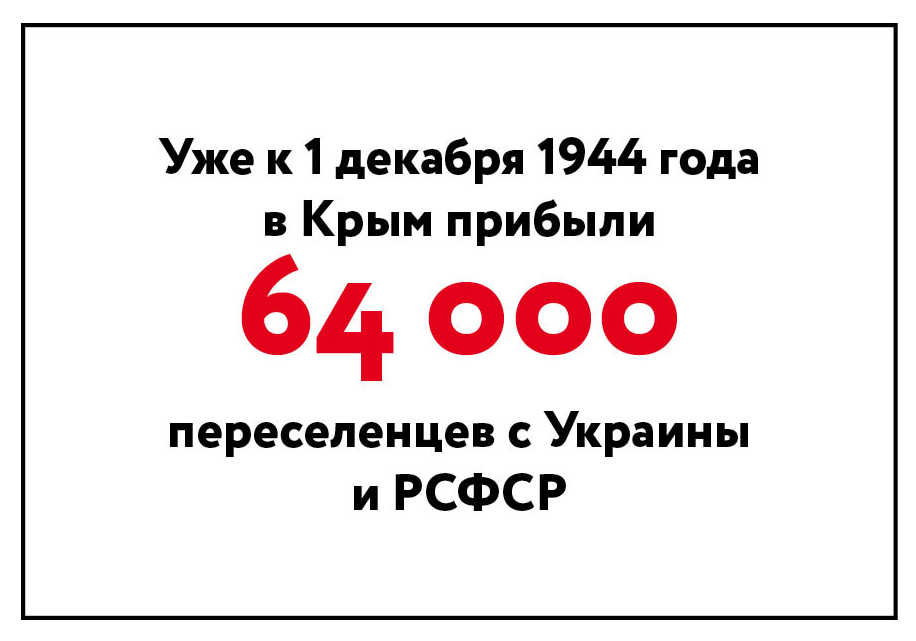
By December 1, 1944, 64,000 immigrants from Ukraine and the RSFSR arrived in the Crimea, including 30,444 able -bodied ones.
The road home
After the death of Stalin. And especially after the XX Congress of the CPSU of 1956, on which the cult of the personality of Stalin was “debunked”, as said in party documents, in the air was in the air in the spring. A number of acts were adopted about the fate of evicted peoples-in this fork of the history of the paths of the “peoples-representatives” they resolutely dispersed. Karachais, Chechens, Balkars, Kalmyks, Ingush were returned to their homeland; Crimean Tatars, Germans, Turks-Meskhetians remained in the places of expulsion.
From this moment, the many years of the Crimean Tatars for returning to the Crimea began. On September 5, 1967, a decree was adopted by the Presidium of the Supreme Soviet of the USSR "On citizens of Tatar nationality living in Crimea." He canceled the decisions of state bodies in the units containing custody accusations against "citizens of Tatar nationality who had previously lived in the Crimea," but claimed that they "rooted in the territory of the Uzbek and other union republics." The decree lifted the restrictions in choosing a place of residence for the Crimean Tatars, however, as those who rushed home found out in the Crimea, they were not waiting there at all: almost none of the arrivals was registered in the Crimea. According to official figures, in 1968-1973, only 3496 Crimean Tatars settled in the Crimea - less than a hundredth of a percentage of those who were expelled from their tribal houses in May for the forty -fourth. Then new decrees of the Presidium of the Supreme Soviet of the USSR were accepted, but they did not change anything either. And in 1978, Decree No. 700 of the Council of Ministers of the USSR, which actually “closed” Crimea from the Crimean Tatars, was adopted.
Only with perestroika, in 1989, the mass repatriation of the Crimean Tatars to their homeland began. In November, the eighty-ninth was adopted by the Declaration “On recognition of illegal repressive acts against peoples who were subjected to violent resettlement and ensuring their rights” and the resolution of the Supreme Soviet of the USSR “on the problem of Soviet Germans and the Crimean Tatar people”. By the decision of the Crimean Oblast Executive Committee No. 261 of October 2, 1990, the Committee on Affairs of Deported Peoples was created, on which the functions of receiving, placing, employment of deported. And soon Crimea was part of independent Ukraine.
Today, after 70 years, the Crimean Tatars are wondering how to live on and what will happen in a situation when they were again in their own free will in another country. And now Mustafa Dzhemilev, one of the leaders of the Crimean Tatar people, who fought for decades for the right to return the Crimean Tatars to his homeland, went through prisons, camps, hunger strikes-the Russian authorities refuse to enter the Crimea.
“Live in the house and the house will not collapse,” wrote the poet Arseny Tarkovsky. The Crimean Tatars have only one house - Crimea.