
Translated material
What in Russia do not know about the Crimean Tatars
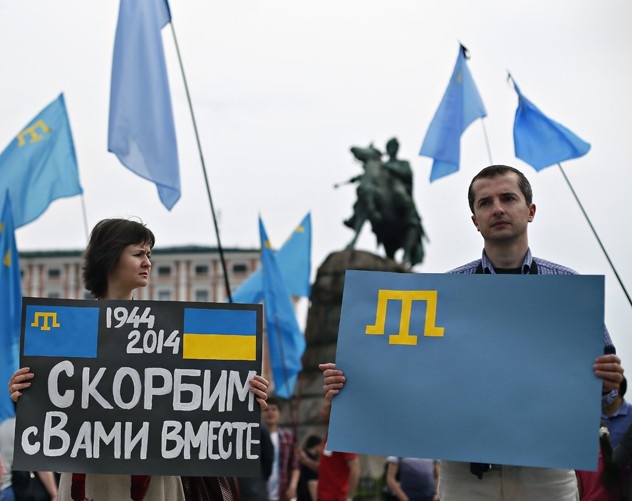
The first impression, as you know, is the strongest. For those Crimean Tatars that grew up in Ukraine, Moscow lustled for glory. Helicopters over the square, riot police from Astrakhan, detained journalists, Batera in the city center-probably this is how the Kremlin looks like a mandatory surroundings for the 70th anniversary of the deportation of the Crimean Tatars. Rallies in the city center are completely prohibited - the events were transferred to cemeteries and to peripheral memorable signs. The tape on Facebook delivers: the key message of pro -Russian supporters is to the fact that "they need so." Solid sailor Zheleznyak: your time is over, the guard is tired.
Shortly before that, Vladimir Putin met with political Crimean Tatars in Moscow. Specially selected, ideologically sustained and politically savvy men showed acrobatic miracles. It is clear right away: the bet was made on their own and comfortable. Now this very “their” and “convenient” will have to explain to everyone else that it was. And why the seventh anniversary of the deportation takes place in the surroundings of the deportation itself.
However, they are unlikely to say something. Although there is something.
For which Crimean Tatars were deported
The official version sounds simple - for collaboration. The mass consciousness continues to believe that relocation to Central Asia is a punishment for mass collaboration and at the same time almost salvation from reprisal from front -line soldiers. The problem is that there are many questions for this version.
For example. Why, along with the Crimean Tatars, the peninsula was cleaned from the Crimean Greeks, Bulgarians and Armenians. Suppose the deportation of the Crimean Germans in 1941 can still be somehow entered into the ruthless logic of the war (in the USA at the beginning of the war, they acted similarly with the Japanese). But the creation of an ethnically monogenic peninsula in 1944 gives rise to a version for versions.
Someone, for example, recalls the memoirs of the chief of Soviet intelligence Pavel Sudoplatov, who wrote about the idea of implementing the Crimean California project on the peninsula. Supporters of the version believe that if this project had been implemented, the modern state of Israel might not have been. More precisely, it would have arisen, but in the Crimea. Allegedly, according to the ideas of the Soviet leadership, the “Crimean California” was supposed to become a region where the idea of compact residence of Soviet (and possibly not only) Jews could be realized.
However, even without “Crimean California” there are enough versions-someone even talks about stripping the peninsula to create a bridgehead to fight for the straits. But when you argue from 2014 about 1944, the question is not even what exactly happened seventy years ago. The question of what you want to get today.
Russians and Tatars have a common myth about war
What makes the people a traitor? Starting with what share of defectors is he out of the law? For that matter, it is dangerous to recall the betrayal of the Crimean Tatars in the CPO, because in response they will begin to recall exactly the same defectors from among the Russians.
Well, if the theme of the Great Patriotic War for Russia is the main screening, then not so much facts are important as historical myth. Fans of discussing someone else's betrayal should understand: “coefficient of collaboration” is calculated from the occupied area on which the people live. Ukraine and Crimea were completely occupied: here everyone was forced to decide with their attitude to the Germans. And in Russia, residents, say, Tomsk, even theoretically could not become traitors - simply because the front line did not reach them.
There is only one way out: to recognize collaboration with a crime of loners against the background of a collective feat.
For many today, the ideological battle for the Great Patriotic War has become almost a reincarnation of the Great Patriotic War. The battlefield is national mythology. For example, the Baltic states and Western Ukraine has developed their historical concepts about the events of those years. They do not intersect with the Russian matrix - moreover, they are mutually exclusive. Meanwhile, the National Crimean-Tatar myth of the Great Patriotic War, in fact, is identical to Russian interpretation.
Neither the Crimean Tatars themselves, nor their political leaders attempt to “turn” those who began to cooperate with the Germans. Boards do not hoist in honor of the national units in the ranks of the Nazis, there are no desires to honor the Crimean Tatar veterans of the Wehrmacht, there is no “conciliatory” pathos in relation to those who were due to circumstances or personal choice on different sides of the front.
Namely, this, perhaps, is the most important thing. If you build the future in the past, it is important not the number of Russian, Ukrainian or Crimean-Tatar collaborators and policemen, but the intonation of history textbooks in relation to their actions. An attempt to refuse the Crimean Tatars in the right to win - even at the level of household conversations - can provoke a search for another, different from the Russian concept of war. With all the ensuing consequences. The myth is not destroyed by facts, they only provoke the creation of an alternative myth.
Starting any discussions on this topic, you need to be aware of what you can hear in response. When Western Ukraine speaks of mass Russian collaboration, it is reply that Russians do not heroize shameful pages in their history. If the Russian Crimea in someone else's person begins to put forward similar claims to the Crimean Tatars, then in response he will hear the same thing. And I decided to bore the past in an attempt to get to the bottom of the truth, even recently, even the State Duma from sin to ban it.
Big politics for small nations
Even if you act with all political expediency, then the 70th anniversary of the deportation was to become the Crimean Tatars an invitation to the number of victorious peoples. With solemn apology, joint prayers, cutting ribbons, presenting orders to veterans, "this is not a long-time." And in the end, it turned out that so far in Kyiv people went out into the streets in solidarity with the Crimean Tatars, in Crimea at that time the streets were forced by autozaks. It remains to assume that from the point of view of the authorities, the intersections clogged with riot police are the best demonstration of solidarity.
The decree on the rehabilitation of the Crimean Tatars, which was signed by Vladimir Putin shortly after the referendum, is not an act of pardon. This is an apology. But after the 70th anniversary of the deportation, there was a feeling that for the authorities this gesture is something like a parole with the transfer of the accused for a trial period.