
Translated material
Memory of Alexei Kolchev
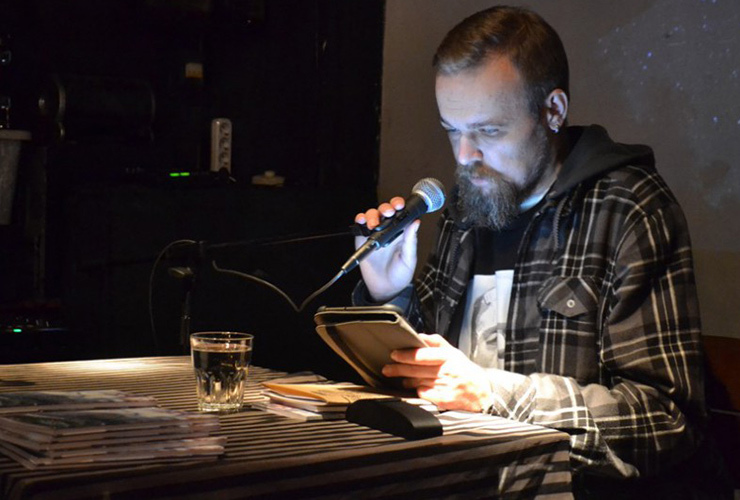
On May 16, the poet Alexei Kolchev was gone. We were not close friends, but I - like many - felt bitterness and resentment when I found out about his death. I remembered my meetings with him: in January of this year, when Alexey presented his (last lifetime) book “Lubok to the Motherland” as part of our Igitur evenings with Kirill Korchagin, as well as a walk around the winter Ryazan, where Lesha (we then switched to “you”) invited me to perform last year. With great difficulty, I endure long winter walks, but she remained a bright memory thanks to his speech: Lesha ironically commented on the surrounding provincial landscape and thoughtfully talked about current cultural events. He very sharply felt the inertiality of the provincial environment, in his words about the cultural, so to speak, the context of his hometown there was a lot of bewilderment. The social infrastructure of the modern province inevitably collapses, while cultural has long been in decline and often bears the seal of the late Soviet, frankly, squalor: in the case of Ryazan, the cult of curly classics, the singer of the vast expanses of the murderous homeland and its own white birches are superimposed on this. I think this situation was upset by Lesha. But he not just shook his hands, but, for example, organized a cycle of literary evenings, on which a variety of Moscow and St. Petersburg poets performed: from Mikhail Aizenberg and Linor Goralik to Natalia Azarova and Andrei Cherkasov. The community of like -minded people living in Ryazan or between Moscow and Ryazan was also important for him: poets Elena Gorshkova and Julia Grekova, artist Vladislav Efremov and many, I think, others, about whom I do not know anything. I, as well as the relatives and friends of Alexei, I express sincere condolences.
The anthropology of his texts makes us recall the story from an interview with Alexei German about his father’s once intelligent friend, who, having freed himself after a long imprisonment, came to their house and, asking Chify, sat down near the battery, as he was warmer there.
Last year, Lesha released three collections of poems at once. I must say, this is not the most common case in modern poetry: as a rule, the “break” between collections is a couple of years. But in the 2013 -marked book, the verses of several (maybe even many) years have included. I don’t know for sure when this building began to be created, and Alexei was not inclined to open all the cards, answering ironically to the question of dating: if I say, it would be not interesting. And yet, if you read these books in a row, some common picture is formed. I think that the book “PRODUCTION” published in an almost self -made way includes early texts that show, as they say, many development opportunities. Here are the lengthy verlibers that the language will not turn to call objectivist, and rhymed texts, where a grotesque and risky humor already appear. The usual characters of his texts appear: homo Sacer , which lives on the side of the society, which more and more resembles the curb. Poems of the next book “The imperfect species”, published in Nizhny Novgorod, are no less gloomy. But in them there is also a motive for the materiality of the poetic labor itself, its connection with the body in the process of constant formation. Poems arise at the time of the acute interaction of the poet’s body with the environment, which is why they emphasized material, textured. At the same time, Kolchev’s poet may not write poetry at all (like an artist can not draw anything), it is enough to simply designate himself as “Satunovsky” or “Brodsky”, “choline” or “Swarovsky” and cross the plain or courtyard, which is the most frequent toponym in its texts. But this is not a grain of empty-heating Yernia: the anthropology of his texts forces to recall the story from an interview with Alexei Herman about his father’s once intelligent friend, who, having freed himself after a long imprisonment, came to their house and, asking Chify, sat down near the battery, as he was warmer there. The lyrical subject in Kolchev’s texts every time undergoes such a degeneration, becomes different: it is it that allows him to find words to describe phenomena, which are very difficult to describe. At the same time, he retains the opportunity to observe this from the side, taking off the readings of leaning sensors: after all, despite shocking stories and motives, these texts are quite restrained and well made, even when they assure the reader in the opposite.
It is difficult, almost impossible to illustrate the thesis of Kolchev’s poetry with quotes: the body of his texts is so targeted that either everything or nothing must be quoted. But I would still like to give a fragment from the two-part poem “Pistol”, which once struck me with a combination of subtle cultural analytics and gloomy humor:
When I hear
word
Culture
I'm grabbing
For the pistol
The gun plays
An important role
In modern
art
pistol
Artists
They write pictures
pistol
Poets
Draw poems
Musicians
They are selected in harmony
On the pistol
Cinematographers
pistol
Remove
outstanding
Fine films
May be
and I
I can
With the help of a pistol
extract
From yourself
Something