
Translated material
How to hide on the Internet?
Tor (abbreviated from The Onion Router) is a program designed to protect the confidential information of users. It makes it possible to anonymously use the network in countries practicing censorship, it is associated with the exposures of Edward Snowden and the struggle for freedom of speech, but also the phrase “shadow Internet” and the arrest in the San Francisco of the owner of the portal, which earned millions on the sale of drugs for electronic currency (bitcoins).
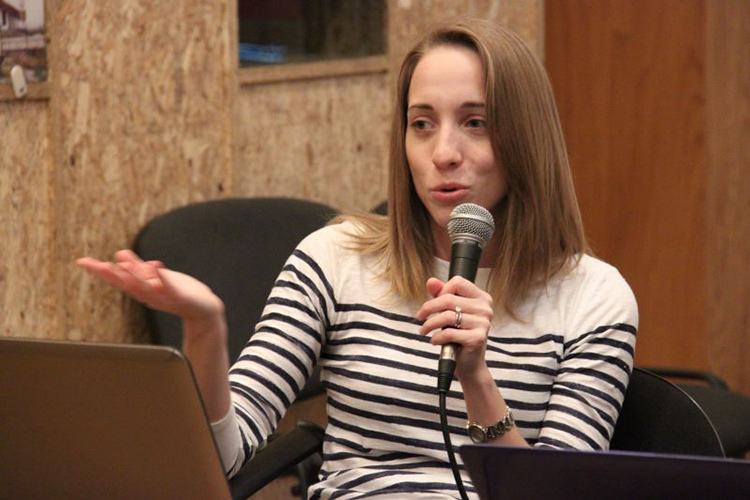
The leading technologist Center for Democracy & Technology Runa Sandwick, who has worked for four years in Tor Project in London, talks about how Tor is arranged, whether the project is connected with the special services, who is its creators and ordinary employees and whether the Big Brother can handle it.
Tor Project is engaged in the free distribution and technical support of software that allows a person to remain anonymity on the network.
It works like this: you launch the Client program, which uploads a list of all project servers - “nodes”. The “client” chooses three “nodes” that will use - a watchdog, intermediate and weekend. Thus, your appeal, for example, to the address www.facebook.com will be encrypted at three levels and passed through three different servers. Your provider will see that you are going to Tor , but will not know what you are doing there. On the output server, you can understand that someone goes to Facebook, but it is impossible to determine that this someone is you.
In the Tor browser, each entry to the site is one connection using a combination of three nodes. The program is arranged in such a way that every ten minutes your computer changes three used nodal servers with three new ones. They change in random order - no records (logs) are not conducted, no centralized control system exists. You can manually change the installations so that the replacement will be made even more often, or use the American output node, that is, get an American IP address to, for example, watch television programs. In these cases, the load on the system will increase, which will negatively affect the connection speed.
Not only Tor can maintain your anonymity on the Internet. You can establish privacy in the browser settings, and it will not store the history of visiting sites, while it remains by the provider. You can use a virtual private network, VPN (that is, one node works between you and the site), and in most cases the VPN provider records your actions on the Internet - it stores, for example, the number of credit cards that you use, etc., and this information can be obtained from it. In the case of Tor there are more components, and no logs are conducted.
Who among Tor users is more - journalists, political activists, criminals or simply those who want to hide their private life from prying eyes, we do not know.
To date, about five thousand Tor components are operating in the world (of which there are only one thousand output nodes that direct traffic directly to sites). If, for example, at the last level the connection was not encrypted and the HTTPS protocol was not used, then you could find out your password and login if you were registered on some site. In recent years, there have been several attempts to harmful activities on the weekend nodes. For example, nodes with the same name Trotsky , by the way, located in Russia, tried to intercept the outgoing traffic and receive information about the names and passwords of Gmail , Facebook and other sites. Similar problems were in China. Tor Project has developed special tools in order to identify such nodes and exclude them from the project.
The popularity of Tor in the world is growing. All statistics available to us are posted on the website Metrics.torproject.org (it is also popular explained by what methods the project employees determine the approximate number of users. - Ed. ). True, the numbers were greatly influenced by the attacks of the bots. The viral attack on Tor , which began in August last year, provoked a powerful increase in requests. We had previously seen the growth of requests, for example, in Egypt, Syria or Tunisia during radical political changes in these countries, but such an explosion, such a gigantic leap on the graphs was not observed until then. The number of users increased rapidly, which affected the speed of the system. Microsoft helped us determine the infected computers, we gradually clean them. Tor had about half a million users before the viral attack. It is still difficult to trust the current statistics - the elimination of the consequences of a viral attack is still going on. But it is very clearly visible that the popularity of the program depends on the political situation in the country. For example, a few months ago in Turkey they blocked the Twitter service, and the number of Tor users grew there from 40 to 60 thousand in only a couple of days.
Indeed, on the Internet there is what is called a “dark zone” or a shadow Internet in the media. Hidden nodes allow us to create .onion websites, which can use only those who have installed TOR software. Their owners are unknown - there is no physical danger for these people. Such sites are created by journalists, their insiders can come here, anyone who wants to publish socially important information and remain elusive for special services. In this zone, obviously, criminals are also found. Who among Tor users is more - journalists, political activists, criminals or simply those who want to hide their private life from prying eyes, we do not know. We cannot even evaluate the proportions. If Tor Project are able to do this, it would mean that we have the opportunity to follow users, which means that someone else could do it.
Tor was not illegal, but seemed suspicious to law enforcement.
It is clear that the high -profile stories related to crime are more concerned about the public so that public opinion will always be ambiguously in relation to Tor Project . Does this mean that Tor Project should bear some moral responsibility for criminal sites in Tor ? I do not think that the question is so absurd. What is happening in Tor is not specific only for him, this is the specifics of the Internet as a whole. For this reason, it is necessary to consider the creators of the Internet morally responsible for cybercriminals? I think no.
Leading employees Tor Project is found twice a year in different countries of the world. Usually the first days are their professional communication with each other, and then there are several more days to communicate with users, answers to questions of interest to the public. The last time the meeting was held in Iceland, the next should take place in the summer in Paris.
For a long time I worked at Tor Project in London, and was engaged in research on security problems. And three months ago she became a technical specialist in Center for Democracy & Technology in Washington, an organization that helps people understand how technologies in the modern world are used, what can be the consequences of this use after the adoption of certain national specialized laws. In a sense, this is the same area in which Tor Project works-protecting democracy in the field of high technology. And I'm still Tor volunteer.
 © Sakharovsky Center Runa Sandwick
The TOR program has five thousand servers today. Anyone can become a volunteer, that is, the holder of such a server. You just need to upload software to your computer (then by default you become a user), and then announce your intention to be an operator of the node, open your IP -address, give a list of ports that you will use. We check the reliability of the information, that is, we determine whether it is possible to establish a connection with you, and if there are no problems, then people can start using your server.
Volunteers are usually not anonymous. After all, you need to inform your IP so that the server can be used. And your provider knows that this IP belongs to you. There were cases of detention of owners of nodes when someone performed unlawful actions using their server. The most famous case is the interrogation in 2007 by Alexander Janssen in Düsseldorf. As a result, he was released, but he decided to stop his cooperation with Tor . Yes, in a sense it was a loss - Janssen worked as an open German platform for many years, he entered the project, while still a student. But this was his decision, and, in the end, if one person leaves, then another comes. Of course, we can connect volunteers who have problems with those who are able to provide them with legal assistance. But in any case, I do not know a single example when the volunteers of the project were in prison only for the reason that they supported the Tor node.
TOR financing comes from individuals and non -governmental organizations.
In the early stages of Tor Project in Massachusetts, where Tor was born, where the head office of the project is located, the organization had problems with the police understanding. Tor was not illegal, but it seemed to law enforcement agencies to something unknown and therefore suspicious. We solved this problem, regularly conducting presentations for them, told what kind of program it was, what capabilities we have, we explained that by definition we cannot provide them with information. Seminars were held in different countries.
I do not know whether Tor Project employees met with Russian security forces. But Tor developers talked with students in Moscow. The project has a long -standing plan to get in contact with university circles, to interest them with the possibility of cooperation. First of all, this applies to the United States (we thought about joint work with MIT - Massachusetts Technological Institute), but also some European countries. The system has many users, but few servers, and cooperation with universities would help to solve the problem of speed.
And, finally, about the financing of Tor , about the "relations with the special services" and the simultaneous attempts of the same special services to hack the system. Tor was created at the beginning of the two thousandth as a project of the US Navy Research Laboratory Naval Research Laboratory . In 2002, the development was decided to declassify the development, and the program code was then published, so everyone could check it for the absence of bugs and backdors. Today, TOR financing comes from private individuals and non -governmental organizations, but primarily through the US Government Government system. But the project never carried out someone’s assignments, did not provide information in exchange for a grant, so in this regard Tor Project is an independent organization. Another question is that special services can use TOR software for their work.
Power structures and governments of different countries do not leave attempts to hack Tor.
With the Naval Research Laboratory, the project was not interrupted. We do not receive money from them, but individual laboratory staff are involved in Tor Project . When I say “involved”, this means that they explore the possibilities of improving Tor , ways to counteract attacks or blocking it in different countries. This is completely legal cooperation, anyone can offer their options for improving the program and its protection.
Power structures and governments of different countries do not leave attempts to hack Tor or somehow block the possibility of its use. For example, in China, the most simple opportunity seemed to block the Tor site - if a potential user does not have software, then, of course, he is not able to use it. You can also try to block access to all five thousand system servers, and China did it too. In response, Tor Project created a system of so -called bridges - bridges. These are ordinary servers, but their IP -addresses are closed. The user must know the address to connect to such servers. And how to block such nodes in China do not know. Therefore, Chinese users can still use Tor .
Of course, I know about the initiatives of the Russian authorities to control the Internet and even the creation of an almost autonomous Internet. And by the way, I want to express my admiration for the courage of people in Russia, volunteers who take part in the Tor project and set up servers to work in the system. I do not really understand how the alleged laws will act. In my memory, so many countries have declared the need to create their own Internet, but so far none of them have achieved success. And if you take into account the need for coordination with ICA N N , a system of international Internet trade ...
The US special services do not leave their attempts to hack the Tor . We once again became convinced of this after the revelations of Edward Snowden, who talked about how the US National Security Agency tried to decode the program. They are undoubtedly trying to cope with Tor and all special services. But definitely, if special services need the results in the fight against crime, there should be some other, more logical and effective methods than attempts to slow down or hack the Tor .
Runa Sandwick visited Moscow as part of the Sakharovsk Center and Research Resource Aggentura.ru and participated in the public discussion “Access to Information in the Internet Consults”.