
Translated material
Beat the dollar
The New Times sorted out new methods of war of the 21st century
The European Union expanded the sanctions in response to the annexation of Moscow Crimea and its support for pro -Russian separatists in eastern Ukraine. In addition to the former, 48, another 13 Russian (and Ukrainian) citizens, including the first deputy head of the Presidential Administration, Vyacheslav Volodin, the Airborne Force Commander Vladimir Shamanov and the head of the Duma committee on constitutional law, Vladimir Pligin, are included in the stop list. There are two Crimean companies - Chernomorneftegaz and Theodosius*. The sanctions against Russia were expanded by Canada, and the American Ministry of Internal Security announced its intention to engage in the search for assets of the defendants in the Black List in the United States.
Obviously, the West is not going to stop, and in the event of a breakdown of the presidential elections in Ukraine on May 25 (see material on page 32), sanctions will be tightened. But it is already noteworthy that instead of double -edged measures like an embargo on Russian hydrocarbons, the West, contrary to the assumptions of many experts, applies a different method - point, but extremely painful financial blows. Such tactics, as international experience shows, leads to the desired results faster
*On May 12, 28 EU countries first decided to punish legal entities, while the United States has already announced restrictive measures against 17 Russian companies.
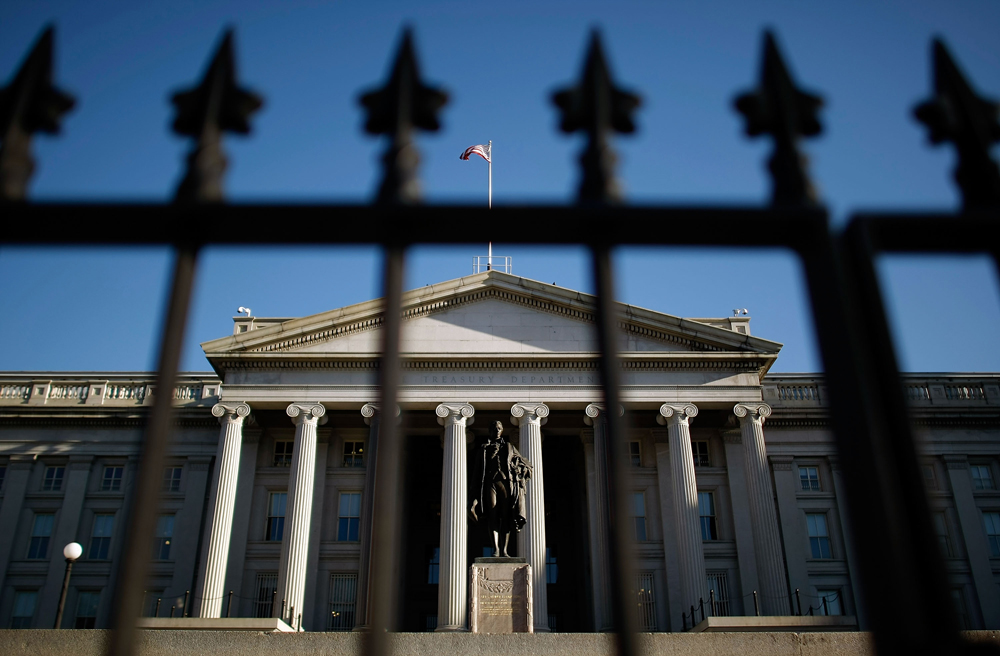
The building of the US Department of Finance in Washington. Before entering the monument to the first chapter of the department Alexander Hamilton (1789–1795)/Photo: Imageforum/AFP/East News
“We will move step by step and act a surgical way,” said Jacob Lew Minister Jacob Lew, answering the question of a relatively possible embargo for Russian oil. He actually confirmed Washington's readiness to impose new sanctions against Russia. The question is which exactly? It is clear that the embargo on the products of Gazprom and Rosneft is a frontal blow. Truly subtle surgery is hidden from prying eyes. But it is noteworthy that journalists are addressing the sanctions not only to the White House press secretary or congressmen, namely the United States Department of the Treasury). It is this department that plays a key role in the long-standing confrontation of America and the Rogue countries like North Korea or Iran. Even in Washington, the American Ministry of Finance is considered by Washington as one of the types of weapons, which is sometimes more painful and more precise than drones or tanks.
From Al-Qaeda to the Bank "Russia"
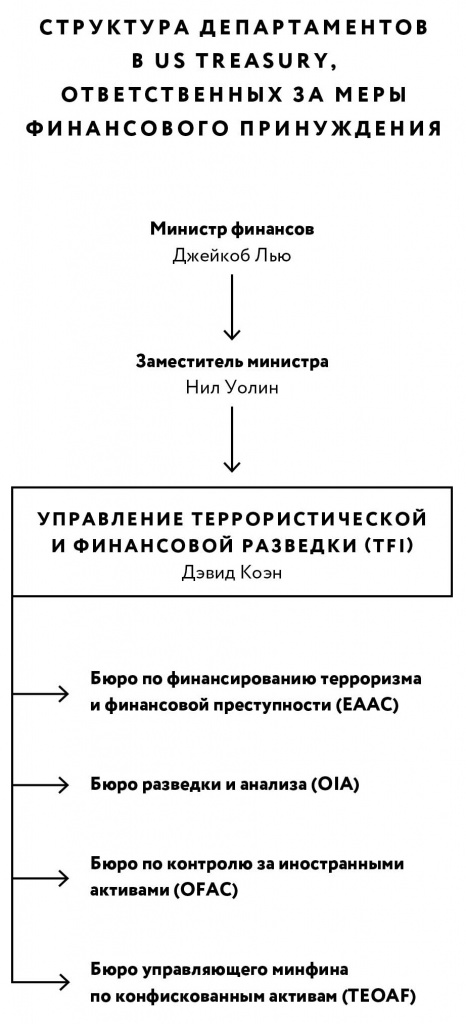
The financial struggle with opponents of the United States is engaged in little -known not only abroad, but also in the United States itself of terrorist and financial intelligence (Office of Terrorism and Financial Intelligence - TFI), which appeared in the structure of the American Ministry of Finance after the attacks of September 11, 2001. TFI is 730 employees: highly qualified lawyers, computer scientists, financiers, banking specialists and diplomats. They have a common task: to weaken the enemy as much as possible using the American financial system. Moreover, if at the very beginning of the management of the management of his main goal was al-Qaeda, then entire states were added to it-North Korea, Iraq, Iran, Libya, and today Russia.
Washington’s calculation is simple: the American dollar accounts for 87% of foreign exchange transactions around the world, most countries hold their currency reserves in dollars, and banks use the dollar for international settlements, making payments through correspondent accounts in America. At the same time, the US remains the largest economy in the world, and New York-the main financial center. Overlating the bank, company or the state access to the American financial system, the US Treasury is giving them to imminent bankruptcy, because there is no adequate replacement for this system yet.
“The Ministry of Finance realized that representatives of the private sector, especially banks, can isolate odious regimes much more efficiently than the governments, simply because of the desire to avoid unnecessary business and reputational risks,” writes Juan Zegotte in his book “Financial War”, who worked in US Treasury for many years. The market thus begins to fight the defendants in black lists. So, the American companies Visa and MasterCard, after Washington’s introduction on March 21, sanctions against the Rossiya Bank and the Sobinbank belonging to him, on their own initiative, ceased to serve these two Russian structures. “The immediate environment of Vladimir Putin, and not only politicians, but also businessmen, and therefore fell under the sanctions that our task is to make them outcasts so that the names of the Rotenbergs or Timchenko brothers raise questions from companies around the world,” the US Congress source explained to The New Times. “And they, in turn, when they understand that they are losing real money, they should put pressure on the Russian president, forcing him to change his policy.”
The same source once again confirmed: only the “second level of sanctions” has been introduced against Russia, the third will follow the blockade of large Russian companies and entire sectors of the Russian economy, including oil and gas.
On a thread - for a terrorist attack
On September 12, 2001, the day after the twin towers of the World Trade Center in New York, a bunch of Islamist-Kamikadze Islamist were turned into ruins, burying up to 3 thousand people under the rubble, President George Bush called the then Minister of Finance of the United States Paul O'NELL and asked how his department was going to participate in the fight against terrorism. The task was not only to punish al-Qaeda for terrorist attacks, but also to defend America from new attacks. In response, the Ministry of Finance prepared and presented the president with a plan for a week. After that, in a matter of days, the famous presidential directive of the EO 13224 was prepared. She saw the light on September 24, 2001. Bush himself accompanied her with the next written remark: “Today at 12.01, with one stroke of the pen, we started a massive attack on terrorism. We will hit the financial supports of the global terrorist network. ”
The finances were not mentioned by chance. Employees of the FBI who investigated the terrorist attacks were amazed: money to finance the operation came from Dubai through one of the leading German banks - Dresdner Bank. And already from there were transferred to the States, where future suicide bombers calmly opened accounts for their own names. They did not arouse suspicions of banks, because we were not talking about too large transactions, and the entire terrorist operation on September 11 cost only $ 500 thousand. It was significant different: the largest terrorist organization all this time calmly used the global financial system.
"
The largest terrorist organization all this time has calmly used the global financial system
"
In general, according to experts, a small terrorist attack with the participation of a suicide bomber costs only $ 1000. But in order to organize it, you need to recruit this suicide bomber, train it in a special camp where the instructors prepared earlier work, and then on the chain - that is, terrorist work should be put on a stream that needs constant and considerable financial infusion.
| *Havla - an informal system of mutual settlements that formed in the countries of South Asia before the appearance of the banking system and spread to other Asian and African states. Money is transmitted through a network of brokers on the same principle as through Western Union, but using faxes and phones. |
In the case of al-Qaeda (in addition to income from the sale of drugs, weapons, human trafficking and other criminal activities), funds came from hundreds of thousands of Muslims around the world. Some sent money through hundreds of departments of Al-Haramein's charity foundation, not even knowing what they would go to. Others passed the cache or jewelry through friends and relatives who went to Hajj in Mecca, regarding such donations to their contribution to Jihad - a sacred war. The chain of Haval*, especially popular in India, Afghanistan, Pakistan and the Arabian Peninsula, took part in the circulation of funds. After the washing procedure, the funds entered the accounts of terrorists in Europe and America.
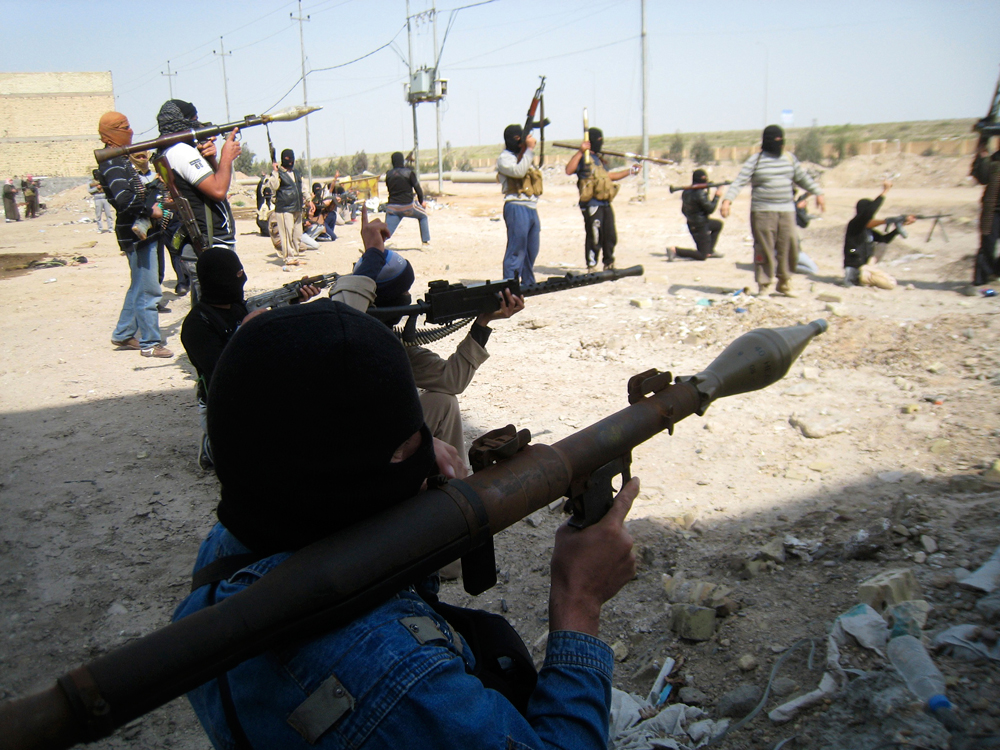
To organize camps for training jihadists and suicide bombers, Al-Qaeda raised money from Muslims around the world /photo: Stringer /Reuters
The court will judge
For a new type of fight against terrorism invented by the US Ministry of Finance, neither the consent of the UN Security Council, nor even the American Congress, was needed: there was enough presidential directive to be blacklisted with another Ministry of Finance - the Bureau for Monitoring Foreign Assets (OFAC). This automatically imposed on American citizens and the company a ban on cooperating with the person involved in the list, and at the same time sent a signal to the rest of the world: here is a dangerous client, it is better not to do with him.
At the same time, in order to avoid possible mistakes, dozens of TFI lawyers collect evidence that a particular bank is involved in illegal activities. As Juan Zarath says in their book, employees are guided by the 80/20 rule: if there is 80% of the evidence in stock, and in order to get the remaining 20% you need to spend too much time and money, the decision may be made on the basis of already known 80%. Moreover, according to the Americans, they do not violate the law in this way: “If someone believes that he was blacklisted without sufficient grounds, he can file a lawsuit in an American court,” the Freedom House executive director David Craimer explained in an interview with The New Times, there were such cases. However, from Russia, for example, not a single claim has yet been received. ”
However, according to the source of the magazine in the American Ministry of Finance, Washington has all the necessary evidence in case one of the Russians who fell under the sanctions-be it an individual or legal entity-will decide to sue.
Washington has all the necessary evidence in case one of the Russians who fell under the sanctions decides to sue
"
The first OFAC black list was released in 1986, today it contains 5843 individuals and legal entities, and, according to the American Newsweek magazine, if earlier, about 391 named after 391 named after 391, then in the last four years this number has been growing annually by 558 new names and names.
And by the way, Washington did not act alone. Cooperation with the international interbank financial messages in Europe Swift (Society for Worldwide Interbank Financial Telecommunications) made it possible to track suspicious banking transactions. Despite the fact that the authorities of Saudi Arabia refused to control the financial background of pilgrims in Mecca and Medina in any way, managed to control al-Haramein, as well as to achieve the closure of its branches in Bosnia and Somali.
In turn, India, Pakistan and the UAE, on the recommendation and with the help of Americans, tried to establish control over the operation of the Haval system. Large Broker offices of Haval, suspected of cooperation with Al-Qaeda, were also closed. Already in 2005, in a letter to the second person in Al-Qaeda, Aiman Az-Za-Zawakhiri, the leader of the Iraqi branch of the organization Abu Musab Az-Zarkavi complained that "many channels of the funds were cut off." In fact, Al-Qaeda admitted: the financial petition was drawn too much.
Hunger for sanctions is not a hindrance
International terrorists did not long remain the main opponent of US Treasury. Very soon, TFI was engaged in the two other worst enemies of Washington - North Korea and Iran.
In fact, against both states of the rogues, a variety of sanctions are used for a sufficiently long time. However, the West understood over time: all kinds of embargoes do not work. The regimes are really poor, the population suffers, but this does not lead to a mitigation of state policy, on the contrary, dictators use the actions of the West in propaganda campaigns, sometimes even strengthening their own power due to external pressure. An example of this is the famine of 1995-1999 in the DPRK, during which, according to various estimates, up to 3 million people died. But this did not force Kim Jong Ira to reconsider his positions. The same thing in Iran: despite the sanctions of the United States, the first of which were introduced immediately after the Islamic Revolution of 1979, Tehran did not abandon his nuclear program.
At the same time, odious regimes are actively using the world, and therefore by the American financial system, dictators and their environment store money in dollars, and often in Western banks, and also acquire for this money the luxury of Western production.
So, the sanctions did not prevent North Korea from working with banks in Austria, Russia, Singapore, Hong Kong, Macau and, of course, China. Moreover, these banks were used by Pyongyang to receive money for smuggling nuclear fuel, cigarettes, drugs, as well as fake mass consumption goods, in the production of which the DPRK succeeded in the 1990s, the funds received to financing nuclear development.
In addition, North Korea in the 90s began to produce ... $ 100 bills on an industrial scale. The quality was so high that fakes were not determined even on the most modern (at that time) equipment. In the States, these banknotes were even called "Supercurious" (Supernote). Pyongyang printed $ 15–25 million a year and sold each Supercurious in the black market of $ 70–80. In 2009, a veteran of the IRA IRA (Irish Republican Army-Irish Republican Army) Sean Garland, who in the late 1990s, came for the North Korean Embassy in Moscow, and then sold millions of dollars in Ireland in the late 1990s, was arrested in Dublin.
In Washington, they caught on time: the position of the dollar as a world reserve currency No. 1 was at risk, because two -thirds of cash US dollars ($ 530 billion) are in circulation outside the country. Not only did confidence in them could be undermined forever, the all European currency of the euro that quickly gaining momentum, which was quickly gaining momentum, could take the freed niche.
In 2003, in order to protect the dollar from a fake, the United States introduced new $ 100 bills with an increased portrait of Benjamin Franklin. At the same time, TFI began a campaign against banks working with the North Korean regime, selecting as the first goal of the Banco Delta Asia (BDA), which was based in Macau. BDA was cut off from the American financial system, the Macau authorities introduced trust in the bank and blocked $ 25 million belonging to companies and individuals from the DPRK. The amount was not too large, but the main thing was again in the other-to send a signal to other banks cooperating with the DPRK, mostly Chinese: each of you can be the next.
The North Korean $ 25 million was eventually unlocked: Pyongyang included all possible diplomatic channels. But, as Juan Zaratte writes, the “negotiator” from North Korea during a personal conversation with one of the representatives of the White House admitted: “You, in the end, found a way to harm us.”
Minus oil
However, it turned out to be not so difficult to limit the insulated from the outside world in finances. Another thing is Iran, which in the early 2000s was the sixth supplier of oil in the EU, an important market for Europe, Asia and the same America.
But such a strong involvement of the Iranian economy in the global financial market was its Achilles fifth: like Moscow, Tehran received dollars for its oil, Iranian banks had representative offices in London, Frankfurt and Tokyo, and a part of the Iranian money went to pay for the Khzbollah’s accounts - the Lebanese Shiite Genitical Group. Also, the USA included in the list of terrorist organizations. In order to deliver an effective blow to the Iranian economy, in 2006 the then head of TFI Stuart Leva personally visited dozens of banks and insurance companies on both sides of the ocean, warning their leadership: gentlemen, keep in mind that the office entrusted to you is used to support the terrorist groups and to enrich the leadership of the Islamic Revolutionary Corps (Xir) - a powerful organization that controls up to 40% Iranian GDP.
As a result, banks began to abandon Iranian customers. Large insurers stopped working with Iran, and in July 2011, Iranian goods refused to transport one of the largest international carriers - Maersk. Iranian vessels, including oil tankers, remained blocked in the ports of Hong Kong and Singapore for a long time: they could not go into the raid without registered insurance, and the local authorities had questions to their real owners.
On the Council of TFI in 2006, one of the largest Iranian banks - Saderat, through which Hezbollah was financed from the international financial system, was followed by other Iranian banks associated with the Iranian nuclear program. By 2012, the settlements in dollars and euros were already inaccessible to most Iranian banks, including the Central Bank of Iran. Prior to this, in 2007, the OFAC black list was included in the Corps of Guardians of the Islamic Revolution and the Iranian Ministry of Defense. Ticks contracted.
The US Ministry of Finance also included tracking all the prohibitions and restrictions to be strictly executed. Так, в 2009 году британский финансовый институт Lloyds TSB Group был оштрафован на $350 млн за то, что проигнорировал американские санкции и продолжал долларовые транзакции с иранскими бенефициарами.
К 2012 году в западных банках было заблокировано до $100 млрд иранских денег, экспорт нефти упал на 75%, валютные запасы иранского ЦБ снизились на $110 млрд. Страдало, безусловно, и население: инфляция в 44% и обесценивание иранского риала на 70% всего за два года (2011–2012) привело к голодным бунтам, которые в Иране называли куриными (из-за роста стоимости курятины, основного продукта питания бедного населения).
В результате воинственный режим аятолл дрогнул: сразу после своего избрания в августе 2013 года новый президент Ирана Хасан Роухани заявил о готовности начать переговоры с Западом, к апрелю 2014-го была уничтожена половина запасов обогащенного до 20% урана, а 13–16 мая в Вене прошел очередной раунд переговоров между Тегераном и «шестеркой» международных посредников (члены Совбеза ООН + Германия). С начала массированной атаки против иранского финансового сектора прошло около 10 лет, но, по словам источника The New Times в американском Конгрессе, «за этот срок была отработана практика борьбы», которая с большей эффективностью может сегодня применяться против России.
Впрочем, мир не стоит на месте, каждое действие рождает противодействие. Вот и Хуан Зарате считает, что Штатам не стоит расслабляться: рано или поздно их соперники извлекут уроки, чтобы начать свои финансовые войны — на этот раз против Америки. The New Times попытался связаться с автором «Финансовой войны», чтобы узнать его мнение относительно последних санкций против России. Однако Зарате, сославшись на занятость, предложил прочитать его недавнюю колонку в газете Washington Post, где он пишет: санкции необходимы, однако Запад должен быть готов к ответу Москвы. Первыми могут пострадать американские компании, которым будет закрыт доступ на российский рынок, однако Кремль может развернуть и войну другого рода: «В прошлом Россия использовала в своих интересах поставки газа и нефти, чтобы надавить на Украину и Европу, организовывала кибератаки против Грузии и начинала расследования о нарушении налогового законодательства, чтобы заставить замолчать критиков. Сегодня Кремль может привлечь хакеров и организованную преступность, чтобы нанести ущерб финансовым системам и компаниям на Западе».
С Хуаном Зарате на страницах той же Washington Post полемизирует Дэниэл Дрэзнер, профессор международных отношений в юридической школе «Флетчер». По мнению ученого, санкции против России не будут работать, потому что «они и так никогда не работают». Да, они дорого обойдутся Москве, но вряд ли США добьются перемены политического курса, не говоря уже о смене режима, таких примеров просто нет: «даже в Иране режим аятолл устоял, несмотря на санкции», пишет Дрэзнер. К тому же Россия играет несравненно более важную роль в мировой экономике, чем Иран, от ее углеводородов полностью зависят многие страны Европы.
Кто может гарантировать, что американский бизнес в этом случае не начнет давить на собственное правительство, чтобы оно ослабило финансовую удавку. И кто знает, быть может, тогда хирургам, оперирующим с помощью санкций, понадобятся новые инструменты.