
Translated material
El Camino: Roster of sins
The New Times correspondent passed the dear Jacob: from Saint-Jan-Pie-de-Por (France)-through the Pyrenees and the entire northern of Spain-to Santiago de Compan
Report about the last week of the path 775 km long **
*El Camino (Spanish) - Path ** Continuation. Beginning: No. 13 of April 21 , No. 14–15 of April 28, 2014
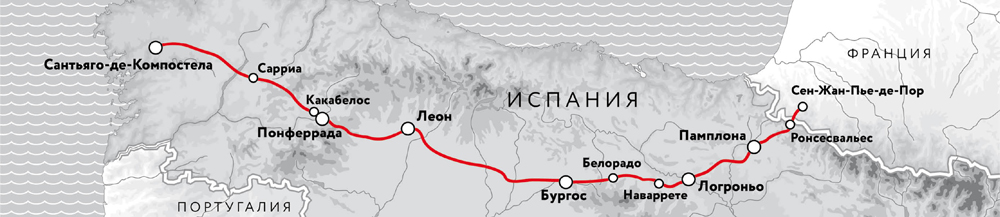
Saint-Jan-Pie-de-Por Polika Route to Santiago de Compostel
This road taught me a lot. But the main thing - I realized that much in our life, in our world of things, is not necessary at all. It turned out that I could cost three T -shirts and only jeans for a month. Drink unnecessary water. There is once a day. Daily pass for 25-30 km. And find a common language with people of any nationality. And despite all the difficulties, to feel satisfied and happy. I am increasingly dreaming of renting a return ticket to Moscow and staying here in Spain, on a sunny plain. But the path is coming to an end.
Enchanting of May 2–5
The last days of the journey resembled a festive procession.
It all started with the city of Kakabelos. Not yet entering the city, we suddenly discovered ourselves by caring in the stream of cars. Half of Spain seemed to go here! We asked people: "What is happening?" And they answered: “Fears! Grand Fear! " We did not immediately realize that the extravaganza is a fair!
The main and only street of Kakabelos was all entirely busy merchants. The goods on the trays are simple: milk, bedding, screwdrivers, saddles for horses, plastic buckets, copper figurines, “real” bags from Louis Witton and pies from local grandmothers. The people bought almost nothing. But the excitement was amazing: laughter, screams, crowds everywhere. By the evening, the floors of local cafes were covered with walnut shells (it is customary to clean the nuts here right under their feet), the asphalt in the streets sparkled with beer.
Enchanting haunted us further.
But this is no longer a fair.
112 kilometers from Santiago is the city of Sarria. This is another starting point for pilgrims. From here are those who cannot or do not want to spend much on the road. You will have to go for long, and the pilgrim certificate at the end will still be given.
The route from here everyone has a single one, so travelers, one might say, go in a crowd. After a couple of nights in noisy companies, we decided that we would stop only in the villages.
"
“She mutters under her breath:“ How tired I am, how can I explain to me ... ”And I:“ Yes, you tell me in Russian! ” What has begun here! "
"
A spoonful of tar - municipal Alberg, hotels (municipality here is called "junta"). They are cheap, but unfriendly and without the Internet. Otherwise, Galicia is a wonderful edge: the road is shady, the people are friendly, and for local cheese it is worth selling their souls. This region is the green belt of Spain. In winter, rain does not stop here, but even sticks stuck in the ground bloom in spring and summer. Locals speak in their own dialect, herds of cows are walking along the roads, and graffiti on the walls report that Galicia is not Spain, and call for separatism.
We decided to spend one of the last nights in private Alberg. A complete woman with a Slavic face and a Spanish smile came out to meet us. She looked at us for a couple of seconds squinting and suddenly if she gave out: “Well, healthy!” It turned out that this Alberge was holding a Russian-Spanish family. The wife of the owner of Luda - about 15 years ago, together with her daughters, she exchanged Omsk for Barcelona, and then moved to Galicia. Now the third generation is growing here, and the whole family, including the burly owner, interferes with Russian, English and Galician speech. “The day before yesterday, one girl came already in the dark - so dusty, exhausted. But he doesn’t know the language, but I see that ours, Russian. She mutters under her breath: “How tired I am, how can I explain to you ...” And I: “Yes, you tell me in Russian!” What has begun here! She rushed to my neck! I fed her, and then we were sitting on a bench at midnight, we spoke for life. ” According to the description, we learned our fellow traveler Natasha from Moscow. Remember, I wrote about her in the second text - she still has a husband’s husband? It turned out that she had already reached the goal.
In the morning, people poured coffee at the expense of the institution.
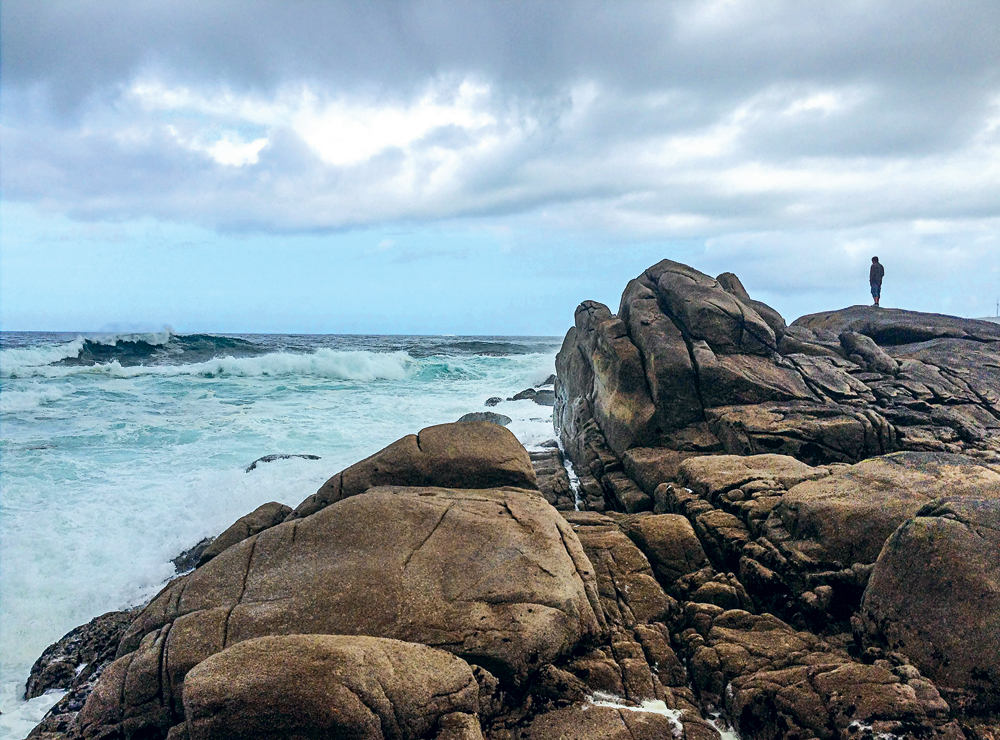
Friends of pilgrims. May 6–8
The last three days were the happiest. I did not take my eyes off the layout - 55 km, 53 km, 49 km ... A month ago, exactly the same columns showed 725 km, 723 km ... The roads on the way were strewn with philanthropic shops: take what you want, pay, how much you consider necessary. Usually in such places they offer coffee, cookies and fruits. I especially remember one such tray: in the middle of a long stuffy crossing, we stumbled upon a dilapidated building. Next to it was pulled by a tent, benches were placed, and a small counter beckoned a dozen fruit varieties. The owner - the Romanians Victor - had been living here for six months, on a bale of straw. In the same place, on a bale, a huge, still green clustard of bananas ripened. He gave us delicious coffee and convinced us not to be shy and take another piece of melon. For free. To my question, why he does this, he replied: "Why not?"
The last part of the path had another feature: on almost every tree, colored stickers hung along the road - orange and yellow, in French and English. They wrote simple, spiritual phrases, such as “bad news: you can only love with your heart; Good news - you have it! " And on each leaf, the signature is Philip. This man is a real legend. All local people know about him, but the information is very contradictory. Some say that Philip is a Frenchman 60 years old, who lost his family and business and set off in despair. Others assure that he is a young German who dreams of changing the world for the better. Someone saw him, someone even talked to him. Be that as it may, this phantom Philip became a good friend of all pilgrims: everyone at least once stopped to read his messages. Maybe they even helped someone.
Santiago de Company. May 9
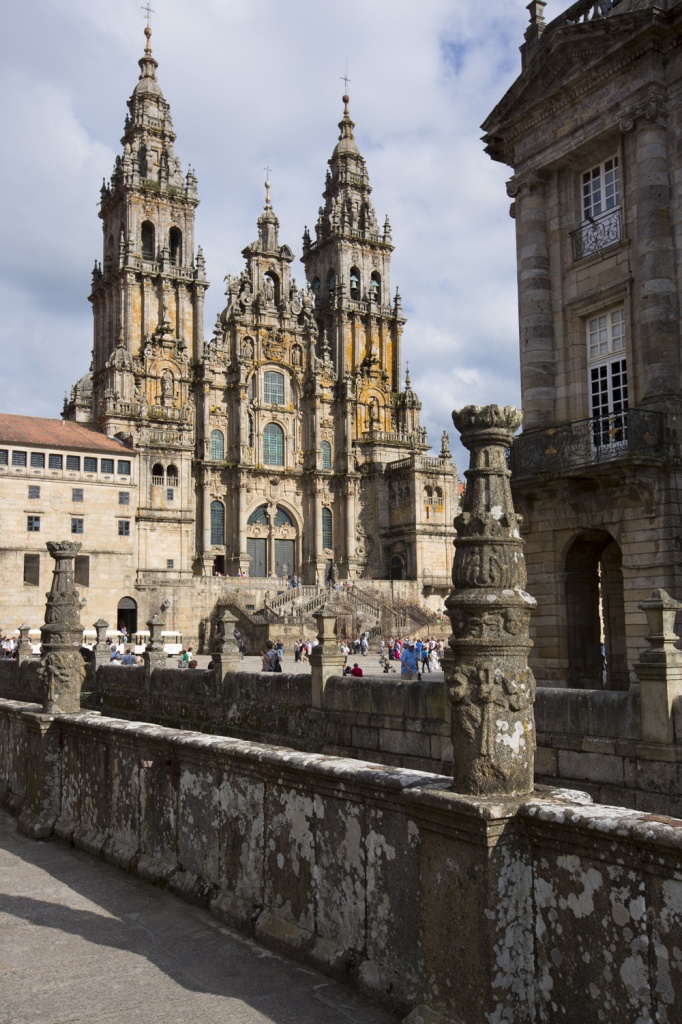 |
| The Cathedral of St. James is the final point of the path, where all the centuries have been released for many centuries all sins /photo: getty images /fotobank |
When we entered the city, there were no 9 in the morning. The streets were covered with fog. The signs reported that only 3, 2, 1 kilometer to the end of the path. The Cathedral of St. James at some point simply emerged around the corner. It began to be built in the XI century, in the XIII - finished, then rebuilt many times, so experts in architectural styles will be able to find at least five eras in it. But the central facade is considered an example of late Spanish Baroque. At the same time, the color of the cathedral gives with herbs-it is all overgrown with something like moss. And all together - moss, openwork turrets, elegant balconies and giant windows - creates a feeling of a fabulous palace.
Bicycles were lying on the square in front of the entrance to the cathedral. Nearby, the team of peppy Spanish athletes celebrated the end of the path. Several people simply lay on the pavement. I really wanted to do the same, but first - documents. We had to receive a certificate of passage of the path.
The Pilgrimov office was in a small inconspicuous courtyard. A small queue moved quickly, ten minutes later I already entered the dark hall. At a long bureau table is a seven employees. A polite young man recorded my name, asked the motive of the path: it was necessary to choose - religious, spiritual or tourist. When all the documents were filled out, he solemnly handed me the certificate “On the Preferences of Kamino”. For 3 euros, here you can also purchase a certificate of the duration of the path. So now I have a paper confirming that in 31 days 775 kilometers submitted to me - the classic path of French kings.
At noon for pilgrims, a special mass is carried out. Already an hour before it, sitting places ended inside, there were at least 500 people in the cathedral. My friend and I settled down on an attack of the column.
A friendly nun in front of Messa learned chants with us. She tried very hard to clearly pronounce the words, but I could still understand only one thing - “Hallelujah”.
The most spectacular part of the mass is the launch of Botafumeyiro - the largest censer in the world, which eight monks swing on the ropes. A huge iron pot, in human growth, whistles with a whistle between the rows of benches, leaving a swipe of smoke. They say that the first censer was made of pure silver, but at the beginning of the 19th century the soldiers of Napoleon abducted him, I had to make a new one - simpler. Historically, it was an act of hygiene: hundreds of pilgrims, spent months on the way, spending the night in the sheds, greatly spoiled the atmosphere of the cathedral. Smoke had to dispel the stench. Hence the tradition of burning clothes, completing Kamino.
“The cathedral filled with people, the waterfalls of the light from the windows. I touched the shoulder of the saint and ... all. They say that all sins are written off at this moment. "
"
After the mass, the pilgrims line up around the central part of the cathedral. An inconspicuous door leads up the altar. There is a statue of St. James. To put your hands on the shoulders of the saint means to finish the pilgrimage.
Waiting for my turn, I looked at stone slabs under my feet. They are smooth as parquet, and I thought about those who stood in this line before me. It was at that moment that the centuries -old history of pilgrimage in Santiago suddenly felt so sharply.
In front of me was a small round Mexican, he seemed to manage to shoot every step to which we climbed onto the camera. But here is a statue! She is deployed face to the parishioners of the cathedral, and we could only follow the back of the saint. The Mexican put my camera for me, I snapped it several times - very pleased - in an embrace with the saint. They began to gently push me from behind - they do not like to wait in line for spirituality. I cast a quick look over Jacob’s shoulder: I saw that the cathedral was filled with people, saw the snow -white backs of priests and waterfalls from the windows. For a moment she touched the saint’s shoulder and ... all. They say that at this moment all sins are written off.
The relics of the saint are in a crypt underground. Curious, but there was not even a queue for them. Small silver cancer is separated from pilgrims and tourists with an iron grill and a dozen steps. You can’t touch the chest - just look.
A few hours later, having already left the cathedral and wandering around the city aimlessly, we met Pablo - a local art teacher. He told us that there is a multi -level cemetery around the cathedral. Here they buried in the time of the Romans. “If you came to compostel in the Middle Ages, you would see a huge cemetery, in the center of which the cathedral rises - and nothing more. Yes, we live on the bones. But Santiago is the city of Vera. We keep not the ashes of the saint, but the holy faith. And since you came here, then we succeed. ”
We have a plane to Moscow in a few days. We will still have time to walk around the city, go to the ocean, for the last time to order Pilgrim's lunch in a cafe. Everyone we will meet will be kind and attentive to us. In this region it is so customary: to meet the traveler, as if he had been waiting for him for the last years. And it's not about the money that we will leave is not in our fireplace. They just know how to love and believe here. I'm not talking about the Holy Faith, but about faith in people, the good that is in them. Yes, such a faith is also stored here. And I hope to bring her with me to Moscow.