
Translated material
Service of the exact time
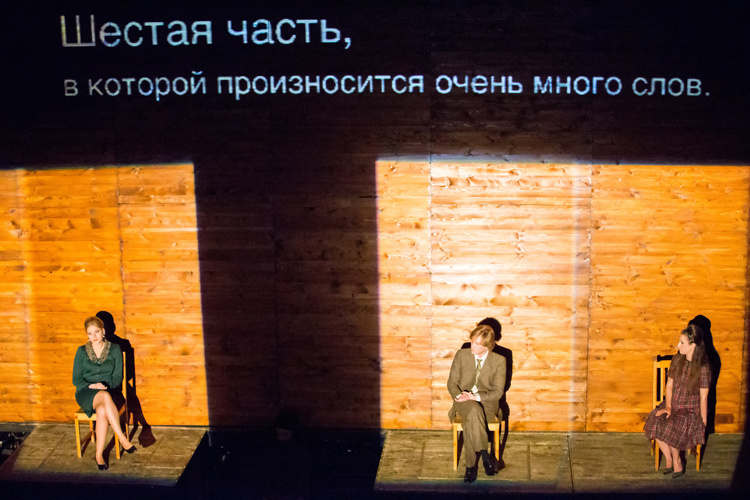
The new project of the Group of the Yubilee year is based on the materials of the New World magazine for 1968. Director Dmitry Volkostrelov co -authorship with artists Ksenia Peretrukhina and Lesha Lobanov, as well as artists of Taganka Elizaveta Vysotskaya, Martha Koltsova, Alexander Margolin, Roman Sorokin and Anna Khleskina, who settled in a written, most part of the journalistic, speech - which, as clarifies the performance, at the very performance, at the very performance, at the very performance, at the very performance. The business is almost nothing to capture and fix.
The futility of the attempts of the artist, journalist, well, or just a person to “photograph” the reality in its non -obviousness and fragmentation has long occupied the director of Volkostroelov - it is no coincidence that the founder of the “ Pos theater” constantly works with the drama of Pavel Pryazho, who studies the limits of conscious anonymity in the modern art of the theater. Reality eludes in the case of a private everyday experience of a contemporary, and when it comes to symbolic on both sides of the border of the distant 1968. It is most honest to recognize the absolute unknowableness of the world, in our spectator, the presence of removing it, the covers dead over time. This is what the agnostic of wolf stakes is engaged in inventively synchronizing various temporary, spatial and semantic experiments. A bobbin tape recorder flickered once on the screen, with a pleasant rustle scrolling at a broken tape, may well serve as one of the keys to the play, where other people's voices sound that have not gained personal affiliation.
 © Taganka Theater
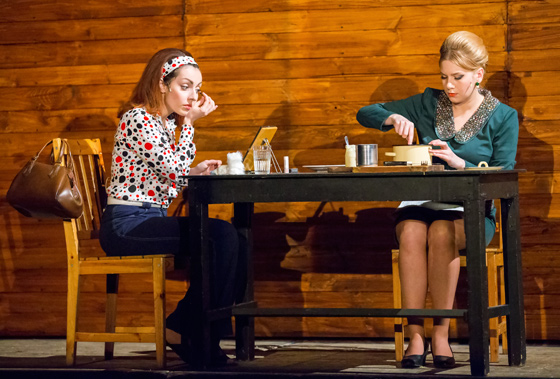
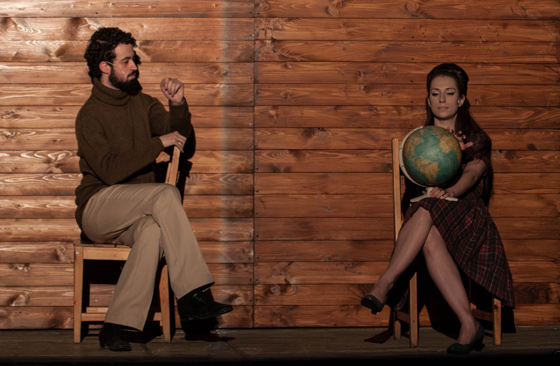
Installation of essays, articles, prose and poems published in the “New World” in the year when student riots rattled throughout Europe, and Soviet tanks were included in Prague, voiced from the stage by three girls and two boys in jeans, dresses and sweaters on the standard fashion of the sixties - and the sincerity multiplied by the hidden irony, makes the visible the very sama. The texture of the text, its specific style, sometimes easily darkening the meaning of what has been said. Another group of sources used by Volkostroilov is the theater performances of Maya Turovskaya and Konstantin Rudnitsky, curious adventures of ideas: inspired by Brecht, one of them asks for a question about the potential activity of the viewer and complains about the passiveness of Soviet actors who are not able to interrupt the performance in the middle and ask the question: “What does this mean?” The performance of Volkostroelov also works with the audience as a partner in the dialogue: the credits talk to us “on top” and across the action, the first Titre says that this is a part “in which nothing happens”, and in the final the title “asks” the hall to vote for or against the epilogue - which, however, is shown regarding the results of the vote.
The performance of Volkostroelov is completely devoid of a postmodern stake: the transparency of the intentions of his authors and the warmth of the look at the “old” discouraged and forced to experience an acute sense of involvement.
The counterpoint to the “Soviet” body of the texts is silent (“The song sounds so quiet that we don’t hear it”) The soundtrack of the hits The Beatles (“Back in the Ussr”) , Rolling Stones (“Sympathy for the Devil ” (“Hello I love You ") . Both vital Western music, born of the revolution of the 68th, and the broadcast of an interview with a student levik from Germany, explaining their anti-capitalist beliefs (“We attack only institutions, but not on people”), only add melancholy of kitchen dissident life, the echoes of which are heard from the reports on the shock labor of the Luch state farm. On the same side of the iron curtain, only recognition of love and kisses are equal to: in one of the most important episodes of the “new world” endless thawing “I love” and “where you, like you” float in the credits in different languages of the world exactly like patterns in the night sky. At the outcome of the hourly performance, the wooden “Fire Curtain” Ksenia Peretrukhina, as if continuing the wooden casing of the walls of the Taganka spectator hall and pushing the effect on a narrow strip of advances, is immersed in the darkness-on it, like punctures, stars of the point are displayed. The voice of the leading production gymnastics calls for the artists not moving from the place of “not to be afraid of fresh air” and at the same time “bend down, bend”: Volkuletov does not give answers to the complex questions that the “New World” is only complicated and simply understood the reality of our personal presence in the ocean of the important words or important words.
 © Marusya Galtsova / Theater on Taganka
Already in the final, when the actors pronounce the texts of the “last words” protesting against the introduction of Soviet troops into the Prague of the participants in the demonstration on Red Square in August 1968 and the same lines from the speeches of Larisa Bogoraz, Konstantin Babitsky, Vadim Deloye, Vladimir Dremlyuga and Pavel Litvinov crawling on the screen, merging into the unremarkable, sad noise, a distinctive noise, a distinctive noise. It becomes a straight line, in the forehead, connection with the present times. As then, today's protest movement remains marginal phenomenon, as then, they plant for a demonstration of their disagreement, as then, the fact of detention very soon ceases to tickle the nerves of the public. The irrationality of the poetics of the performance with the present is even stronger in the eye of the rhyme with the present. The play of Volkostroelov is completely devoid of a postmodern stake - the transparency of the intentions of its authors and the warmth of the look at the “old”, various optics and filters through which in the “New World” look at yesterday today, discourage and forced to experience an acute sense of involvement.