
Translated material
Journalists in the war
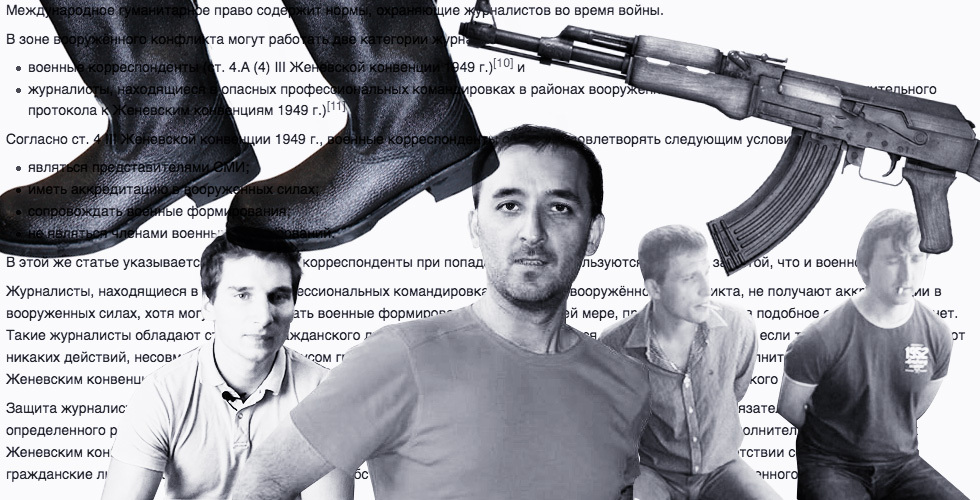
Some more than a year and a half ago, they argued on the networks whether the journalist is decent to participate in rallies and demonstrations-and if so, whether to present a press card at the entrance to the car gut or more honestly to pack incognito.
Arguments about neutrality and objectivity were put forward, the boundaries were drawn between political and civil activism, swords were crossed, the threads went into infinity. Law enforcement officers did not participate in the debate, who authorized or directly packed in autozaki, but they, judging by practice, had different points of view. Some of them retreated from the owners of the press cards, someone did not recede, but was somewhat shy about twin again. But the main law enforcement argument-“And I have a h **, what a journalist you are there”-gracefully removed the issue of the press card from the agenda.
What is happening with journalists on the Ukrainian front seems to me a logical development of the topic.
The special team of Novaya Gazeta Pavel Kanygin is taken hostage by militias in Artemovsk. The Crimean journalist Osman Pashayev in Simferopol is grabbed by people from self -defense and interrogate with addiction to the FSB. Oleg Sidyakin and operator Marat Saichenko arrests the Lifenews correspondent in Donetsk SBU.
Who seriously treats this archaic in post-Pelic time?
We are habitually, almost mechanically, indignant. Margarita Simonyan calls to forget about the difference between the views and together, in jointly, to demand that journalists be allowed to do their job. Oleg Kashin says that you can not treat media employees as an enemy army.
Actually, why?
Who said? Where does this rule come from? Well, yes, international humanitarian law stipulates the special status of a journalist in the war: “Military journalists, an intensive care unit, military medical team and military lawyers are considered non-combatants, despite the fact that they are part of the armed forces.” But you never know what was agreed in the Geneva Convention. For example, she qualifies the annexation of foreign territories as aggression. It condemns "sending armed gangs, groups, mercenaries, etc. On behalf of the state that carry out acts of armed struggle against another state. ” Prohibits "impact on unprotected cities, villages and buildings." Who seriously treats this archaic in post-Pelic time? Who complies with these norms?
No one has declared wars for a long time, does not march under the drum, does not come under the enemy walls with a solemn system in ridiculous red uniforms with a gold rim. Why should ancient etiquette be respected in relation to journalists?
Because civil journalists? And who is a military man here? There is a hybrid war, around the green men without identification marks, retired political technologists, amateur Cossacks and the leaders of the rebels who wear epaulettes, portup and the pseudonyms of home dressing.
In the course of the military styles - simply, directly, eagerly swear allegiance to one of the warring parties.
Because journalists act in the interests of society? The society has few illusions in this regard. In the interests of their publications, their owners or customers - the state, the private owner, shareholders - yes, this society has learned. Vice opinion - journalists lie how they breathe, the sales press - no one has been refuted. For a soldier of the Army of Ukraine, a militia of the DPR or an FSB officer, this is an extra reason to give journalist Pink, putting on him handcuffs.
We have long been talking about our media in military terms - propaganda weapons, information war. Our media has long ceased to portray non -angigious - the latter broke on the Maidan. In the course of the military styles - simply, directly, eagerly swear allegiance to one of the warring parties. We have an honor. Why would journalists consider it involuntary? And aren't journalists awarded orders for the Crimea - massively, like a real army, a closed decree, like real scouts?
So, you can with journalists like everyone else. According to the same Geneva Convention: "If non -bombans take a direct part in hostilities, they lose their status, become combatants, and only then weapons can be used against them."
The journalist himself is armed. If you take a camera, a microphone and a phone from him, eyes, ears, hands remain. It is necessary to neutralize - to throw a bag over your eyes and ears, knit your hands, sequent your mouth. And why it’s impossible to twist your hands and glue your mouths in the war, if in peaceful life, journalists - at least ours - all this allow you to do with them?
Journalists are captured as military personnel of information troops - either as saboteurs and scouts. They are abducted as a product that can be sold or exchanged - more or rather they will be paid a ransom. And it is hardly more cynical than sending militants to neighboring countries without identification marks or going into a combat raid by transport with the UN marking. What are we talking about at all? OSCE observers are detained, the Red Cross doctors are taken hostage-why are journalists better?
This war can be called as you like, anti -terrorist or punitive operation, uprising or revolution - but it is clear to everyone that this is a civil war. In such a war there are no right and guilty, their own and strangers. All of their own, all wolves to each other, everyone is guilty and all are victims. Including journalists.
In such a war, a family of troops or classes is not disassembled. Here they beat not for xiva - for the style of the pants. For the fact that the business card is on Latin. For photos on the phone. For glasses. For non -election emphasis. For the local accent. Brother shoots his brother - and we urge him to respect a journalist.