
Translated material
"Such Zen Buddhism is in Ukrainian"

Sergei Stutsenko is considered one of the most promising young documental operators of Ukraine. He graduated from the Kyiv National University of Culture and Arts, went on the set a difficult path to the first operator. Stutsenko worked on four iconic Ukrainian films: he was one of the operators “Mom died on Saturday in the kitchen” by Maxim Vasyanovich and “sickly assucia” Yuri Rechinsky and completely removed the “green jacket” of Vladimir Tikho. The Maidan who was in the epicenter of events from the first days of the Maidan, Stetsenko almost alone removed most of the "Maidan" by Sergei Loznitsa.
- Have you got acquainted with Loznitsa before the filming of the Maidan?
- Personally no. I knew his films, was impressed by his documentary works - the same “portrait” or “half -line”. Once with a friend we even made a documentary, inspired by the films of the Loznitsa. We went to the Carpathians and shot videos of people - full -length portraits. The man saw the camera and thought that he was photographed, we recorded a 40-second static video. From part of this material, the Grozovska Band group was then mounted.
- How did your acquaintance happen?
- Sergey came to Kyiv with a camera and sound engineer and shot on the Maidan. But then I realized that everything does not end, that it is necessary to continue to fix what is happening. Then he threw a cry, and he actually found me. We met on December 16-17, talked, after which I spent a day with a camera on the Maidan. In the evening we met again, literally on the laptop looked at what I shot. We still met several times, but until the tenth of March I already shot absolutely myself, I sent all the captured materials over the Internet. Sergei did not set specific tasks, did not limit anything, but rather made small comments. And he constantly repeated: "Do everything as convenient for you." Such trust was, of course, to me a certain indicator of the openness and sincerity of our cooperation. Because, working with some Ukrainian directors, you simply do not expect that such trust is possible.
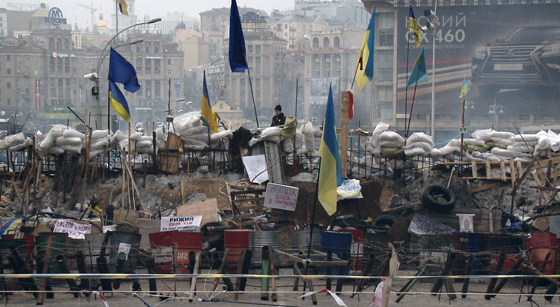 © Atoms & Void frame from the movie "Maidan"
- What task did the Loznitsa set before you?
- mass. The more multifaceted you have, the more interesting. All this to some extent reminds the film “Portrait” in style: absolutely a static camera, frames lasting at least three minutes. The film has literally a couple of unstable shots.
- How many of the 128 minutes of the film were you personally shot?
- In the final installation, 45 minutes is what Sergey took off, 6 minutes - personnel taken from Radio Liberty, the rest is what I shot.
- At the very beginning, the film had another name?
- As far as I know, Sergey wanted to call him “Maidan. The battle of Shrovetide and the post ”in honor of the picture of Bruegel, but after all the events that took place, he decided to abandon this idea.
-I heard many stories about the shootings on the Maidan: that it was impossible to make some plans there, that everything changed on the go, that many first thought about the composition, but then concentrated directly on what was happening. Tell us about your experience.
-I went to the Maidan on the 20th of November, when there was the first message from Mustafa Nayem. I often took the camera, shooting more for myself. And since December 18, he began to shoot for a loser. Technically it was completely different. Because it is one thing when you rush about the Maidan, taking off here and here, and another - when you need statics. The task set by Sergei seems to me generally a very important and even educational thing for a documentaryist. Because when you stop at one point and spend a long time on it, you begin to literally observe life, a huge number of connections between people, interaction, some personal points. Pay attention to things that might not notice in another situation. For example, there was a wonderful woman with the flag of Cherkas. You just observe her, how her behavior changes: everything is in order, here is the song of the Gadyukins brothers “Fayna Mo Ternopil” from the stage, and she first hears this music. And this is six in the morning, Maidan. For a long time she just is in the frame, sits on a bench, and then begins to dance in complete solitude. There were a huge number of such contemplative things. For a documentaryist, this is an invaluable experience.
- Did you feel the changes in people on the Maidan for all the time of filming?
- The biggest changes, of course, occurred after February 18-20, when Yanukovych ran away and everything seemed to be calmed down in Kyiv. After those events, I was not on the Maidan for about a week, and when I returned, I realized that those people who were active and were there from the very beginning; They have something to do. For the most part, the majority of rather marginal characters, who already had their own shape, weapons, remained on the Maidan. And this was the most unpleasant, because, as often happens, some people make the revolution, and others use its fruits.
Loznitsa is preparing for the filming of the Babye Yar, and the mass, it seems to me, was also interested in him in this context.
And, of course, during all these events, being inside, you literally physically felt how more and more hatred accumulated. And it is clear what all this resulted in. One of the Medical girls said a very good phrase-we shot her with Babylon'13 for their film “Heavenly Hundred. The winter that changed us ”(was shown on the Ukrainian channel“ 1+1 ”. - Ed. ):“ You can climb under the tank in a fit, but stand for three months - this should be very deep and firm belief. ”
- Did you shoot on February 18-20?
-On the 18th I shot upstairs, on the silking and on institute. I went out there in the evening. But I understood that I was interfering with my camera there more, and therefore I tried to make short sorties to shoot.
- At the Kiev festival, Docudays recently shown the collection “Maidan. Chernova installation ”, which consisted of a video shot by various young directors during those events. I most of all remembered the excerpt of Katerina Ermine: she had a grandfather in the frame, who, after some disputes, sat on a bench, began to cry, and you literally felt this pain of him. And when tears appeared, the ermine removed the camera. It seemed to me a very important ethical decision by the director’s decision. What do you think about the ethics of a documentaryist in general?
“She should be, of course.” I cannot give any specific examples from my experience on the Maidan. But if I saw that a person makes it clear that he was against being shot, I cleaned the camera. I think you must first remain a person, no matter what situation you are. And if you see that at the moment you can somehow really help, then you must do it, and no shooting is worth it. I could not shoot people who are killed in the frame.
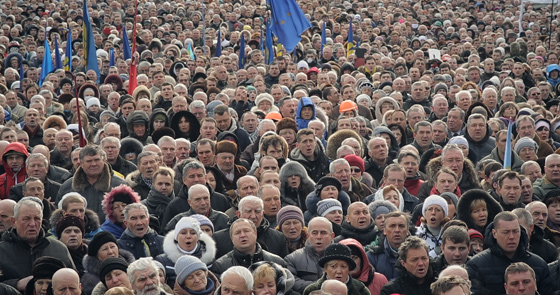 © Atoms & Void frame from the movie "Maidan"
- What, in your opinion, is the “Maidan” of the Loznitsa differ from the films “Babylon'13”?
- The short clips of Babylon are rather observations that stating a fact, small fragments of a lot of work. And about their large films ... Here you need to understand that the same “Winter, ShO Snaken us” is already the order of the television channel (“1+1”), which has its own requirements. And, I think, “Babylon” most likely has to go to large compromises so that the channel is satisfied.
- If they were interested in a person in the crowd, then, as I understand it, the crowd was interested in the loser?
- Yes, no personalities. If there is a close -up, then this is a plan with the flow of people who go to the camera. That is, technically there are, of course, large plans - but this is a constant movement of people. This is what Sergey needed: mass, the movement of the masses. For him, for example, it was important that there was a three -plane action in the frame. Something happens on the front, on the middle and on the far-there is also some kind of action. It is no accident that one of the tasks was that the three -minute frame would be interesting to consider during this time on the big screen. Plus, Loznitsa is preparing for the filming of the Babye Yar, where there will already be game mass scenes, and, it seems to me, he was also interested in mass in this context.
- Have you talked with other operators on the Maidan during all these events?
- Yes, we are all familiar with each other, we constantly saw each other. But it was not like an exchange of experience or impressions. Everything happened so quickly that, meeting, immediately exchanged some information. Someone reported that they were lying there a monument to Lenin, and all immediately fled there. But I had a slightly different task, I did not need to run and take everything what I saw on the go. I had to stop, get a tripod. My friend Bushinsky was often with me, together we just went to Grushevsky, because one was really dumb. When I took out the camera, he took off his military helmet, put it on me and silently went aside. Everyone understood that everyone had their own task. I remember very well how on February 18 the camera was sealed with a black tape, because at night a luminous screen is a beautiful target for snipers.
Sometimes I left a camera with my friends and went to break the paving stones.
- How did people on the Maidan react to camera?
- A completely different reaction. But here you still need to understand that I had a special manner. Technically, for example, this is a long -focus lens. There was an opportunity to become somewhere in the distance and observe from the side. At the same time, it is clear that if I saw that a person waves me - they say, do not take me away, then I could calmly turn the camera in the other direction and find another composition. In this sense, I will better spend the extra 10-20 minutes and build the composition so that it fully meets my requirements and at the same time so that I do not interfere with anyone. Of course, there were situations when you came to the Maidan with a camera, with a tripod and understood that if not all this equipment now, then he would have taken a bag of bricks and carried it to the barricades. And it happened that I just left my friends a camera and went to break the paving stones.
- After the events of February 18-20, the attitude towards people with the camera also changed. Then the operators became even more dangerous to be on the Maidan.
- That's it. But I always tried to distance myself from such things. Because at that moment everyone was on such a platoon that there was no sense to enter into disputes or to aggravate the situation. Plus, I tried to enter the press center before starting each shooting and take a daily certificate. Of course, all these badges are quite conditional. I often had to shoot from the scene, the people gathered in front of her. I come there, I say: "I need to go to the stage with a tripod and camera." To me right away: “Where are you from? Your journalistic certificate. " I began to tell that I am not a journalist, I have no certificate, I am a movie operator. Then they immediately asked me: "And from whom?" Sometimes I said that from Babylon'13, sometimes from a luster.
- And who was better reacted to?
- Loznitsa, as it turned out, few people know in Ukraine. Several times they remembered and said: "Yes, yes, remember this, he came to us a couple of times."
 © Atoms & Void frame from the movie "Maidan"
- The most memorable moment of filming?
- Grushevsky, of course. The moment when the first time was really creepy. Because you understood that Ukrainians are on both sides and some of them shoot and throw grenades in others. Now, of course, there is no reason to blame one of these sides. But I still want to remind you that there is a 63rd article of the Constitution, which states that you have the right not to comply with criminal orders.
- How did the Maidan change you?
- I saw blood on the streets ... This is a terrible experience that had never had to be experienced before. And you will never forget this. Plus, the attitude to power has changed. Let me be a small person and a microintic in some large system, but I understood for myself what to demand, I need to go out into the streets. I also realized that, as my friend said, actress Ruslan Khazipova, "if you are not ate, I hto yak is not mi." We live in this country. I and my generation still have a lot of work, and all these conversations that Ukraine are bad ... I don’t know who is bad, let him leave. We will somehow figure it out here.
- What is the reason that Ukrainian documentary cinema on the head is stronger than the game? There is a version that it is easier to shoot ...
- I would not say that it’s easier. It seems to me rather the opposite. There is such a good joke: if the preparatory process is organized correctly, then during the filming process the director of the feature film needs to pronounce only four words: yes, no, up, down. And these words will be enough in 99% of cases.
On the other hand, perhaps this is also connected with our mentality: Doc is such a Zen-Buddism in Ukrainian. People who have discovered this is easier for them to join society, look at everything, take the position of a participant in the event and observer simultaneously.