
Translated material
But the pipe is still calling ...
Why did the German business captains go to the forum in St. Petersburg
Judging by the number of exclamation signs and the tear -off notes in the voices of representatives of the Russian Political Bombom, the Russian economy will be waiting for another wave of severe sanctions, and there can be no question of traveling leading German business managers to the St. Petersburg Economic Forum. However, we went
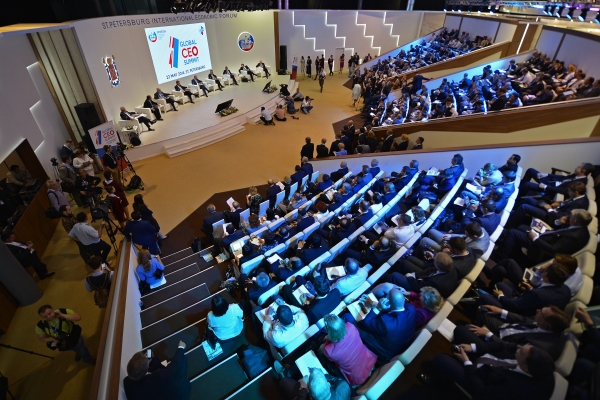
Summit of global business leaders in St. Petersburg/ Photo: Vladimir Astapkovich, RIA-News
“Finally, it is necessary to make Moscow reckon with our opinion!”, “Let the Russians fully feel what the strict sanctions of Europe are!”, “If they don’t understand, we will be even tougher!” In approximately such slogans, German politicians broadcast in recent weeks, commenting on the position of Europe in relation to Russia in connection with the Ukrainian crisis. But the slogans by type - “return Kyiv Crimea, otherwise it will be bad” - this is one thing, and your own wallet is completely different. Therefore, waving his fists and shouting, almost all giants of German business went to St. Petersburg: the manager of Metro Grupp Olaf Koch, the chairman of the BASF Board Garady Schwanger, the head of the supervisory board of the largest European and German tourist concern TUI Klaus Mangold-a list of top managers who drew a ticket to St. Petersburg can continue.
“It is impossible to stop the conversation with Russia - this applies to our economy,” said Ulrich Grillo, president of the Federal Union of the German Industry of the German Industry of the German Industry, commenting on the requirements of almost all the political factions of the Bundestag, literally on the eve of the St. Petersburg Forum. He was immediately supported by the president of the Association of German banks Jurgen Fitzhen, who stated that he did not see any alternative to a dialogue with Moscow.
What kind of unexpected dissonance between politics and the economy? Or did the business switch to the methods of the yellow press - he sees one thing, but says the other?
Mutual dependence
The Eastern Committee of the German Economy recently sent its addressees curious information. In terms of trade turnover, Russia is in the eleventh place after Poland, which means the amount of the EURO order of 76 billion per year. At the same time, the Germans export goods to 36 billion. More than 6 thousand German firms are engaged in business with Russia, which occupy almost 300 thousand employees. In recent years, these firms have invested in Russia, which means in their business, more than Europe 20 billion. Well, the figure finally - 35% of the gas requirement and 30% of the need for oil, Germany covers through supplies from Russia.
“We are dependent on each other and therefore must find acceptable solutions to us problems,” said Rainer Lindner, director of the Eastern Committee of the German Economy.
When there were ex - -Chancellor Germany Helmut Kohl, whom the opponents accused of tyranny, cynically dropped: "The dog barks -the caravan is coming." This is quite applicable to the current counter-positions of the government and German business.
While Merkel assures Obama in support of the course for the introduction of new sanctions against Moscow, German business continues to actively lobby for its interests in Russia. The Germans are not going to give everything that has been developed for years. But then, for the sake of maintaining minimal political correctness, they add that they fully support their government - yes, they say, it decides that when and how to do it.
“Politicians should be aware of what consequences the sanctions can lead to,” the German Grillo “chief economist” of the German business, the Grillo, criticizes the German government.
That the Russian is good, then the German is not bad
We distract ourselves from dry numbers and speculate a little about the main thing - about the gas, while focusing on the pragmatic and cold mentality of the Germans. It is impossible to abandon gas from Russia in the near future, even if you accept the promises of the United States and Canada to pour all Europe with liquefied gas.
Firstly, according to the most modest calculations, this will not happen today, not tomorrow and not in a year. Secondly, so far no one can calculate how much blue fuel will cost from behind the ocean and what kind of penalty will have to be paid for non-compliance with Moscow. The European Commissioner for Energy, the German Gunther Ot -Sponger admits that it would be time for Europeans to think about how to better use resources, including the possible extraction of the notorious liquefied gas in Europe. Nevertheless, in a recent video message to European colleagues on the occasion of discussing a fashionable topic of diversification of energy, he expresses a clear and unambiguous position of all Europe, and not just Germany: “In no case do we want to terminate our energy relations with Russia. On the contrary, we want to develop and expand these relations - not against Ukraine, but with it. ”
The electorate solves
The next factor is the same 300 thousand jobs that, in the case of the most stringent option of sanctions, will quickly turn into a new line on German labor exchanges.
Chancellor Merkel, who is terribly proud that she managed to reduce the unemployment rate to the number of less than three million, will not survive the growth of this indicator at once. Perhaps that is why in an interview with the influential German newspaper FAZ, Chancellor Merkel said that she did not see the need to change the vector of his oriental policy: “In the global world of the 21st century, I am not going to return to the 19th and 20th centuries that have outlived my structures.”
Who will pay the penalty?
Meanwhile, it became known that the public German-Russian Chamber of Commerce sent the so-called “positional letter” to the German government, in which it describes the future of German business in detail in the case of introducing the next stage of economic sanctions against Russia. In a letter that was partially published on the website of the German satellite television channel N-TV, it is argued that if, as a result of the sanctions, “German business will have to leave Russia, the vacuum will be quickly filled with other countries.”
But this is not even the most problematic, but that it will not be possible to leave Russia without oncoming claims. “Contracts were signed on the basis of German civil rights law and violators of such contracts are obliged to pay significant compensation to the other party,” the letter says. The authors have no doubt at all: the Russian side will easily achieve such payments by contacting any international court or arbitration.
We will scold. But not much
“It is important to continue the dialogue at all levels- at political, military and economic,” the speaker of the CDU faction in the Bundestag Joachim Pfaifer recently said about the introduction of new sanctions against Moscow. His colleague, Social Democrat Klaus Bartel, echoes in unison: "It would be very inappropriate to send Russia and Putin to quarantine."
These confessions may seem strange against the backdrop of the oath promise of Merkel to his eldest overseas brother to oppose Putin as a united front. But, apparently, state solidarity is one thing, and his own voter in a country where not a single politician receives his chair forever is completely different.
According to a representative survey of the population, which was recently conducted by the Forsa public opinion research institute, 73% of Germans are opposed to the application of economic sanctions to Russia. Note that in March there were 69 %, i.e. The growth of pro -Russian sentiments is evident. By the way, the vast majority of respondents - 89 % - believe that sanctions will harm not to Russia, but primarily the EU and Germany. And the vice-chairman of the Left Party faction Klaus Ernst generally believes that the sanctions will lead to a recession and Germany itself.
Alas, in this chaos of mutual claims, calculating the balance of profits and losses, they almost forgot the main thing - Ukraine. The poor country between rich Europe and self -confident Russia during the endless bargaining about sanctions, zones of free and lack of freedom, about political ambitions and personalities, it seems, has turned into a bargaining coin. And how much will you have to pay for this coin, no one still knows.