
Translated material
You are what you agree to
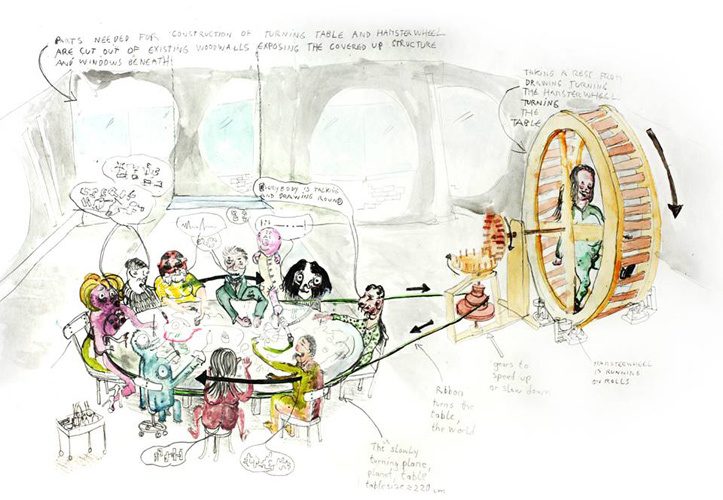
You are what you agree to. At some point, anyone who works in the cultural industry feels all acutely. The Die Tusovka Runde exhibition is about this that each specific artist as a social unit is determined by what exactly is offered to him, and how he agrees to this. Louis Altusser has a word “interpellation” - the subject of the subject with ideology. We can say that the artist in general is the one who is naked. A specific artist is the way the hazelled manner responds to the call. The State Gallery on Solyanka called to make a project a group of artists from Austria Gelitin , which in Moscow is known with the first Biennale for working with the toilet and a giant icicle from urine . The group came up with the project and called to take part in Russian artists. The result was a roll call of interpellations and a hierarchy of conditions lined up: the conditions of the existence of a gallery; the conditions in which the "gelatins" were invited; conditions that local artists agreed to participate.
In the middle of the gallery there is a large wooden unit. One artist, like a squirrel, walks inside a large wheel, which, with the help of a drive belt, makes a round table table turn to rotate: the rest of the artists sit around the circle and paint the surface slowly leaving from under their brushes, which after a few hours and several dozen rotation cycles, it turns into a spectacular, type of unexpected tonson behind an indefinite author. But the "gelatins" have no picturesque ambitions, they just came up with a structure, mechanism. True, how the structure is arranged, determines the result. Affects the case and casting. Among those who were invited to participate, there are many older painters (those who started in the 1990s, in many-like, saturated with images and man-made dexterity, the postmodern period of heyday of the gallery) and a lot of cheerful, not alien manual labor of youth (Alisa Joffe, Anastasia Ryabova, Duet Elikuka, Irina Korina and others). The list also includes Zurab Tsereteli, famous for his pastry smear, but only looked, ”say the employees of“ Solyanka ”), as well as a couple of artists who are little -known on the“ relevant ”scene.
Different companies worked on different days. When the youth, when the elders. I found Mount Chahal, Vladimir Dubosarsky, Irina Zatulovskaya, Alexander Savko and several more people. There was awkwardness in the air, but also a certain satisfaction. It was evident that the artists liked working with paints and generally creativity. They were pleased to be in demand as those who know how to write-and let the conversation with the “collaborators” did not glue, they were called, they responded and were satisfied. They were artists.
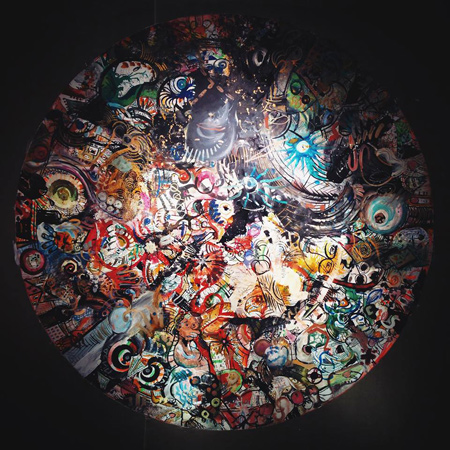 © State Gallery on the Solyanka Die Tusovka Runde I - Pesulet of the first day of Gelitin collaboration with Russian artists: Stas Shuripa, Gosha Ostretsov, Katya Bochavar, Oleg Kulik
The day before, other artists came, among them-Anastasia Ryabova, Varvara Gevorgizova, David Ter-Oganyan. Unlike painters of the 1990s, they produce art not as a motor practice of drawing, but as a social practice. Obviously, they responded to the call of the "gelatins" because they build social systems. But Die Tusovka was not friendly and not quite real: the work, according to Anastasia Ryabova, was not about cooperation, but about the inequality of artists - and, it seems, such an explanation is closer to the “gelatins” themselves, than the “Solyanka”, whose presentation of history as a collaboration gave gloomyness.
Indeed, this structure could be read as a downward hierarchy of interpellation. The "gelatins" were invited by the "salt" as well -known professionals, they paid for travel and housing, as well as the work of work. Russian artists invited by them worked for a symbolic increase, interest, food, communication and drinking: a table with a snack and bottles stood in the corner of the room. The bottles were constantly brought, thanks to this, Die Tusovka arose from an awkward silence. Tusovka , like buffes, is a value from the 1990s. Then they spoke little about labor rights, but they talked a lot about their community. This word was even in the name of the text of Viktor Misiano about the domestic scene of this decade.
But, in addition, the room had another category of people - a translator and a volunteer. They constantly stood behind four Austrians who were Gelitin . The Austrians either concentrated the canvas or twisted the wheel, but very little came into contact even with invited artists. They worked as professionals. And when they were asked who these girls, inseparably standing behind them, were surprised: "We were so busy that we did not notice the girls." So the girls were extremely in this chain.
The young artists who felt the situation were embarrassed and called their friends, who were not invited to the project: to overcome the hitch, they had to do what was needed from them - to make a party. Then they were also able to be satisfied. They were artists. The next day, on the site, the names of those who were not invited, but still came, were added on the site.
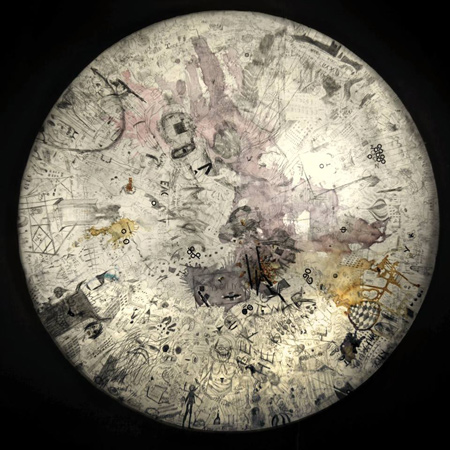 © State Gallery on the Solyanka Die Tusovka Runde II - Pesulet of the second day of Gelitin collaboration with Russian artists: Igor Mukhin and Alisa Yofffa, Mishmash (Misha Leikin and Masha Sumnin), Elikuka (Oleg Eliseev and Evgeny Kukoverov), Valery Cherina, Irina Korina, Anastasia, Anastasia Ryabova, David Ter-Oganyan
Despite all the ambiguities that have arisen in this project, as a rule, Gelitin can accurately show how the human body is built into the social, namely, in the process of artistic production. That famous icicle from urine, according to them (so, however, is it), is a truly democratic collaboration. The urine becomes unifying socialist substance, which the Marxists of the 1910-1920s dreamed of: humanity is united through it and the democratic work of the masses is carried out. But at the same time, an icicle from urine is the maximum that such substantial unity is capable of. This is the whole joke. The most successful works of the "gelatins" come out immediately from the body producing an object without medium mediation. It is important to understand that shit , urine, pus and anal theme in their work are not needed at all for the scandal, but to illustrate this position: the remarkable paraphrase of the well -known work of Andrei Monastyrsky (in which the viewer looks into the peephole and forced to recover, hearing the call) looks the work of “gelatins”, in which the viewer sits on the toilet and, looking into the eye, sees his ass. The elegant rhyme, where the accumulative and anal coincides - the eye and the anus as those holes through which the subject is built into artistic consumption and production.
But although the artists are depicted in the “reduced” form on the sketch-caricature of their Moscow socio artist-farting and boys, that is, bodily giving their artistic product as a result of rotation of the wheel-in reality the body did not work out, everything has spoiled the culture. The combine, which was built by the “gelatins” in the “Solyanka” premises, is more metaphor or parables - unlike more literal, emerging directly from the body of the work. On the other hand, it is the high metaphorism of the Runde structure that actively provokes participants on the own interpretation. However, there is an advertising trick - bright metaphors are easier to sell, and the flows of interpretations are born not only among artists, but also among journalists who write about the exhibition. In a paradoxically, this parable-Kombine makes the participants think about their place in production, but at the same time obscures the true position from them. With enthusiastically, recording the surface and gaining wine, they put forward different versions regarding the meaning of their existence in this circle, forcing to recall the important anti-utopian motive from the 1990s, which is described in the Pelevinsky story “The Recluse and Six-Pacific”-there the chickens discuss how their world works: and they lived on the poultry farm. The trick here is only that the “gelatins” themselves, although they participate in the work along with other artists, but on other conditions.
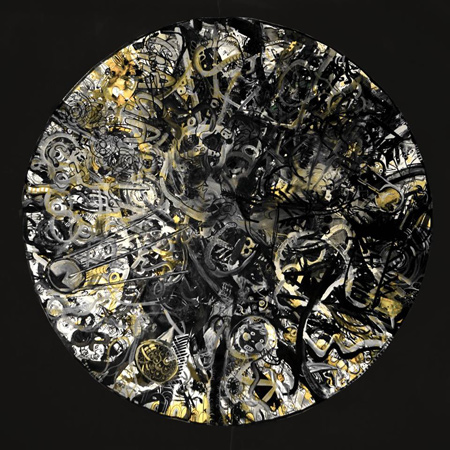 © State Gallery on the Solyanka Die Tusovka Runde III - Pesulet of the third day of Gelitin collaboration with Russian artists: blue noses, Zurab Tsereteli, Sergey Shutov, AES+F, NATTA KONSHEVA, Anna Titova, Alexander Sukharev
Such insensitivity to the institutional and gender context or its intentional crowding out is characteristic of the period of bright art of the 1980-2000s, when the strict covenants of Anglo-American criticism of the 1970s were forgotten for the sake of radical metaphors. On the other hand, regardless of the decade, such insensitivity has been developing among famous artists who have arrived from developed Western countries at the invitation of their institutions of less developed countries. This can be called the "unintentional syndrome of the colonialist." Artists joke over fascism and exploitation, but do it so amazingly witty that they turn into stars with template reactions insensitive to the changeable context of stars. Of course, if you perceive the mechanism of cruelty and the exploitation of creative work in the Moscow project autonomously, then such work is clearly read in the spirit of the postmodern subversion of fascism, which has become a noticeable line in the art of Austria, Holland and Germany since the 1990s. It was then that a number of artists arose, who and the subsequent decade arranged absurdly cruel, scandalous and spectacular performances and built emphasized tough anti -utopian structures, the purpose of which was to turn the inside out the fascizoid impulse that permeates the life of the local (especially the Austrian) bourgeoisie - after the nationalist parties came to power. It is clear that he cannot be defeated by simple moralizing. Here Gelitin stand on a par with Jupa Van Lishaut, Christoph Shlingenzif and Jonathan Mezie. And we must pay tribute to them-it’s not so easy to work with excrement, urethral and other bodily products in the 1990-2010s.
On the other hand, it is not so great to build an art institution in the 2010s according to the laws of advertising and PR of the 1990s that Fedor Pavlov-Andreyevich is trying to do, which promotes the state gallery on the hodgepodge. In this space, the “live collaboration of Gelitin with Russian artists” is read a little as “ Gelitin ’s collaboration with living Russian artists”. To a large extent, because of the recent project “Solyanka”, the “Zoo of Artists” , which throws an unpleasant shadow on the story with “gelatins”. For the gallery, it seems, it seems, the system: the “hodgepodge” caught a wave of parties, adapting it to its needs - the needs of not the most popular state exhibition hall, which is not guided by the curator, but an energetic PR (not in position, naturally, but in fact) and where the issue of traffic is resolved with the help of artificial “production of life” - pumping by information farms. And for such a production of an information life, a model of a pre -built parties of “creativity” in conjunction with the Artists Is Present model is simply perfect. As a result, practices associated with the already man who had already managed to wash themselves with the artistic ideals of horizontalism, democratic participation, direct action and accessibility, begin to have a strange hybrid of masochism and exploitation with their content.
Neither Gelitin , nor Russian artists who participated in her project were free to respond to the received invitations in any way: their options were limited by certain frames. The project was a success in the sense that the lack of freedom and limitations of the possible response of artists to a call to the content and the topic of work invented by the “gelatins” of work. He became a failure because the “gelatins” themselves did not show that they were also called - and therefore, their own options were also institutionally determined. At the level of metaphors, the artist is free to put himself in a cage himself or do it with others. The only problem is that the metaphor should in a certain way meet the real sociology of the project - inconsistencies and omissions in the party art, which is ironic over cultural production, make it treacherously ambiguous. Even if the work is ironic, that is, it is arranged as the wrong side of its own meaning, and the lack of democracy shows through the emphasis of inequality, the iron law of exposure should work here: witty colonization should not be called a collaboration - this misleads and hides real interest. Ultimately, artistic operation differs from criticism of artistic operation not at the level of the meaning of the work (even if the statement should be ironically and should be read the opposite), but only at the level of those real social positions in which all participants were.